Labor & Leisure — Trinidad, June 19 – July 14, 2014

Trinidad has always been for us a mixture of hard work and good fun, and that has been especially so this year.  We have undertaken a number of projects, and of course there is the usual list of things that must always be done to prepare the boat for sitting on the hard while we travel .

Barb spent a lot of time washing down walls and cleaning out drawers and cupboards, and making covers for the boat’s nameplates.  She made herself a dress.  She made reflective/insulative covers for the inside of many of the boat’s windows.  She cleaned and waterproofed the canvasses for the dinghy and the bimini.

I dismantled the seacock for the John Deere and cleaned it up so that it closes properly again. I changed lubricating oils for the dinghy outdrive, the genset, the John Deere and the transmission. I flushed the dinghy outdrive cooling passages with fresh water. I replaced the diesel fuel filters.  I did a bunch of varnishing, both inside and out.  I cleaned and lubricated the dinghy winch and the anchor windlass.   We replaced 330 feet of ⅜ inch BBB anchor chain, and placed distinctive marks every 25 feet so as to be able to tell how much chain we have out when we anchor.  I conducted a “self-survey” of TT2 to support our shift of boat insurers.

On the fun side, we socialized with many cruising friends in a variety of settings, including pot lucks at Crews Inn, swordfish nights and bake-and-shark nights at the Wheelhouse Pub, roti and buss-ups at Grace’s, and a gourmet dinner at the Hilltop Restaurant. The latter is an adjunct to the Trinidad & Tobago Hospitality & Tourism Institute.  The restaurant is staffed and run entirely by its students as part of their education. The menu for the five-course meal on the day of our visit:

1. Herb Chicken Canelloni, Tomato Fondue, Basil Puree, Parmesan, Garlic Crumbs
2. Vehyssoise, Cream Potato and Leek Puree, Scallion Froth
3. Tuna Nicoisse, Sieved Eggs, Green Beans, Peppers, Tomato Confit, Tapenade, Pomme Gaufrettes
4. Roasted Chicken Ballontine, Dried Cranberry Jus, Sauteed New Potato & Onion Fricassee, Vegetable Etuve
OR
4. Grilled Mahi Mahi, Salsa Verde, Eddoes Risotto, Yellow Pepper Veloute, Glazed Vegetables
5. Tonka Bean Panna Cotta, Wild Berry Compote, Creme Chantilly, Rum Caramel

And if you have seen the post previous to this one, you know that we had a memorable experience watching Leatherback turtles come ashore to lay their eggs.

And I had a great time photographing some of the birds that frequent the immediate area around the marinas and boatyards of Chaguaramas.

We got hooked on watching the World Cup while having cable TV at Crews Inn and had to finish watching it at the Zanzibar pub in the Peake boatyard.

I wrote this blog entry while we were on the hard.  On July 15 the boat went into secure storage and the day after we flew back to the States. We are now in Bismarck, North Dakota.  This blog will continue, but as you can imagine, the subject matter will shift considerably for the next few months. Stay tuned for more of “Chuck & Barb go cruising traveling the world.”

Nesting Leatherback Turtles — Trinidad, July 4, 2014

On July 4th we joined a number of other cruisers for a trip with Jesse James, of “Members Only Taxi Service” fame, for a night-time visit to the shore near the village of Matura, in the northeast corner of Trinidad. There, we joined locals and tourists gathered to observe a remarkable sight:  leatherback turtles lumbering up onto a soft sandy shore to lay their eggs.

Leatherback turtles are the largest turtles in the world; they can weigh up to a ton, and they can dive to depths of 4,200 feet—deeper than any other turtle—and can stay down for up to 85 minutes. They are unlike other turtles in several respects that result in their deep-diving ability:  they can maintain their body temperature as much as 18 degrees Celsius above the cold deep waters where they feed, and their carapace is not a hard shell, but is rather is a spongy material covered with, um, well, “leather”. The lack of a rigid breastbone allows it to collapse during deep dives, putting pressure on the lungs.  And the large amount of oil in the skin and the leathery shell absorbs Nitrogen, reducing problems arising from decompression during deep dives and resurfacing. (You may at some point have seen a picture of someone standing on a turtle as though it were a surfboard. Never do that to a leatherback: the soft shell will collapse and puncture its lungs and in a few hours it will die from a hemorrhage.)  Leatherbacks are an ancient species; they were once contemporaries of the dinosaurs, and they are currently listed as endangered.  There was a time when the poaching of turtles and their eggs was a major problem on the beaches of Trinidad, but no more. In 1990 Nature Seekers was established as a non-profit organization with the aim of protecting nesting Leatherback turtles in Matura. It is the oldest turtle conservation group operating in Trinidad & Tobago. Today, Nature Seekers participates not only in beach patrols but also in data collection and tagging of sea turtles and also provides tour services to visitors, including trips to nesting beaches such as the one we experienced. 

After all visitors had arrived, we first heard a general discussion of what we would see and what rules we should follow:  red lights only while traversing the beach, and kept pointed straight down.  No flash photography until given the ok by the tour guide, who would wait until the turtle had begun actually laying eggs before giving permission, since the turtle enters a trance while laying, a trance so deep as to permit volunteers to measure and tag and to permit visitors to gently touch and photographers to use flash.  At the conclusion of the orientation, we broke up into small groups of about ten with each group assigned its own guide.

Leatherbacks live in the open seas around the world.  In the Atlantic Ocean their range spans across the entire region, as far north as the North Sea and as far south as the Cape of Good Hope.  Unlike that of other sea turtles, feeding areas for leatherbacks are in colder waters, where there is an abundance of their jellyfish prey, which broadens their range. However, only a few beaches on both sides of the Atlantic provide nesting sites; they return to the tropics in order to mate and lay their eggs.  Trinidad is especially popular, with more than 2,000 turtles coming each summer to Matura, the most popular of the nesting beaches in Trinidad, with a shore of nice soft sand that runs for about five miles.

It is an incredible sight to see such a massive creature laboriously pulling herself out of the sea and up onto the dry soft sand just above the highest point of the recent tides. She digs herself a shallow pit with her flippers, scraping off the top layer of sand, and then settles for a bit, testing the temperature and moisture content of the underlying sand. If satisfied, she uses her rear flippers to dig a hole, using first one flipper and then the other.  The precision of the dig is mindboggling.  If the right fin is doing the digging, it moves through the bottom of the pit like a spoon scooping from left to right, and then, retaining the spoon shape, lifts the fin carefully out of the hole and flips its contents to the right.  It then places that fin down flat on the shoulder of the hole in order to prevent sand from re-entering.  When the left fin has done the same things in a mirrored effort, the right fin first flips out to the right to clear any sand that might have rolled down to it, and then carefully, ever so carefully, lifts up high to swing to the middle of the hole to descend for another scoop. When the hole is finished, its shape is that of an inverted light bulb:  straight down for a bit and then flaring out at the bottom.

Then she begins laying her eggs:  anywhere from 80 to 120, with about 85% viable, although a few are small and are thought to be useful for providing “packing” cushioning and extra sustenance for the hatchlings that will appear in about 60 days. Why extra sustenance? Because a hatchling that breaks out of the membranous “shell” will not emerge from the sand if the sand is too warm; warmth indicates sunlight and that indicates extra vulnerability to natural predators like crabs and birds and mongooses.  Best to wait for the cover of darkness.  What if the weather is cool and rainy?  Then the hatchlings will emerge if ready, and it may be feast time for the predators.  How do the hatchlings at the bottom of the heap manage to climb out?  They pull themselves up past the hatchlings above them, so hatching is kind of a “first in – first out” discipline.

Tagging has revealed that adults are prone to long-distance migration, which occurs between the cold waters where mature leatherbacks feed, to the tropical and subtropical beaches in the regions where they hatched. In the Atlantic, females tagged in French Guiana, for example, have been recaptured on the other side of the ocean in Morocco and Spain.

Mating takes place at sea adjacent to the nesting areas.  Males never leave the water once they enter it, unlike females which nest on land. After encountering a female (who possibly exudes a pheromone to signal her reproductive status), the male uses head movements, nuzzling, biting, or flipper movements to determine her receptiveness. Females mate every two to three years. Fertilization is internal, and multiple males usually mate with a single female.  One female may lay as many as nine clutches in one breeding season, with about nine days between nesting events.  After laying, the female carefully back-fills the nest and then packs it down a bit by using her body and then disguises it from predators with a scattering of sand. The temperature of the nest determines a hatchling’s gender. Warmer temperatures produce mostly females, and cooler temperatures produce a majority of males. There is a pivotal temperature that produces an equal ratio of males and females. While other sea turtle species almost always return to their hatching beach, leatherbacks may choose another beach within the region. They nest at night when the risk of predation is lowest. Since leatherback turtles spend the vast majority of their lives in the ocean, their eyes are not well adapted to night vision on land. The typical nesting environment includes a dark forested area adjacent to the beach; the contrast between this dark forest and the brighter, moonlit ocean provides directionality for the females who often nest facing towards the dark and then return to the ocean and the light.

On the night of our visit we walked a considerable distance to the south along the beach from the entrance point, stumbling along in the soft and uneven sand. Finally, our guide received a message on his radio that there was a turtle on the beach ahead of us. When we arrived, we stayed well back and watched it settle in.  She had dug for perhaps 45 minutes when our guide said that he knew she would soon abandon the effort: she had reached water and that was causing the hole to repeatedly cave in.  So we moved on, giving her privacy for her laborious trip back to the sea.  Soon, we encountered another turtle, and this one was experienced:  she had two tags on her rear fins and she expertly and efficiently dug her hole, exhibiting the behavior I described above.  When she began laying her eggs, we were given permission to use flash and to gently touch her.  Our guide pointed out that as she deposited, she shielded the hole with one of her rear fins in order to prevent predation of the new eggs.  We left when she finished laying the eggs and covering the hole and camouflaging the area.  As she laboriously began to drag herself back to the sea, it was clear that she was exhausted.  We were tired too – it had been a long night. But it was also clear that we human observers all felt a sense of wonderment and awe at such an elaborate and fantastic demonstration of the beauty and power of nature. 

Grenada — June 5-18, 2014

Arriving in Grenada is like arriving at home.   Through the years we have had so many good times here.  We have local friends, and we see so many of our cruising friends.  We know where to shop, where to walk, where to swim, where to catch a bus (and which ones) and where to eat.

But things evolve.  Things change, albeit slowly.  De Big Fish in Prickly Bay is closed and undergoing a major enhancement — reportedly to become an upscale restaurant under new management.  Roger has enhanced his rum shack, but has weekend competition.  The bridge to Hog Island is suddenly open and vehicles are driving across and parking in the southeast corner of the island so their passengers can party on the small beach there.  Whisper Cove has more tables than ever, but continues to serve delicious meals.  Mount Hartman has begun actively attempting to attract vessels to their under-used marina.  Bob at Clarkes Court Marina has lost out to the banks and must depart; new owners are already bringing in equipment to convert to a boatyard.   The docks will go and a breakwater will be built.   And if Bob’s dreams can be realized, the Oasis bar will be floated away to another location in Clarkes Court Bay, where Bob will start again with a small marina.  Bob was still on the premises while we were there; we attended some of the very last hamburger nights & potluck nights that will ever be held at Clarkes Court Bay Marina.  A tremendous blast of wind on Father’s Day dislodged the mooring for the middle dock at the Marina, causing it to rotate around the ramp and pinning a wooden sailboat up against the rocks for a time.  Bob is not the owner anymore, and no one else has stepped forward to pay for any damage to the vessel.

We stayed busy while we were there.  A large group noodled practically every morning off the beach at Rogers.  Ann gave a lesson on board Tusen Takk II on how to cook duck; the entire crews of TT2 and Receta and Asseance enjoyed the results.  I took Devin & Liz (Moosetracks) on a hike with the intention of showing them a high vantage point; alas, a former dirt road was so overgrown we had to divert to easier destinations.  We twice walked to Mickey’s Jamaican Jerk Chicken stand, once w/ Ann & Steve (Receta) and Heather & Don (Asseance), and once on our own.  We got together w/ Mike & Cynthia (Minx) in several venues, including Clarkes Court Bay Marina and Taffies and Whisper Cove.  We visited Nimrod’s for rotis twice.

And of course we saw Dwight & Stevie, the local fishermen who have become our friends.   I have already written about our nights at Stevie’s sister Charlene’s establishment.   (See previous post.)  We also had Dwight & Stevie over for dinner late one afternoon; Barb went to considerable trouble to secure turkey and the fixings so we could show them what an American Thanksgiving meal is like.

So it was with some reluctance that we left Grenada earlier than planned; we could not resist the opportunity to cruise down to Trinidad through conditions that were unusually mild when weather and sea forecasts promised soon-to-arrive long-lasting nastiness.  We left at 2 am on June 19 (Corpus Christi Day) and arrived in Trinidad at 3:30 pm, where we gratefully paid the holiday “overtime” fees to Customs and Immigration.

But I’ve gotten ahead of myself.   To read about our stay in Trinidad, see our next blog post.

Charlene’s Rum Shack — June 6 & 10, 2014

On June 6 & 10 we spent delightful evenings visiting Charlene’s rum shack, located in Upper Woburn.   Who were “we”?  Barb & Chuck, Ann & Steve (Receta) and Heather & Don (Asseance).  Charlene is the sister of Stevie, local fisherman made famous by Ann’s accounts of Dwight & Stevie in her books “An Embarrassment of Mangos” and “The Spice Necklace”.   Also in attendance were Stevie and some of his brothers, Charlene’s daughter Blossom, some of Charlene and Stevie’s neighbors, including kids, and some regular customers.

Each visit, we dinghied in to Whisper Cove just before dark and then walked up and down (mostly up) the hills to Charlene’s shop.  On June 6 we were treated first to fried chicken and then deliciously-seasoned fish prepared in foil.  On June 10, Charlene ran an informal “workshop” for the benefit of the ladies in our group but for the enjoyment of us all.   The menu:  a fritter appetizer made with the roe of a type of white sea urchin known in the guidebooks as West Indian Sea Egg, followed by chicken prepared in a “burnt” brown sugar sauce in a heavy kettle over an open fire, and coconut “bakes” also prepared in another heavy kettle.  In order to ensure an even heat for the bakes, the kettle was covered with a large circular flat upon which was built another fire.

Both nights were lazy and leisurely and filled with plenty of visiting and beer drinking as we waited for the various preparations.   Non-cruisers sometimes appear to think that we spend most of our time sitting on beaches sipping punches.  Make no mistake; it is nights like these that make cruising so special.  

Carriacou — May 18 – June 5, 2014

Our stay of over two weeks in Carriacou gave us an extended opportunity for socializing with old and new friends, beginning with a sundowner party on Nirvana on May 20, and ending with a game of Mexican Train dominoes on Tusen Takk II with Debby & Bob (Chimayo), Jo & John (Out of Africa) and new friends Devin & Liz (Moosetracks) on our last night, June 4.

In between, we did some noodling, some dining out, some hiking (including two (!) treks to the top of one of the highest peaks on the island: Chapeau Carre) and some boat chores, including replacing the o-rings and seals in the Energy Transfer Device of our Sea Recovery water maker.  John & Kathy (Oceana) were in Tyrrel Bay briefly; we spent a delightful evening with them getting caught up.  And we finally met Jackie & Brian (Gotta Smile), recent arrivals in the Caribbean, whose Kadey-Krogen 48 North Sea is a sister to ours, with just a few months separating their births.

In other news, the customs/immigration office is now in Tyrrel Bay, and reportedly the ferry that uses the dock at Hillsborough will move to the Bay as soon as the new marina in the northeast corner of Tyrrel is completed.  Yes, that is right:  after a long period of little or no progress, construction has resumed.  Why move the ferry terminal? Reportedly because the dock in Hillsborough is in terrible shape.

Uprighting an upside-down barge — Tyrrel Bay, Carriacou, May 14-June 2, 2014

This post will depart from our usual “travelogue” format and instead focus on an unusual event in Tyrrel Bay, Carriacou, Grenada, West Indies.

When we arrived at Tyrrel Bay on May 18, we found a large tug anchored in the entrance, tied to a strange-looking barge.  Bay gossip soon provided an explanation.  While in Barbados, the cargo on the barge had shifted – presumably because the workers had not attended to the notion of stability while unloading the cargo, and the barge had overturned.   Carriacou entrepreneur Jerry Stewart put in a successful bid for salvage rights and had it brought to Tyrrel Bay by two tandem tugs – laboriously pulling it upside down the whole way against an incredible amount of drag.  Now, the barge was sitting at the entrance to the Bay and workers were trying to get it turned upright.  The first attempts were not successful.   Several lines were attached to the west side of the barge and run east under the barge and somehow moored.  Then lines were attached to the east side of the barge and run west over the barge out to Troll, which was anchored.  The plan was to use the powerful winch on Troll to pull on the west-running lines and produce a rolling force.  But Troll could not get a secure grip on the bottom with her anchor and so she slipped back east when the winch was engaged.

A few days later a second tug appeared, and it seemed familiar.  Closer examination revealed why; it was “Flying Buzzard”, the tug that had improbably served as the committee boat at the Antigua Classic Yacht Regatta in April, 2014.

On May 25 we watched as a small float hosting two men and some kind of motor hovered near the barge.  Gossip said that they were pumping water into the barge in an effort to lower the center of gravity in order to make it easier to flip upright, but it was not clear whether the engine on the float was a pump, a generator, or a welder, or some combination of two or more of the three.   We took a few pictures from our dinghy and then retired to TusenTakk II.  Later that day we noticed that the Flying Buzzard had hauled her anchor and was positioning out west beyond Troll, so we grabbed the camera and hurried back out to watch and document the flip.

Nope, not that day either.   A long cable was run from the rear of Flying Buzzard to the front of Troll.   Troll was again anchored, and Flying Buzzard was powering to the west, attempting to hold Troll in place.  We could see that the cable was taut, as was the cable that ran from Troll to the barge.   We could see that the barge rotated a bit, but not enough to flip the barge.  We saw Flying Buzzard pause and alter the angle of their pull, but to no avail.   We returned to our vessel.

And then Bay gossip said that another much larger ship had been contracted to stop by for 6 hours on their way past the island.   On May 30 the ship Sydney Marie appeared, and they replaced Flying Buzzard as the west-most vessel in the tug-of-war.  By the time we got out to the site in our dinghy, the barge had been partially flipped, but progress was stalled.  A taut cable ran east from the top of a pole on the (true) top of the barge and that was preventing the completion of the roll.  We waited and waited and waited, but it appeared that the various members of the crew were doing the same, including a man perched on the now west-leaning bottom.  Two men, who appeared to be retrieving large timbers from the sea floor, laboriously pulling them up and into their small boat, provided the only action.  We finally returned to Tusen Takk II, and only much later noticed that the flip had been completed.

On June 2 we returned to the site in order to document the upright barge.   Several pumps were busy sucking water out of the barge, and several workers were on the deck putting things aright.   Much of the sidewalls on the deck had been restored, and we could now see that the timbers we had seen earlier were the material used for the walls.

(On subsequent days I noticed a large pirogue transporting workers to and from the barge.  So the project has been good for the local economy.)

We love Tyrrel Bay, Carriacou, and like spending time here even when nothing extraordinary is happening.  Watching the flip of a barge made our stay even more enjoyable.  For an account of our more conventional activities on the island, look for our other Carriacou posts.


St. Lucia — May 10-17, 2014

We traversed the 21 nm from Le Marin, Martinique to Rodney Bay, St. Lucia on May 10, making nice progress except when we slowed down to haul in a wahoo, our first of that species.  There is a lot of meat on a wahoo, so even though this one was a modest size, as wahoo go, we have had many fine meals since.  On May 11, Barb decided to use up some of the gluten-free flour she had purchased in order to support my glutten-free experimental diet.  Something went wrong; see below the picture we also posted on Facebook.  Next day, it was time to get the quarterly blood tests that are needed to monitor for possible bad side-effects from my arthritis medicines.  Barb went along, and we also asked for cholesterol tests.  A few days later we had the results:  no problems from my meds, and my cholesterol is just fine, thank you.  Barb, on the other hand, has had another spike in her cholesterol.  Faithful readers may recall that she had one about a year ago, and went on a crash program of reduced alcohol and carbs and increased exercise.  In just a month, she reduced her cholesterol by 100 points to normal, as verified by a subsequent test in Trinidad.  Guess who is once again on a crash program?  Speaking of crash(ed) programs, about a week ago after about 10 weeks on the experiment, I abandoned the glutton-free diet.  I never saw any real improvement while on the diet, and I have not seen any deterioration after getting off, despite some rather joyful episodes of gluttony as regards pasta, bread, pancakes, cake, cookies, chips and beer — not all in the same meal, I should add.

We got a lot done in Rodney Bay.  We both got our teeth cleaned at one of the few offices in the Caribbean that has a hygienist on staff; in most offices the cleaning is done by the resident dentist. We took the boat in to the Marina in order to equalize the batteries.  While there, Vision came around and we asked him to wax and polish the entire outside.  It took him and his lady Meshana two days, but they did a great job for a fair price.  Meanwhile, I got started on cleaning up the engine room and all four bilges, so that I could take pictures in support of a self-survey we must complete in order to change insurance companies.  We had hurried down to Rodney Bay in order to attend the Jazz Festival, but after arriving the weather turned rainy and the list of performers seemed too lack-luster to justify the steep admission fee, so we limited our participation to attending the free jam session held on the night after the official final close of the festival.

Rodney Bay is the home of one of our favorite restaurants:  A Taste of India.  We actually went twice during our week stay; once for dinner and then again the next day at lunch to take advantage of the marvelous 4-dish sampler that is offered every day (except Mondays) from noon until 4 pm, but with different dishes each day.

On May 17 we left Rodney Bay and motored on down to Bequia.  As we passed the Pitons on the south end of St. Lucia, we were joined by a pod of spotted dolphins that played in the pressure wave of our bow.  Initially there were many, but after a time there were only three, and they stayed with us for a very long time.  I always wonder, when they stay so long, how they can find their way back to the pod.  We hope you find your way back to our pod, um, blog.  Until next time.

Martinique — May 5-10, 2014

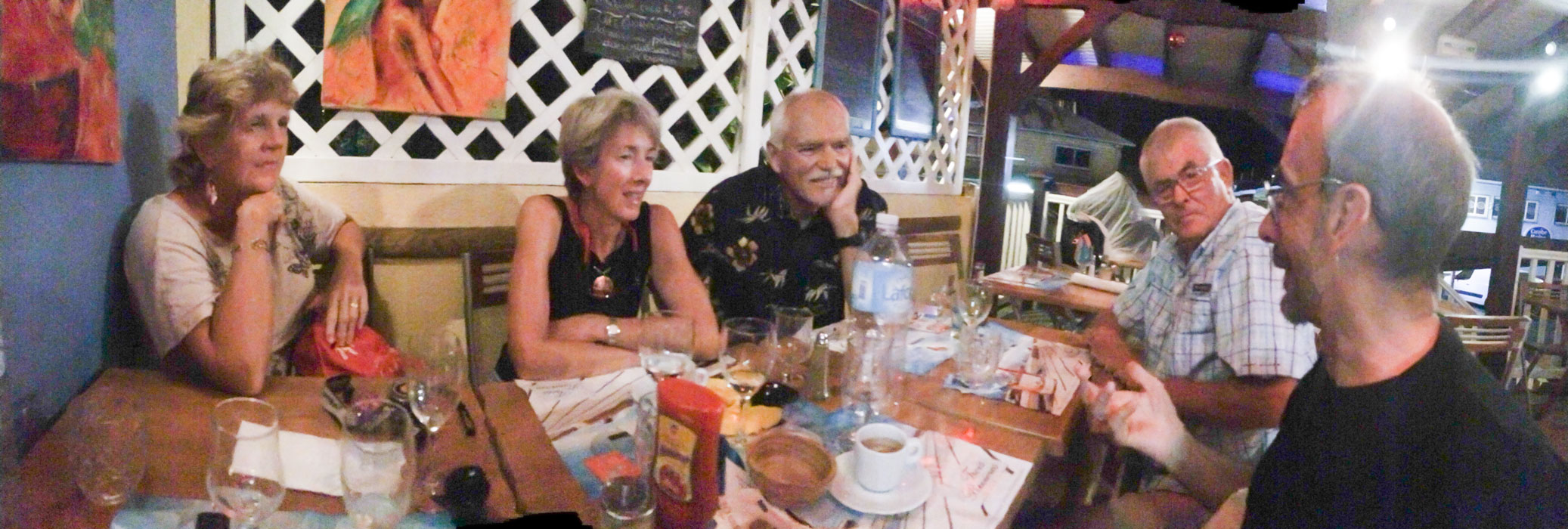
On May 5 at first light we left Prince Rupert Bay, Portsmouth, and motored down the west coast of Dominica and crossed over the open sea to Martinique.  When we got into what is normally the lee of the island, we were surprised to find that we were bashing into steep, short-period waves.  The wind was out of the northeast, and the currents were flowing out of the south.  Current against wind can cause ugly conditions, and that is what was happening.  St. Pierre, up in the northwest corner of Martinique, is a lovely place to spend some time when the anchorage is not too rolly.  That day, it was definitely too rolly.  Fortunately, we had gotten an early-enough start that we still had plenty of daylight left, so we kept on plowing down the west coast of Martinique, pitching all the while, passing Fort de France and then finally tucking into Grande Anse D’Arlet for the night.  Another early start the next morning, and alas, another pitching passage.  Finally, when we rounded the corner at Diamond Rock, the wind and current were no longer in such severe opposition, and our ride smoothed somewhat.  And of course, once inside the Cul-de-sac du Marin, we were in Nirvana.  As is our custom, we turned south almost immediately after passing the Club Med peninsula and anchored in the peaceful waters adjacent to Ile Baude, far from the windy and crowded and dirty waters on the east end of the huge bay.  There we remained for four days, with a number of dinghy expeditions to shore.  Barb did some walking on shore with the ladies from Receta and Asseance, we all attended several happy hours featuring Ti Punches, and we all had one fine dining experience at Ti Toques.  During one such get-together, Barb took a panorama with her new iPhone, an operation accomplished by sweeping the camera from one side to the other.  She will need a little more practice, as can be seen in the picture below.  On another day, Steve, Ann, Heather and Barb took a rental auto on a wine-and-rhum expedition; Don and I stayed back to work on our respective boats.

When we left Le Marin, it was not because we were not having fun, but because we had a slight weather window to get further south, where we hoped to attend the Jazz Festival in Rodney Bay, St. Lucia.   But to read about our experiences in St. Lucia, you must turn to our next blog entry.

Dominica — April 30-May 5, 2014

Dominica is an eco-wonder.  We spent five glorious days there, arriving on Wednesday, hoping for a PAYS BBQ but learning that there were not enough vessels in the anchorage to warrant the event.   We went on two hikes with Steve & Ann (Receta), the first on a major portion of section 11 of the Waitukubuli National Trail, and the second, joined also by Heather & Don (Asseance), to the Source, the spring from which the Indian River originates. The first was much more difficult than the second, passing as it did up and down narrow ridges that did not always permit creating switchbacks.  We had intended on turning off section 11 and cutting over to the Source to end the first hike, but we missed our turn and ended up extending the hike by several hours.  I was a tired puppy with sore ankles by the end. After a day of rest, as I have indicated, we tried again for the Source, succeeding this time and having a much easier time on a gentler, wider path that was actually a dirt road.  On the way back down, Steve and I ducked down into an adjacent creek and took pictures of the interesting formations. Martin, one of the PAYS “boat boys” invited Steve & Ann and Barb & me to visit CALLS, a struggling operation designed to rescue/rehabilitate young locals with otherwise unpromising futures.  We ended up making contributions that would fund the education of one or more for a year.   CALLS struck me as a humble but worthy organization.

Les Saintes, Guadeloupe — April 26-30, 2014

We spent three wonderful days in Les Saintes this time, enjoying the sensation of being in France.  One doesn’t hear much English, and the fare at the eateries has a definite Gallic or Creole bent.

Barb is newly motivated (and suitably equipped) to get in ten thousand steps per day, thanks to the FitBit gifted to her by niece Cathy.  She also has the ‘Map My Tracks” app on her iPhone, so she has become almost obsessed with getting her walks in every day, and sometimes more than one.  All of the pictures in this posting were taken by her on her various expeditions.  Wish I could keep up with her!