Family & Friends in the Deep South — Sept. 3-12, 2013

On Sept. 3 we rented a car and drove down from Raleigh, NC to Savannah, GA.  Next day we took advantage of Iris’s generous offer and swapped the rental for one of hers.  We spent a lot of time in Savannah shopping for clothes and small marine items.  We needed the clothes, and we had waited on the marine items until arriving in the States since I had a large gift certificate for West Marine that was burning a hole in my pocket.  The certificate was a consequence of being a finalist in the last two photo contests sponsored by Kadey-Krogen Yachts.

Son Jeff was changing jobs and on the east coast, and daughter Danielle lives in Rincon, a small town north of Savannah, so we decided to all meet in Charleston for a weekend, where we did some touring in the downtown area and visited the Aquarium.   As the pictures below show, granddaughter Abbie was considerably less camera shy than granddaughter Kristen.

Back in Savannah, we had lunch with former Armstrong Atlantic State University Mathematics colleague Dick Munson and his wife Karen, and another lunch with former Computer Science colleague Joy Reed, and yet another lunch with a bunch of Barb’s former colleagues from Southern Company (Melissa Mallard, Chuck, Patrice Cole, Mike McAlister- who hosts our website, David Schiller, Paul Hudson, Barb and Anna nee Sparks).  Good friends Iris and Mike Dayoub had us over for dinner one night, and invited good friends Steve and Beth Ellis to join us.  And of course, we got together again with Danielle and her girls several more times before departing from the area.

On Sept. 12, I caught a flight to Bismarck, ND, and Barb caught a flight to Las Vegas.  To read about those visits, see our next posts.

Labor Day Weekend in Cary, NC — Aug. 30 – Sept. 2, 2013

On August 30 we flew from Dublin, Ireland to Raleigh, NC, changing planes in New York City.

We spent the weekend of Labor Day in nearby Cary with daughter Nellie and her daughters Jessie and Katie.  Jessie is a freshman at Appalachian State University, and was home for the holiday.  Katie just graduated from Meredith College, and is working while taking a term off before attending graduate school.  Nellie is a very busy equity partner in the  law firm Womble Carlyle Sandridge & Rice.  So our visit, although very short, was about as long as could be squeezed in.

We visited, went for some walks, saw a movie, went out for sushi, made some delicious meals at home and generally just enjoyed spending some time together.

County Mayo, Ireland — August 25-30, 2013

Sunday, August 25th

We needed to set out from Dublin for County Mayo early in the morning since Barb had made an appointment with her third cousin Imelda to meet at the Killasser Church for 11:30 am mass.  Imelda (who lives in London), had arranged for a Carr mini-reunion starting at the very church where Barb’s Irish great-great grandfather Hugh Carr had his first two sons baptized before immigrating to the U.S. in 1865.  Many Carrs still live in the area and Barb welcomed the opportunity to meet some of them.  While driving the three hours to Killasser we passed hundreds of cars going in the opposite direction (towards Dublin) flying red and green flags on the sides of their cars.  We didn’t know what that was about, but supposed it involved some type of athletic event.

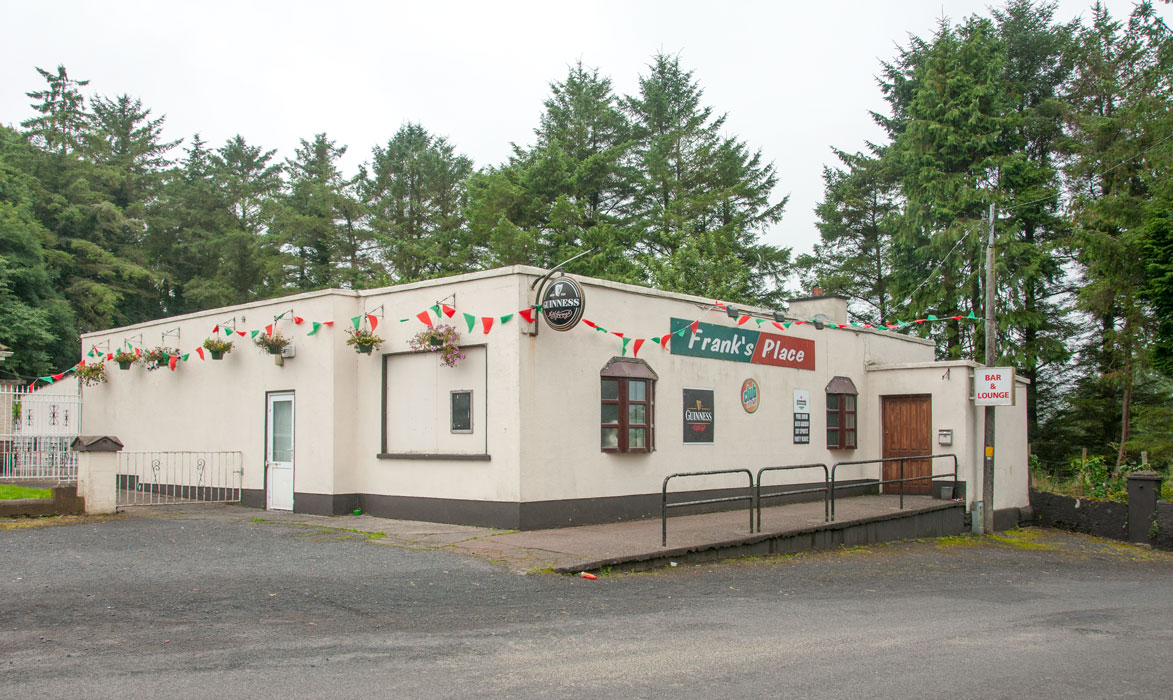
We had difficulty finding the church since the back roads leading to the church were so narrow and full of bends.  We used the iPad to get to the general vicinity, but then took a wrong turn down a single-lane road that had grass growing in the middle of the track.  We knew there was a pub (where we would all gather after church) across the street from the church and so we expected to find a small village — but we could find no such thing.  Finally we asked someone working in his front yard for instructions and were directed onto an asphalt road that was just barely wide enough for opposing traffic.  We made it with only ten minutes to spare and were surprised at the size of the “village”.  Just a few homes, the church, and the pub.  Introductions were made to many Carrs, but we learned that a number of them were missing; County Mayo was a semi-finalist in the All-Ireland Gaelic football competition being held in Dublin — so that solved the mystery of the many flag-bedecked vehicles heading in the other direction, and explained the absence of many of the male Carrs. The County Mayo team had last won the All-Ireland  county title in 1951 so the possibility of winning the semi-finals and playing in the finals on Sept 22 was a big deal.

But I digress.  During the mass the priest, Father Durkan, initially dedicated the mass to the Carr family but focused most of his sermon around the efforts of the Mayo football team with only a belated short tie-in to the need for Christians to show similar dedication and determination.  We were amused when later in the service he had the congregation say a prayer for the team.

After mass Barb was able to take some photos of the baptismal font that would have been used for her ancestors.  The priest was charming and joined the Carrs in the pub for the afternoon reunion.  Imelda had ordered sandwiches to be brought in so we had a nice afternoon tea while we all visited and exchanged stories.  While Barb was busy visiting, I watched the televised junior division semi-finals with Father Durkan, who explained some of the features of the game as it was played.  Gaelic football is apparently unique to Ireland.  In some respects it resembles a combination of basketball, football, hockey and soccer.  The ball is round and somewhat like a soccer ball.  Points are scored by kicking the ball between goal posts or into a net under the posts.  Goals into the net count for three points and those over the net but between the goal posts count for one.  The players wear no protective clothing, and run with the ball in order to get into position to score, but may take no more than four steps before either “throwing” (by striking the ball with a hand) or kicking or dribbling the ball once or dropping the ball and kicking it back into the hand.  There seemed to be no emphasis on tackling, but rather on possessing the ball.  Should a carrier and the ball be temporarily “tied-up”, it appeared that action stopped and began again with a kick of the ball.

All of the televised commentary for the game I saw was in Gaelic.  The priest explained that a certain percentage of television must be in Gaelic, and that the station had evidentially decided to fulfill that requirement during the junior contest, which they refer to as the “minor” contest, since all of the participants are no older than 18.  Incredibly enough the County Mayo minor team was also playing and they won the game I watched.  About the time the big game was on late in the afternoon (and after some of the relatives who lived a distance away had left) it was suggested that we go visit the places in the area where the Carrs used to live and go see some of the gravestones.  Barb was quite moved to be welcomed so warmly into the family since it had been almost 150 years since her ancestors had left Ireland.

At the cemetery we discovered that the Irish often reused graves (in the same family) and would dig up all the old skulls and lay them on top of a new casket before it was covered up.  Thus the gravestones didn’t tell the whole story.  Also many graves had collapsed and many gravestones had fallen.  In an old section of the graveyard the surface was quite uneven since there were so many sunken holes and overgrown fallen stones.  We were also shown a number of ruins of Carr houses.  When we returned to the pub we found a celebration underway since the County Mayo majors had also won the semi-finals.

Although Imelda lives in London, she and her husband also have a charming and large Irish home.  She invited us over, and we had a typical Irish meal of ham (they call it bacon), potatoes, cabbage, blood pudding, and salad followed by dessert.  Delicious.  Her husband Mike had been in Dublin for the game and arrived home with his sister and two friends about 10:00 pm. We were entertained by their stories of their day and of local politics.

Monday, August 26th

We met cousins Imelda, Desmond, Ann, and Gerard and began a tour around the area to see more of the Carr family and then to visit Gerard’s farm.  It was heartbreaking to hear some of the stories of family members being evicted during the difficult times following the famine.  We found a number of houses with no roofs and learned that land was taxed as if someone was living in a house even if it was vacant if there was a roof on it.  Thus, they removed the roofs to avoid taxes. We also saw the ruins of a church from the Middle Ages.  It was destroyed during one of the purges of the Catholics in Ireland.  Barb was surprised that a lot of it was still there after all these years and no one had torn it down to build something else.  Barb’s Irish relatives explained that no one would ever consider doing that, either out of respect or out of fear of faeries.  We thought “thank goodness”.

Cousin Gerard had us over to his house for tea and we met his children. The oldest is home for a few more days until he goes back to the university in Galway where he is studying computer science.

Then we went to the Heritage Museum, an incredible display that is essentially the work of one dedicated man.  It started as a tribute to his family and featured the restored home of his childhood.  Over the years he has added buildings and rooms to exhibit various aspects of life as it existed in that part of Ireland in former times.

Imelda thought it might be interesting to contrast the two sides of Ireland.  We had spent the day seeing and hearing about the hard lives of the poor.  She and Mike took us and Desmond to Mount Falcon to experience how the other half had lived.  The lodge was built in 1860s  and reminded us of Downton Abbey.  Massive in size and grandeur, it was the hunting lodge for a rich landowner who owned much of the farmland in the surrounding area.  It was just such a family that had owned the land from which Barb’s ancestors were evicted for being unable to meet rental payments.  Fantastic meal and fantastic way to dramatize the contrast between the tenant farmers and the landowners.

Tuesday, August 27th

We drove to meet Sheila at Croagh Patrick, nicknamed the Reek, a 764 meters (2,507 ft) mountain that is the third highest mountain in County Mayo.  It forms the southern part of a U-shaped valley created by a glacier flowing into Clew Bay in the last Ice Age.

Croagh Patrick had been a site of pagan pilgrimage, especially for the summer solstice, since 3,000 B.C. It is now a site of Christian pilgrimage associated with Saint Patrick who reputedly fasted on the summit for forty days in the fifth century A.D. Thousands of people climb the mountain every Reek Sunday, which is the last Sunday in July.  A small chapel was built on the summit and dedicated on July 20, 1905.   A seam of gold was discovered in the mountain in the 1980s:  the ore could yield potentially over 300,000 troy oz of gold (worth over $475 million). However, the Mayo County Council decided not to allow mining.

A bank of low clouds occluded the peak for most of our visit.  Barb and I walked up the beginning of the path, turning around at the statue of St. Patrick and the sign which promised a special dispensation for those who made it to the top and performed prescribed rituals at each of the stations.  We also saw a Famine museum, and the ancient ruins of a church. Sheila drove us to Louisbourg to see the coastline.  Driving back, we noticed that the clouds had cleared enough for us to see the chapel at the top of the mountain.  When we got back to the Reek, we had lunch at a famous restaurant at the foot of the mountain:  Campbell’s.

Back at our B&B, Cathy picked up Imelda and Barb and they went to her place to sort out genealogy records and have dinner.  Another instance of unforgettable warm hospitality.  I stayed at the B&B to recover from all the family talk.

Wednesday, August 28th

We checked out of our B&B in Swinford and stopped in briefly at Imelda’s.  She presented Barb with a Killasser school book that covered the last 100 years.  It has a number of photos of Carr relatives in it and some history.  We said a sad farewell to Imelda, who had been so generous and helpful.

We decided not to return directly, but to see some sights on our way back to Dublin. We stopped first in Kitimagh where Barb’s great-great grandfather married Mary McDonagh in 1860.  We took back roads through the countryside to Kylemore Abbey where we visited the castle, mausoleum, the miniature cathedral, and the gardens.  It was built starting in 1861 — around the time Barb’s great-great grandfather found conditions to be so difficult that he had to immigrate to the States with his wife and two children.  The estate was incredible.  Then we stopped at Connemara National Park where we learned about the bogs and how  87% of the peat  has been consumed in the past 90 years.  We saw lots of peat harvesting underway and can only imagine that it will all be gone soon if it is not protected.

We took the “Sky Road”, a twisty narrow road high above the coastline west of Galway.  We decided to spend the night in lovely Clifden and used our trusty iPad to find a B&B for the night.  They in turn advised us where to find a good pub for dinner, where we had a great meal, some smooth and creamy Guinness and some fantastic Irish music.  Very nice.

Thursday, August 29th

We headed back to Dublin.  We were going to go to the Gaol in Dublin, but when we arrived the lines were too long and we had to get our rental car returned within two hours, so we scratched that plan.  We checked into a hotel near the car rental place.  Barb wanted to visit the tomb of Matt Talbot, the “patron saint” of alcoholics, so she headed out to do that while I started processing some of the gazillions of photos we had taken in Norway and Ireland.

Friday, August 30th

We caught an early shuttle to the airport — which turned out not to be too early after all.  Turns out there is a US Customs and Immigration office in the Dublin airport.  After we went through the normal check-in procedure and through security, we were sent to the US Customs and Immigration area, not because we aroused extra suspicion, but because we were bound for America.  We were pre-checked into the US as if we had just landed into the US from a foreign country; we submitted a US customs form and were interviewed about visits to farms and whether or not we were bringing in fruits, etc..  And then we were sent through security all over again(!), sending jackets and shoes and computers, etc., through yet another x-ray machine and setting off metal detecting alarms with our artificial knees, even though the only access to this security check was through the normal Dublin airport security.  BUT.  Barb had also been randomly selected for an additional screening interview, so we were glad we had taken the early shuttle and had had plenty of time to deal with all the additional steps and long lines.

PS:  The pre-check takes the place of the normal check that occurs when one lands in the US; when we arrived in NYC we did not have to go through Customs and Immigration again.

PPS:  Dublin won the other semi-final Gaelic football match, so on September 22 the finals for the All-Ireland County championship will be Dublin against County Mayo.  Can you guess who we will be rooting for?

Dublin, Ireland — August 23, 24 & 29, 2013

We had a direct flight from Kristiansand, Norway to Dublin, Ireland on Aer Lingus.  We caught an Express Bus from the airport to downtown Dublin, where we schlepped our luggage to our hostel Abigail’s in Temple Bar.  Our room was equipped with four beds, but Barb had reserved it just for us, so we were comfortable.  Breakfasts in the downstairs lounge area were available as part of the room fee, and although they were nowhere near as bountiful as those we had in hotels in Norway (although this was a hostel and not a hotel), they were several orders of magnitude better than those typically available in American hotels. Not sure why Barb decided to switch us to a hostel but maybe it had something to do with some of the expensive hotels we stayed in during our time in Norway.  (The exchange rate of the US dollar didn’t help either.)

We did a fair amount of exploring by foot in Dublin.  We particularly enjoyed visiting the museum Dublinia which covered the early history of Dublin, with major components on the Viking and Medieval periods.  Of course, Barb insisted that we poke our noses into Christ Church and St Patricks Cathedral and we also had a pleasant walk through Trinity College, Merrion Square, Iveagh Gardens and St. Stephen’s Green.  All that walking stressed my arthritis-plagued ankles, so Barb struck off on her own to pick up a small rental car in preparation for our trip to County Mayo.  Her progress was delayed when she encountered the scene of an accident just after it had happened.  Somehow, in swerving to avoid hitting something, a car had tipped onto its side!  The upturned car was right in the way of the exit/entrance to the rental shop, so there was a bit of a delay before Barb could get our car.  The driver (who was fine) could not have been going very fast in the narrow city street.  Yet, when we had our accident in Norway, we were going faster than 60 mph.  I said it in our last post and I say it again:  we were lucky.

In Ireland, of course, they drive on the left side of the road, and so the steering wheel is on the right side, with the gear shift on the floor to the left of the driver.  As she drove back toward our hostel, while waiting for a traffic light she was just congratulating herself for doing such a good job of adjusting to the differences when there was a tap on her window.  She was sitting in the right lane — which of course belonged to the opposing traffic!  After that, she turned the driving over to me.

We later used the car and the mapping function on Barb’s iPad to find and visit the Guinness brewery.  Their display is in a huge building that formerly was used for brewing and storing, but now all seven floors are used for the display.  The top floor contains a bar at which all of the adult visitors have the option of a free soft drink or a free pint of Guinness.  Barb had her first Guinness and became an instant fan.  For the rest of our visit we tried to have our meals in pubs.  Can you guess why?  By the way, we certainly had no trouble finding pubs; they are even more common than rum shacks are in the Caribbean!

On August 25 we took the small car to County Mayo.  But we’ll describe that trip in the next blog.  For now, I’ll simply mention that when we returned to Dublin on August 29, Barb satisfied a request of her father and sought out the church (Our Lady of Lourds) that contains the crypt of Matt Talbot, 1856-1925.  Although not a formal saint, he is known as the patron saint of alcoholics. After 16 years of alcoholism he maintained 40 years of sobriety. Barb arrived just as the priest was locking the doors of the church but he was more than willing to keep it open to show her around and to share with her information about Matt Talbot. The priest said that many people from overseas stop in because of Matt Talbot but most are from the USA and Canada.  He brought out a chain that Talbot wore as a symbol of his devotion to the Church and had Barb put her hand on the box containing the chain while he said a prayer for her family.  Her father should be pleased.

Back to Kristiansand — August 19-23, 2013

Ever hear someone describe a horrible accident as one in which they were “lucky”, because they were “only” hurt and not killed?   That has always seemed to me a bit strange; what is lucky about having an accident?  But now I understand.

When we finished our visit to the Frogner Park on August 19, we began the four-hour auto trip back to Kristiansand.  I was driving, as I had for all but five minutes of all of our rental car travel in Norway.  About 30 miles outside of Kristiansand, while driving in the left lane of a two-lane-each-way section of the highway, with a sturdy guardrail separating the two directions of traffic, I momentarily fell asleep and was awakened by the sound of the car scrapping along the rail at a speed of about 100 k/h (62 m/h).  Fortunately (or should I say “luckily”) upon awakening I pulled away from the rail and we were not injured.  In fact we didn’t even slow down, let alone stop, although Barb’s initial reaction was that we should stop and assess the damage and call the police.  I reasoned that a) the car was moving along fine and b) since no other vehicles were involved, there was nothing to report and c) there was no immediate space into which to pull over and d) whatever damage was done, it was a fixed fact and would not be affected by our stopping.

When we arrived at the condo of Lars Helge and Tove, I found that I could not open my car door, and so I had to exit out of the small vehicle by climbing over the manual shift lever on the floor and then out the passenger-side door.

Accompanied by Lars Helge as a translator, we took the auto back to the rental agency the next morning.  The boss man was not there, and so we dealt with a young man who had been washing the cars.  Lars Helge completed the agency’s form for reporting the sites of damage, and we departed, making certain that we had left Lars Helge’s phone number.  Later, we got a call saying that the car would be taken elsewhere so the extent and cost of the damage could be assessed.  We had been given to understand from the bossman when we took possession of the car that the rental fee included insurance for everything but liability, with the condition that a relatively small fixed fee would be assessed if the insurance was invoked.  Barb thought all but liability was covered by our credit card, so with no personal injury and only minor cost if the agency insurance was invoked, and presumably no cost if the credit card insurance was used, we had been “lucky”.

Then we learned that since we had not (!!!) taken out insurance, we would be responsible for up to 43,000 Norwegian Kroner ($7,800 US).  Later the damage was pegged at 37,000 NK ($6,092 US).  The bossman claimed that he had told us that if we wanted insurance it would be an extra charge, and that we had declined.  Then the credit card company said that they would pay everything, but only if we had not taken out insurance with the rental agency.  So we were “lucky”.  Maybe.  We got an email from the agency asking about a police report, saying that it was required in Norway.  We responded that a) there had been no other vehicles involved and b) as foreigners we were ignorant of the requirement and c) no one in the agency had told us about the requirement.  We have our fingers crossed that all works out well with the credit card company settling with the rental car company.  Wish us “good luck”!

Later on the 20th Kari and Rasmus picked us up and took us on a sightseeing trip around Kristiansand.  It was nice since we really hadn’t seen much of Kristiansand since our first trip there in 1997.  We visited the new Kilden Performing Arts Center, an impressive facility right on the waterfront.  We popped into the fiskebrygga (fish market), where there are also several, mostly maritime, restaurants around the central waterfront. During summer, locals arrive in their boats and anchor up here. We visited Odderøya, an island right next to Kristiansand that was the site of a fort that was attacked by the Germans.  Many of the German shells flew over the island and did extensive damage to Kristiansand.  We visited Ravnedalen (Ravens’ Valley), a lovely park just outside the city centre.  It is surrounded with steep cliffs and presents the visitor with lush flower gardens and manicured lawns perfect for picnics.  There is also a café here, and we each had massive American-style hamburgers with all of the trimmings.  Later we took a walk with Lars Helge and Tove in the huge forest area near their flat in Baneheia.  There are wide gravel paths that are furnished with “street” lights to facilitate cross-country skiing during darkness in the winter, and much smaller foot trails that wind up and down through the rocky and boggy forest.  We found blueberries, and more solemnly, the burial site of Russians executed by the Germans in WW2.

Next day Barb decided to do the walk on her own.  Unfortunately, she got lost and had a heck of a time finding her way back.  She even got a ride part way from someone when she eventually found a paved road.  Her main concern was being late for our trip out to Ogge for a farewell party which Lars Helge and Tove had arranged while we were in Rørvik.

We arrived at Ogge early, and had time to plant some grass around the Brunborg hytte, and time to go for a walk in the area, where we found wild blueberries.

Since it was in the middle of the week, many of our friends couldn’t make it.  But some that we hadn’t seen earlier were able to come, namely Mardon, Marie, and Harald.  We were glad to have the opportunity to visit with them again.  We also saw Lars Helge’s new container cabins that he has had installed near his cabin, in the hopes that they can be rented to temporary workers that will be working on various projects in the area.

On our last full day in Norway, we went down to the waterfront with Lars Helge and Tove for a belated celebration of her birthday, which had passed while we were in Rørvik.  We were also celebrating her soon-retirement, which by the time this is being posted, is a reality.  (Congratulations, Tove!)  Next day, poor Lars Helge had to get up extra early in order to get us to the airport for our flight to Ireland.  It had been a tremendous visit, filled with so many wonderful experiences that it had required twelve separate posts to our humble blog.  We hope the depths of our enjoyment and appreciation have been visible beneath our modest prose.

Vigeland Sculpture Arrangement in Frogner Park, Olso — August 19, 2013

As I have mentioned in previous posts, we have been using Barb’s iPad to assist us in navigation during our visit to Norway.  But the program is not without its weaknesses.  On several occasions, when we asked for a route from our position to some specific location, the program would choose a different location that contained similar words.  Until this had happened several times, we blindly followed the instructions until we had arrived at an obviously-incorrect destination.

Oslo streets are a nightmare.  Without the iPad we could never have navigated from our downtown hotel to the Frogner Park.  But when Barb entered “Frogner Park” into the “destination” blank of the nav program, it chose a street that included the name “Frogner”, a street that coincidentally was near a park.  When we arrived at the destination and had finally found a parking place, it was only as we entered the park that I realized that something was amiss.  We had gotten well into the park when we found a sign indicating that we were in the Palace Park.

Back at our automobile, we then tried “frognerparken” as a destination.  Bingo!

Frogner Park, the largest park in Oslo,  contains the world famous Vigeland Sculpture Arrangement designed by Gustav Vigeland.  Although sometimes incorrectly referred to as the Vigeland (Sculpture) Park, the Vigeland Sculpture Arrangement is not a separate park, but the name of the sculptures within Frogner Park.  The sculpture park consists of sculptures as well as larger structures such as bridges and fountains.

Vigeland’s sculpture arrangement was constructed beginning in the 1920s and is the largest sculpture park made by a single artist.  The park is the most popular tourist attraction of Norway, with between 1 and 2 million visitors each year.

Here are some photos Barb and I took in the park.

Rørvik to Oslo — August 16-18, 2013

On Friday, August 16, after meeting briefly with Muriel, et al, we left Rørvik and began our road trip back to Kristiansand.  We stopped for a snack in Namsos and spent a little time walking the waterfront before continuing.  When we arrived in Trondheim, we booked a room downtown and went for a walk along the river Nidelva that is near the Nidaros Cathedral, historically an important destination for pilgrims coming from all of Northern Europe, and the northernmost medieval cathedral in the world.  We were also obviously near the second largest of the Norwegian universities, The Norwegian University of Science and Technology, as was initially obvious from the nature of the shops and the pedestrians and soon confirmed by the presence of a massive rock concert across the river from us, and another impressive experience.  We noticed a group of young folks, obviously University students, milling about on our side of the river.  When it looked as if they were removing their clothes, Barb walked over to get a closer look.  Turned out they were indeed shedding clothing, which they were stretching along the span of a riverside courtyard.  Their task was apparently to create an unbroken band of clothes that stretched the entire length of the yard.  When they ran out of material before accomplishing that task, they had no alternative but to remove their undershorts and add their naked bodies along the chain.  We arrived close to the group just as they were re-donning apparel.  We learned that they were all mathematics majors and that each major at the university has an associated “fraternity”.  We had stumbled upon the initiation hazing of the new students after their first week of classes.  The “supervising” upper classmen explained that when the task was completed, the freshmen were required to re-dress with clothes other than their own.  There were but a few girls present, and when Barb asked why, she was told it was because not many girls major in mathematics.  Left unexplained was why none of the girls present were participating in the ritual (much to Chuck’s disappointment).

Next morning, we continued our journey south, choosing a route (Norwegian National Road N63) that would take us through Trollstigen (Troll’s Path), a serpentine mountain road that is a popular tourist attraction due to its steep incline of 9% and eleven hairpin bends up a steep mountainside.  During the top tourist season, about 2,500 vehicles pass daily.  According to Wikepedia, during the 2012 season 161,421 vehicles drove past.

Continuing on N63, we crossed a river on a ferry and then drove through more beauty, arriving at Geirangerfjord, described by Wikipedial as some of the most spectacular scenery in the world and named the best travel destination in Scandanavia by Lonely Planet.  It is the third-biggest cruise ship port in Norway, receiving 140 to 180 ships during the four-month tourist season.  Only about 250 people live there permanently.  We stayed that night perched high above the village in a hotel named, appropriately, Utsikten (The View).  We took a short hike and enjoyed dinner at the hotel’s restaurant.

Next day, we stopped in Hamar for pizza and to visit the Hedmark museum, an outdoor museum with the remains of a medieval church — recently enclosed in a protective glass housing! —  and a collection of old farm houses.  Construction of the cathedral began in 1152, and was completed about 1200.  The museum is a combined medieval, ethnological and archaeological museum and has received architectural prizes for its approach to conservation and exhibition.

And then on to Oslo, where I learned with some irritation that Barb had booked a room downtown.  Luckily we found easy parking and had a lovely time wandering around downtown enjoying the sights and sounds.  Notable was the Norwegian parliament building, Stortingsbygningen, which was undergoing a renovation on one of its wings.  That entire wing had been shielded by a covering on which was printed a facsimile of the original building.  One had to look closely to see that the facade was artificial.

By the way, much of our hotel bookings were done by Barb on her iPad while we were underway, using her international cell plan.  We also heavily depended on the iPad for help in navigating, almost entirely eschewing paper maps, since they do not say things like “in 500 meters, take the second exit at the roundabout.”

Next day, August 19, we visited Frognerparken in order to see the Vigeland Sculpture Garden before moving on to Kristiansand.  But this has gotten overlong, so the gentle reader will have to read our next posting in order to learn about our visit and of our further adventures (and mis-adventures).

Rørvik and Kvaløya; seeking roots — August 13-16, 2013

As thorough readers of our blog know, there is a section devoted to genealogy wherein Barb has recorded her findings.  (Look here.)  Barb’s father is half Norwegian and half Irish, and Barb has been researching on both sides.  Some of her distant relatives are also interested in genealogy, and found Barb’s postings in the course of their Google searches.  One such relative from Norway, John Kvalø, contacted Barb back in October 2011 and they have stayed in touch ever since.  John was born in the Rørvik area and spent much of his youth out on a nearby island called Kvaløya (which translates to “whale island”).  John explained that he had moved to Bodø, but that his brother Ivan lives in Rørvik and owns part of the family island.  Barb already knew that her great grandmother Anna Karoline Kvalø was born on the island in 1868.  She immigrated to the United States in the late 1880s and settled in Minnesota.  So when John and Ivan invited us to come visit them at Kvaløya this summer we immediately decided to piggy-back a visit to Rørvik onto our trip to southern Norway.  And then we learned that two of Barb’s American cousins — who have done an incredible amount of research on the family history (back to the 1480s) — were also going to be in the Rørvik area during the same week.  What an opportunity!

When we deboarded the Hurtigruten in Rørvik, we were met on the dock by Barb’s Minnesota cousins Muriel Arms and Rosalie Tarum.  They had arrived a couple of days before and since they visit the area often, were familiar with the location of Kleiva Camping where we had reservations.  After a short visit we followed them out to Kleiva where we settled into a huge cabin.  We had reserved a small cabin but the Kleiva staff had made a mistake in the booking, so we got a huge three-bedroom cabin for the price of a small one with one bedroom.

The next morning nth cousin John from Bodø and his 16 year old son Øystein met us at Kleiva and took us out to Lyngsnes where we met nth cousin Ivan and his six year old son Eiven. Ivan took us in his fishing boat out to Kvaløya where Barb was thrilled to see the house where her great-grandmother Anna Karoline was born and lived.  It is still there and is well maintained by one of her relatives.  In the house some of the lamps and beds are original, as is the sewing machine and a built in china cupboard.  Very nice to realize that those things were used by Barb’s great-grandmother.

John, Ivan and their sons took us on a tour of the island.  Ivan’s summer house is about a ten minute walk from the main house.  He has two houses on the property to maintain.  One is where his grandparents lived, and the other where his father lived after marrying.  The area around the island was thriving more than a century ago and most residents were involved in fishing.  There was a school on the island and a store on a small island very close by.  Ivan was a sea captain who decided to stay closer to home with his family; he now teaches seamanship at a local school during the school year and fishes around Kvaløya during the summer.  Salmon farming has become so prevalent in Norway that he is the only fisherman in the area who still fishes for wild salmon with nets.  He helps the government by taking samples of all the fish he catches so they can determine if the farmed salmon are escaping and breeding with the wild salmon.  At the end of the day we circumnavigated the island and checked Ivan’s nets for salmon before he took us back to the mainland.

The next day we went with John and Øystein to meet John’s parents Oddmund and Jenny who are now living in an assisted living center in Rørvik.  His father spoke some English but John (and Øystein) had to be our translators when speaking to his mother.  While there we met other relatives — one of whom Barb had listed in her genealogy records as no longer living!  (She thought it best not to share that fact with him.)

After lunch with John and Øystein, they began their 8-hour drive back to Bodø and we spent the afternoon looking for family graves and visiting Norveg, the fascinating Coastal Museum in Rørvik.  We were extremely impressed by the warm hospitality of John and Ivan and pleased by their offer to have us come and spend time on Kvaløya some summer soon.

The next morning we met up with Muriel and Rosalie for the first time since they had greeted us at the Hurtigruten, and agreed that it made more sense to spend our time visiting Norwegian relatives while in Norway and that we would try to get together when we are back in the USA.  Muriel lives near Rochester, MN and we will be visiting the Mayo Clinic for Chuck’s check-up in late September so we hope to get together then.

In our next post we will describe our automobile trip back to Kristiansand by way of the famous Trollstigen and Geiranger Fjord.  Stay tuned!

Trip to Rørvik: Oppdal & Hurtigruten — August 12-13, 2013

On August 12 Lars Helge drove us to a car rental establishment in Kristiansand, where we crammed into a tiny Fiat and headed off to meet some of Barb’s Norwegian relatives.  We drove first to Oslo, and then up toward Trondheim, stopping overnight in Oppdal, where we stayed in a nice hotel and discovered a pizza place (Peppe’s) that features some of the best pizza we have ever had.  Turns out Peppe’s is a chain that has now been absorbed by one of the giants of the fast food industry, but that began when an American couple decided to make American-style pizza available to Norway, where they are now widely sprinkled.

Next morning we partook of a Norwegian breakfast the like of which we have never seen.  Anything you have ever heard of in connection with Norwegian breakfast was available.  Massive.  When we had finished gluttonizing, we hurried on to Trondheim, where we boarded the ship “Finnmark”, built in 2002 as one of the two latest to join the Hurtigruten fleet that plies up and down the Norwegian coast.  We took the car aboard as well; Barb schlepping some of our luggage on foot, and me driving the car up onto a tiny elevator that descended with me and the car down to a lower level where the vehicles are kept.  We had free reign through much of the ship, but headquartered into seats at the bow on the seventh level, the highest possible.

But I have gotten ahead of myself again.  We had been told that finding the Hurtigruten pier would certainly be no problem:  all we had to do was follow the road signs when we got to Trondheim.  We saw no signs, so we drove around downtown Trondheim trying to stay close to the water front. Finally I found a parking place and Barb ducked into a beauty parlor, where the hairdressers had an extended debate as to where the pier was and how best to get to it.  Finally, the winner (or the most assertive) emerged with Barb and after much pointing and conversation we headed off in the indicated direction.  After several lucky guesses and a few last-minute course corrections, we finally saw an appropriate sign and were able to get to the pier, where there were no signs indicating where to queue up with the car.  But a very friendly gatekeeper — who like all young and middle-aged people in Norway, spoke very good English — told us where to park in order to wait for the boarding of ourselves and the auto.   (Lest the reader suspect that the base problem discussed in this paragraph stemmed not from lack of signs, but rather from the lack of an ability to understand Norwegian, I should add two comments:  many signs in Norway are in English and I am pretty good at reading Norwegian.)

The “Finnmark” is huge and fancy, with lots of room available for those that are spending nights aboard and with nice dining halls and passenger lounging rooms that feature spectacular viewing opportunities.  Much of our 8-hour leg of the route northward consisted of dodging among the skerries, prefaced by a very long trip out of the Trondheim Fjord, the third longest fjord in Norway, and punctuated by a few ventures out into the open sea.  Barb and I both decided that when we get rich we will take an extended Hurtigruten trip up the entire coast of Norway.  What a cruise that will be.

See our next post to learn about the fun we had with Barb’s relatives.

Skurvenuten — August 3-11, 2013

On August 3, the Brunborgs and Shipleys left the hytte of Bodil and Rune after another hearty (aren’t they all?) frøkost (breakfast), and continued northward to the hytte of the Brunborgs, which they call Skurvenuten, and about which I will say more later in this article.

The hytte was by far the most remote we visited in this series of hytte-trips.  We drove through an increasingly beautiful landscape as we wound down and (mostly) up along the walls of dramatic canyons of granite formed by glaciers in past ice ages.  Our goal was reach a dam in the southeastern corner of a lake high above the timber line:  Holmavatnet.  Just before reaching the dam we met Bjørgulf and Berit driving out from a visit to their hytte.  (More about them later in this blog.) At the dam we unpacked the small trailer we had pulled behind the Brunborg automobile and transferred our supplies to a small boat powered by a new 4-stroke 8-hp Yamaha engine.  It had begun raining in the last part of our auto trip, so we were all clad in waterproof jackets and trousers and rubber boots.  The car was left in a nearby clear space and we took the boat through the driving rain across the lake to the northeastern corner where Skurvenuten lies.

We moved our supplies into the hytte, and immediately started a toasty fire in the wood-burning stove and hung some our clothes and and some of our bedding (which had gotten wet in the trip across the lake) up above the stove.  Then Lars Helge and Tove took the boat back out onto the lake in order to set about a dozen garner (nets).  When they returned, we had a dinner of tomato soup and sausages and some of the delicious Norwegian bread.  Next day about noon, we all went out into the rain and drizzle and pulled in the nets; Lars Helge always at the motor and the rest of us taking turns retrieving; done by reaching out an arm’s length, grasping the net, pulling it up to the body and securing the net onto a plastic prong held in the other hand — and repeating this process until the entire net is retrieved.  If the net contained trout, the net was placed into one large plastic container; if not, and if the retrieve had been “neat”, then the net was placed into an equally-large but different container.  Tangled nets were placed in the “fishy” container, since they would have to be unsnarled just as the nets that had contained fish would.  When all of the nets had been retrieved, we landed the boat on a shore that had nearby large flat rocks, and took the fishy and tangled nets up to the rocks, where the fish were removed from the nets and the nets were unsnarled and readied for another placement in the lake.  While the three of us did the unsnarling, Lars Helge cleaned the fish down at the lake side.  Then we took the boat and the nets back out onto the lake and set the nets in likely but “new” bays or points along the shore.  We performed this routine each day but the last: eating breakfast, retrieving the nets, removing the fish from the nets, unsnarling the nets, resetting the nets in “new” places, and then returning to the hytte for some lunch, which often consisted of boiled trout and boiled potatoes and thinly sliced cucumbers.  But we also had meals of polser or pork loin or smoked trout.   In the long afternoons (in this part of the world at this time of the year the sun doesn’t set until well after 9 PM) we went for walks, or fished with casting rods or lounged inside or outside the hytte (depending on the weather) or performed everyday chores.

But I have gotten ahead of myself.  It rained on and off all day during our first full day on the lake, and then really rained hard that night, causing the lake level to begin rising.  When Lars Helge went out to the boat late the next morning, he found that the boat, whose bow had been pulled up on the shore, had taken on so much rain water that a corner of the stern was nearly submerged.  Attempting to reposition the boat so that he could bail out the water, he inadvertently moved it off a supporting rock and the stern immediately sank, submerging the new motor!  That was the scene when the rest of us arrived at the shore.  Together, we managed to position the boat so that we could bail out the water.   When an attempt to start the motor failed, we removed it and took it up to the cabin, where we extracted the spark plugs and put a bit of oil in the combustion chambers.  We then put the engine on a saw horse with the foot in a bucket of water, and after replacing the plugs were able to start the motor.  Yippee!

We caught an average of about 15 trout a day.  What did we do with that many fish, you ask?  Every day we ate some, either boiled or smoked.  The rest were reserved for rather unusual treatment, even in Norway.  Lars Helge made a batch of gravøret that we ate after three days of aging, and he began several batches of rakfisk; but that delicacy takes several months to mature to the point that it is ready to eat.  Neither preparation involves cooking; the fish are eaten raw and without heat.  We think that they are both delicious.

What are rakfisk and gravøret, you ask?  First, laks is the Norwegian word for salmon.  Øret is the word for trout.  The gravøret was prepared using essentially the same recipe as that for gravlaks; about which Wikipedia says the following: “Traditionally, gravlaks would be salted, buried in the ground and left to ferment (similar to how rakfisk is still prepared), hence the name. Contemporary gravlaks, however, is salt-and-sugar-cured salmon seasoned with dill and (optionally) other herbs and spices. Gravlaks is often sold under more sales-friendly names internationally.”  You can  read more about gravlaks here.  About rakfisk, Wikipedia says:  “Norwegian fish dish made from trout … salted and fermented for two to three months, or even up to a year, then eaten without cooking.”  You can read more about rakfisk here.

A note about the cabin:  years ago when we first visited Skurvenuten, the “WC” was an outdoor affair that consisted of a wooden “bench” with an appropriate hole mounted between two large boulders up some distance from the hytte.   But now the hytte has a snurredass — an indoor toilet that opens up not into the ground but into a cylindrical container with three chambers under the hytte.  When one chamber fills up after some months or years, the container is rotated so that the waste falls into a new chamber.  By the time the original chamber has come around again, its contents will have decomposed to the point that it is essentially empty, a process facilitated by the addition of a handful of a specially-treated tree bark after each occurrence of serious business.

The hytte has no running water, so we fetched water from the lake for drinking and cooking and washing ourselves and our dishes.  The new room containing the snurredass contains a sink and a shower stall, but, without running water, showers are obtained by using a hand-pressurized garden sprayer.

The hytte Skurvenuten is owned by Bjørgulf Haukelid, who has been a friend of Lars Helge since they were school boys.  The Brunborgs fixed up Skurvenuten and have used it for many years.  Bjørgulf and his wife Berit have on the same lake their own hytte, called Vivik, as well as yet another hytte.  The Haukelids also own the northern half of Holmavatnet, as well as a considerable amount of land and several lakes immediately to the north of Holmavatnet.  The King of Norway has hunted Caribou on the Haukelid land.

Bjørgulf is the oldest son of Knut Haukelid, one of the Norwegian saboteurs of the heavy water plant at Vemork during the World War II occupation of Norway.  The Allies placed great significance on destroying the plant and its heavy water production, since it was feared that the Nazis would use it to help create an atomic bomb.  The Norwegians had been trained in Britain, and after the successful raid on Vemork all but two returned there.  Knut was one of the two who remained behind to train and arm volunteers for the Norwegian Home Army, as the resistance movement was known. He teamed up with another Norwegian named Skinnarland and fled on skis to a mountain hut called “Bamsebu” on the Haukelid property where they remained in hiding until the spring thaw of 1943 when they moved to a farm on the lower slopes, where they were better placed to gather information to relay back to Allied headquarters in London. In July they received an inquiry about reports that production of heavy water at the Vemork plant had restarted. It was decided to attempt to destroy the plant by a United States Army Air Force bombing raid. This wrecked the factory but failed to destroy the heavy water plant, which was protected by seven concrete floors above it.

Norwegian technicians were able to convince the German authorities that the plant as a whole was no longer viable but, on January 29,1944, London advised Skinnarland that it was to be dismantled and shipped to Germany, together with the Vemork stocks of heavy water. Haukelid and he took great risks in entering local towns, where both were well known, to gather information about the planned shipment. Eventually, they discovered that it was to be conveyed in a Norwegian ferryboat which would have to traverse Lake Tinnsjo on its way to the open sea. Assisted by others recruited locally, Haukelid placed charges on the keel of the ferry, which blew up and sank in 1,000ft of water in Lake Tinnsjo in February 1944, unfortunately with the loss of several Norwegian lives.

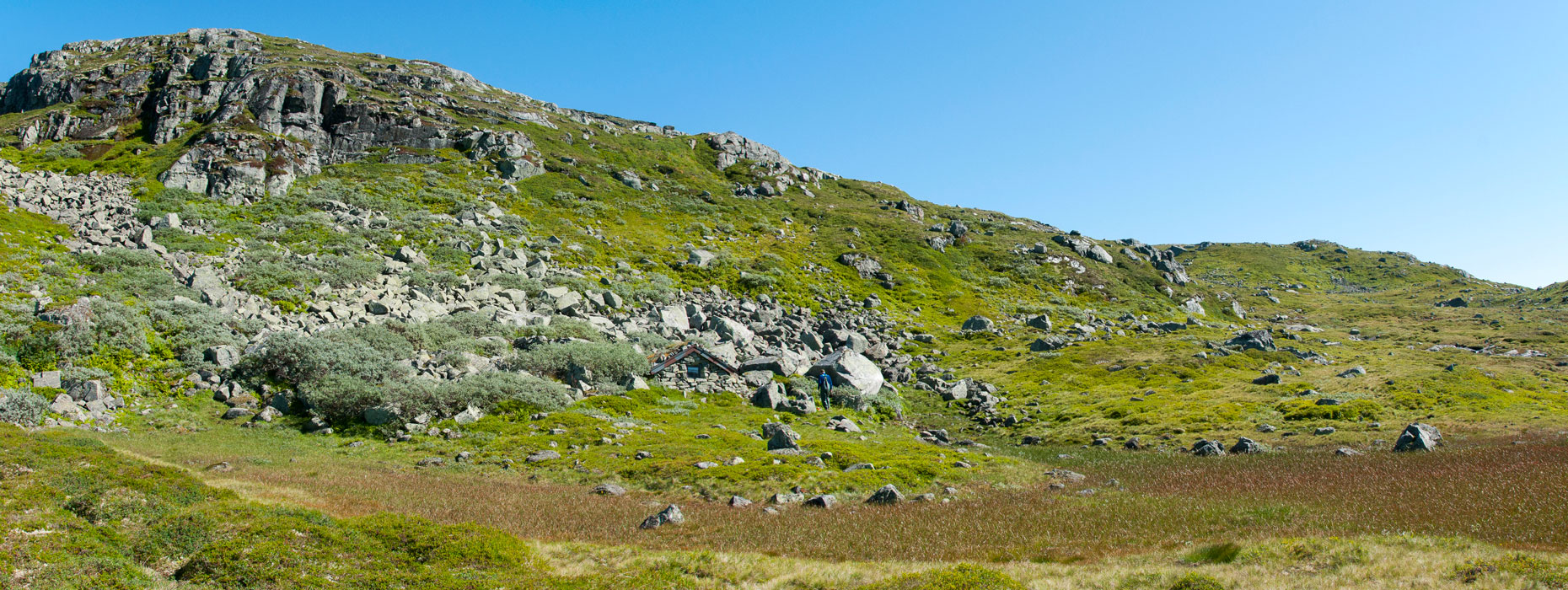
So much for the background concerning the small hut called Bamsebu.  During one of our fishing expeditions, we took a break and walked up to the hut.  It was my third visit.  On an earlier visit some 15 years ago, Lars Helge and I had repaired the roof, replacing a rotten plank and repositioning stones on the edge of the roof and cutting new clumps of sod to fill bare spots in the grass on the roof.  Remarkably, after all of those 15 years, some of the places from which we got the sod are still bare, a testament to how harsh the conditions are at that latitude and altitude.

The Brunborgs love Skurvenuten, and the Shipleys do too.  We consider it a high privilege to be able to spend time in such a beautiful and such a historic place.