Devils Tower — August 21-22, 2014

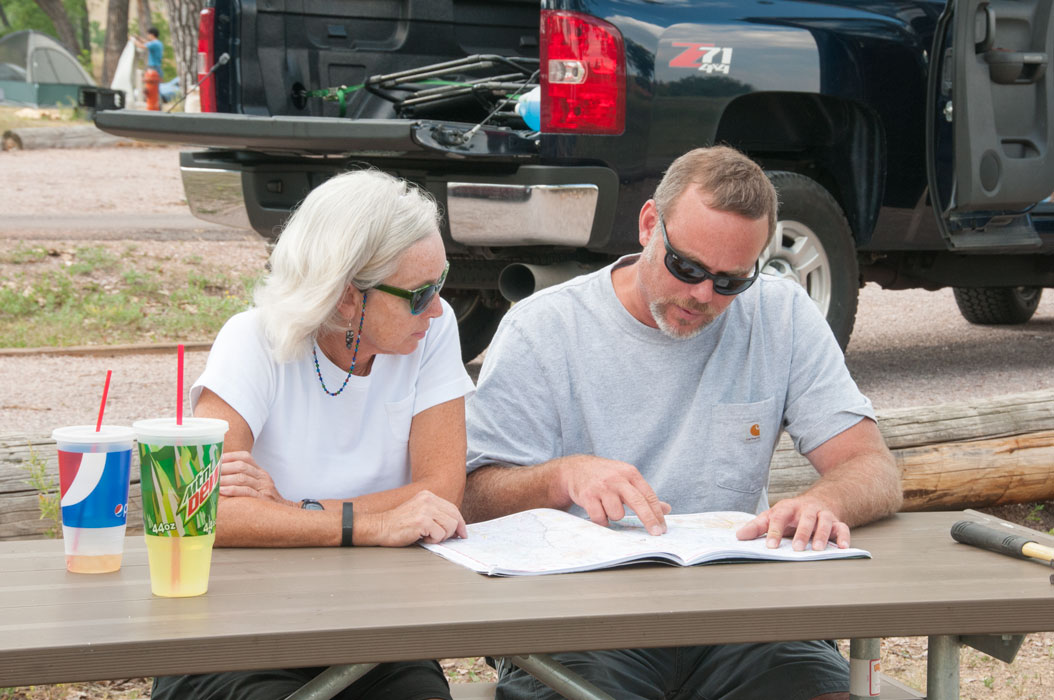
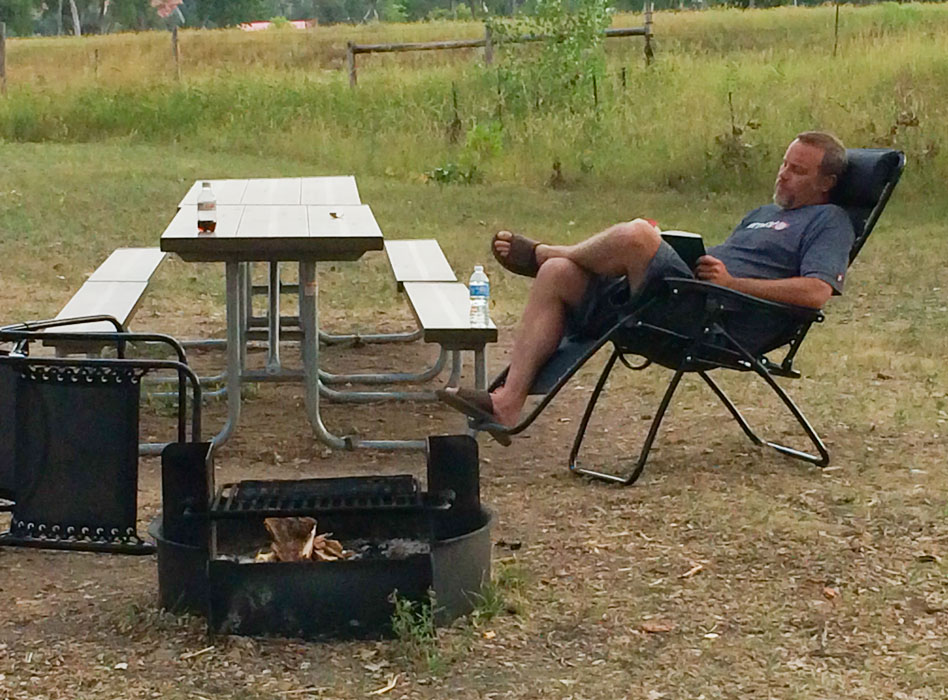
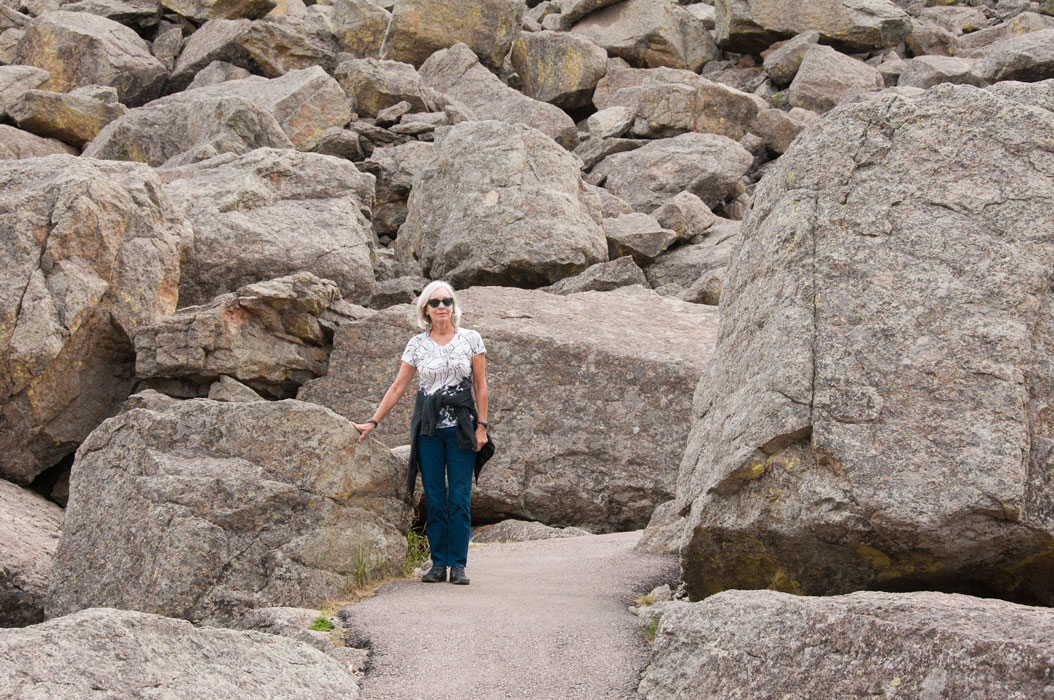
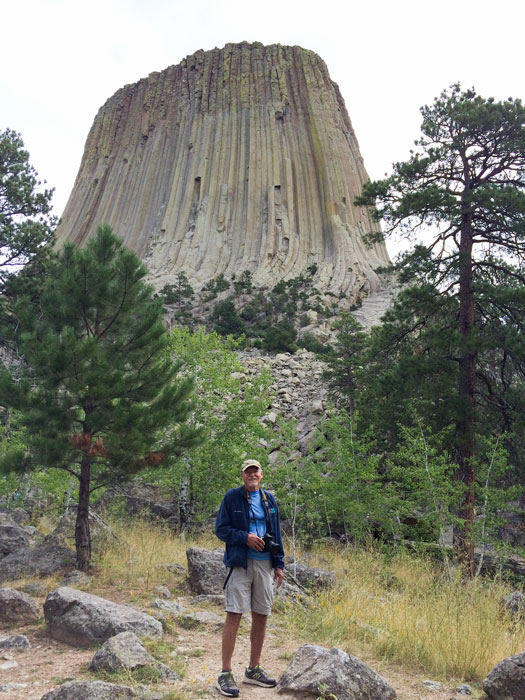
On our way up to Devils Tower, we chose a scenic route through the Black Hills that took us through Deadwood, where I spent too much time reading the displays in the Adams House Museum.  Our route had us going through tunnels lined up perfectly to see the four faces of Mount Rushmore.  We set up in the Devils Tower National Monument campgrounds and then went up to see the Visitors Center before driving to the town of Hulett (population 383) for supper at the Ponderosa Cafe, where we had a huge meal for an incredibly inexpensive price, served by folks just as friendly as you please.  Next day, Jeff took his leave to continue on to Idaho, and Barb and I went back to the Tower to hike around its periphery.  We saw at least four different sets of climbers on various faces of the Tower, including the descent of a team that consisted of a young guide and a not-so-young 70 year old completing his first climb of Devils Tower.

Devils Tower is thought to have been formed as a large mass of igneous rock which intruded through sedimentary rock beds without reaching the surface, but made a rounded bulge in the sedimentary layers above.  As the magma cooled, hexagonal (and sometimes 4-, 5-, and 7-sided) columns formed. As the rock continued to cool, the vertical columns shrank horizontally in volume and cracks began to occur at 120 degree angles, generally forming compact 6-sided columns.

Devils Tower did not visibly protrude out of the landscape until the overlying sedimentary rocks eroded away.  As the elements wore down the softer sandstones and shales, the more resistant igneous rock making up the Tower survived the erosional forces. As a result, the gray columns of Devils Tower began to appear as an isolated mass above the landscape, today rising dramatically 1,267 feet above the surrounding terrain.

The nearby circle of sacred smoke sculpture honors the American people as a gesture of world peace by sculptor Junkyu Muto. The sculpture is designed to help raise visitor awareness of the importance of the Tower to over twenty affiliated tribes. It is the third of seven works planned by the sculptor around the world. The first two are located at Vatican City and Bodhi, India. The sculpture represents the first puff of smoke from a newly lit pipe.

Wind Cave National Park — August 20, 2014

Wind Cave National Park is the site of one of the worlds longest and most complex caves and 33,851 acres of mixed-grass prairie, ponderosa pine forest, and associated wildlife. The cave is well known for its unusual geology, outstanding displays of boxwork, a rare cave formation composed of thin calcite fins resembling honeycombs, and the winds at the caves entrance. The cave also contains a variety of other cave formations such as popcorn, frostwork, and flowstone. Continued exploration is still occuring as cavers actively search for new passages in this complex maze.

The mixed-grass prairie in the park above the cave is one of the few remaining and is home to native wildlife such as bison, elk, pronghorn mule deer, coyotes and prairie dogs.

While many speleothems have formed as water has dripped into the passages, the most conspicuous feature of Wind Cave, boxwork, has probably formed differently. Boxwork is found in small amounts in other caves, but perhaps in no other cave in the world is boxwork so well-formed and abundant as in Wind Cave. Boxwork is made of thin blades of calcite that project from cave walls and ceilings, forming a honeycomb pattern. The fins intersect one another at various angles, forming boxes on all cave surfaces. Boxwork is largely confined to dolomite layers in the middle and lower levels of Wind Cave.

The origin of boxwork remains a mystery. According to one theory, many of the bedrock walls in Wind Cave have resistant fins of calcite from which the intervening limestone and dolomite bedrock has been removed by weathering. The veins in which the boxwork formed are along narrow fractures resulting from stresses produced when the mineral gypsum dried and rehydrated. The calcite formed in these fractures taking on the shape of the original gypsum crystals.

The original entrance to the cave is a small hole, barely large enough for a small person to squeeze into.  Barometric disparities between the inside and outside cause “winds” to flow through that small hole, and that is how the cave was discovered by white settlers in 1881.  Before that, and continuing into the present, the cave has been regarded as sacred by Amerindians.  Indeed, when we were there, small packets of tobacco wrapped in bright cloth were tied onto bushes just opposite the small cave opening.

A number of different “tours” of the cave are available.  We began ours by entering through a steel door and into an excavated passage that ran some 20 feet before encountering the original cave.  We descended down steps and inclines to a depth of 200 feet, sometimes squeezing along narrow passageways and other times entering fairly large rooms.  We saw virtually no stalactites or stalagmites, since the cave is so dry. We exited the cave via a slow limited-weight elevator that permitted only 10 persons at a time.

When we left the cave we paused to photograph some pronghorns and some bison, and then proceeded to the campgrounds at Bismarck Lake in Custer State Park — the very same that we had used on our trip with the Dockters in late July.

Mammoth Site — August 20, 2014

When it looked like it might rain on us during the night on the evening of August 19, we decided to check into a motel.  Next morning, we visited the Mammoth Site, a museum and paleontological site near Hot Springs, South Dakota. It contains the remains of fauna and flora preserved by entrapment in a karst sinkhole during the Pleistocene era 26,000 years ago, including Columbian & woolly mammoths, camels, wolves and giant bears.

In 1974, a construction worker, George Hanson, unearthed unusual bones while the area was being prepared for a new subdivision. His son recognized one of the finds as a mammoth tooth. The landowner agreed to further investigation, and a complete skull and tusk were found in 1974. Donations, some made by local citizens, along with the work performed by amateur and professional excavators, led to its status as a museum. 

The site has been totally enclosed and is still being actively (but slowly and carefully) excavated by trained volunteers supervised by scientists.  An adjoining exhibit hall displays full-sized replicas of mammoths, a giant short-faced bear and a walk-in mammoth bone shelter.  When Barb and Jeff finally pulled me away — I enjoy reading ALL of the text at ALL of the displays — we drove up to Wind Cave National Park.  Stay tuned for that account.


South Dakota Badlands — August 18-19, 2014

On August 18 Barb and I headed south and west, bound for the Badlands.  We avoided superhighways all the way, soaking in the austere beauty of the plains of the western Dakotas.  Barb’s son Jeff, on his way to Idaho from Kansas, met up with us just as we arrived at the South Dakota Badlands.  He had his camping gear along, and we had ours (newly acquired), so we pitched two tents in one site in the Badlands campground. The experience was pleasant in every way; very nice accommodations and great to spend some time with Jeff again.  We spent the morning of August 19 roaming through the park while making our way west, stopping frequently to admire and photograph.  When we exited the western end of the Park, we headed to Wall, SD, where we stopped for a late lunch and the obligatory visit to the over-hyped Wall Drug.  And then on to the Black Hills.  But the latter experience deserves its own coverage.  Stay tuned!

Bismarck — July 15 – August 18, 2014

Our main focus while we were in North Dakota, as always, was as guests of sister Zona and mother Evelyn in Bismarck.  Zona lives up on a hill just outside of town in an enormous house that includes a separate suite for Mom.  The center of our activities is socialization with friends and relatives, of which we saw many.  Zona’s son Erik and his wife Cindy and their children Sophia & Evan are temporary lodgers with Zona as they decide on a home after moving to Bismarck from Minneapolis.  Across town live Zona’s daughter Cathy and her husband Jon and their children Cole & Katie.  Zona’s daughter Suzie and her husband John and their children Mattie & Oliver, also from Minneapolis, stopped in for a few days on their way to the western Dakotas for a family vacation.  Zona’s brother-in-law Floyd and his wife Sheila stopped in for a visit.  Nearby neighbors Jerry & Jean were guests for dinner one evening.  On another occasion, we got together with across-town friends Dawn & Jerry.  Friends Violet & Marvin, next-door neighbors of Zona’s cabin out at Lake Isable, and companions with us on our first visit to Norway, also came for dinner one evening.

When it was just Mom and Zona and Barb and me, we often played progressive rummy, during which Mom showed all the spunk and intelligence and competitiveness that has kept her young for all of her 95 years.

Barb and I also partook of some of the local attractions, visiting historic Ft. Lincoln, where General Custer lived for a time.  We also drove north of Bismarck to see the Three Ditches site of a Mandan Indian village – a site that had already been abandoned when Louis & Clark came through because of a catastrophic small pox epidemic caused by contact with White traders.  And we visited the North Dakota Heritage Center located on the grounds of the State Capital.  This is a first class museum that should not be missed by anyone passing anywhere near Bismarck.  It was with a sad heart that we left Bismarck, for we always enjoy our visits.

Visit to the Ringens — NE Minnesota, August 4-13, 2014

Here are some things I thought I knew about my marriage and my self:

  1. As a couple that lives on a boat in the Caribbean for most of the year and owns no home on land, we have no need for a motor vehicle, and no place to keep one if we had one.
  2. As “old” folks on Social Security, the time has passed when tent camping is an option – sleeping on the hard ground and stumbling around in the dark for the inevitable nighttime visit to the toilet.

And yet, as we prepared to head from Bismarck, ND, to the extreme northeastern corner of Minnesota to visit Jon Ringen — old friend, former undergraduate schoolmate, former fraternity brother, and former college roommate in an off-campus rented house – and his wife Cathie, Barb and I did something extraordinary.  We bought an automobile.  And not just any automobile, but the very same 1999 Toyota Camry that Mom had owned until we talked her into ceasing driving back in 2008 or so.  She had given the car to her grandson and my nephew Erik, who had used it for a number of years before upgrading to something newer.  He was just about to sell the Camry when we appeared for our latest visit to Bismarck and so we bought it, thinking that it would be a solution to the problem of getting to Minnesota and Colorado and Arizona, a subset of our planned destinations during our 2014 visit to the USA.

“Why not camp on those trips?” Barb asked.  Once Barb gets an idea, she is not easily dissuaded, and so we bought sleeping bags and an inflatable queen mattress and an inflator and a ground tarp and a cooler and two small pillows.  Bismarck niece Cathy and her husband Jon loaned us their tent.  The plan was to spend two days getting to the Ringen’s cabin on McFarland Lake, MN, camping the first night along the way at Itasca State Park, MN.  That would give us time to stop on the first day at the Chase Lake Nat’l Wildlife Refuge, near Carrington, ND.  The Refuge is in the heart of the Prairie Pothole region that cuts a swath in the middle of the state, in the tallest and most rugged part of the Coteau, a geological formation that holds some of the highest density of wetlands in the nation.  In particular, Chase Lake hosts the largest nesting white pelican colony in the USA.  Barb, no fool, had realized that if she wanted to talk me into camping, a good inducement would be to suggest that we spend a lot of time in areas where I could do some bird photography.

We stopped in nearby Medina for breakfast and to visit an unmanned information room dedicated to birding and Chase Lake.  Using pamphlets we obtained there, we headed out on gravel roads to the lake.  The first suggested route had us encountering huge trucks on a narrow road that surprisingly dead-ended at a huge gravel works where large machines were creating material for road improvement.   We backtracked and two miles south took a second suggested road that would take us adjacent to a small lake on the way to Chase.  Alas, the road soon deteriorated into a two-track path overgrown with weeds that slapped the front of the car and made nasty noises as they scraped the bottom.  Much to Barb’s dismay, I proceeded.  Or at least attempted to proceed.  When we crested a small hill we could see that our track ran straight into the small adjoining lake.  Were we on the wrong track?  Nope.  Officially a semi-arid State, North Dakota has for the last decade or so gotten an unusual amount of rain, and our small lake had filled to the point that our track was flooded.  I stepped out of the car and could see white pelicans on distant shores, but they were too far away for photographs.  While Barb held her hands to her head and moaned, I pulled a “moonshiner turnaround” and we backtracked again to a real gravel road that could take us back to a highway and on our way to our Itasca destination.  We arrived in time to visit the headwaters of the mighty Mississippi and settle into a peaceful campsite.

Next day, we arrived about mid-afternoon at the cabin of Jon & Cathie Ringen, located on an overlook of Lake McFarland, about a mile east of Pine Lake, one of the easternmost lakes of the Boundary Waters Canoe Area (BWCA).  “Cabin” doesn’t do the dwelling justice.  After years of addition and enhancement, the place has most of the comforts and conveniences (and capacity) of urban homes, lacking only land-line power and telephone, deficiencies addressed by solar power and cellular communication, the latter of which is available only by virtue of their height above the lake, an advantage not enjoyed by most of their lake neighbors.

For the entire visit we had marvelous weather which we took advantage of by hiking and canoeing and sunning on the deck.  We ate like royalty and drank like sailors.  I probably spent too much time attempting to convince them that it is time to retire from professorships and enjoy the benefits of additional leisure, including the opportunity to visit us on the boat more often.  One afternoon we attended a potluck for the residents of the lake, an annual event organized by the Ringens and a lovely neighbor named Jessica.  On our last full day with the Ringens, we all travelled up to the Rendezvous Days at Grand Portage National Monument where scads of French trader re-enactors were camping.  In an arena adjacent to the National Monument, the Grand Portage Band of Minnesota Chippewa was holding a traditional Pow Wow, scheduled each year during the same weekend as the Rendezvous.

We had a great visit with the Ringens – we hope they will come see us soon.  The breadth of their hospitality is illustrated by their beneficence as we left:  they gifted us with a spare camping stove, cook kit, and hexagonal tent so large as to accommodate folding seats in addition to our mattress and so tall as to permit us to stand erect when inside!  As if that wasn’t enough, Jon waterproofed the seams of the tent before we left.

When Barb posted something about our visit on Facebook, we got a nice surprise.  Former cruising friends Ann and John (Livin’ the Dream), who have temporarily swallowed the anchor and are living in Punta Gorda, FL, saw the post and wrote to say that they were going to be canoeing in the BWCA.  They finished their weekend excursion just as we finished our visit to Lake McFarland, and so we met them for lunch in Grand Marais as we headed back toward Bismarck and they returned to Minneapolis, where John was doing some consulting.  So great to visit with them again.

We stopped that night (Aug. 11) and camped at the Savanna (no “h”!) Portage State Park near McGregor, MN, using our new tent, stove and cook kit.  Next day we drove to the Arrowwood Nat’l Wildlife Refuge, located on the James River north of Jamestown, ND.  There, we had much better luck at getting close to white pelicans.  I also photographed a yellow warbler and a Baltimore Oriole.  We then continued to the little town of Pettibone, to camp at a place Barb had found on the net. She had called a listed number, and learned that they did indeed have a small campground, complete with water and electricity. When we arrived, all we could see was a park that shared its space with a fire station.  Asking at a small grocery store, we learned that the park was indeed the campground.  Further, the toilets and showers were accessible via a side door to the fire station.  The camping fee was $5 for no power and $10 if using the power.  Donations were requested for using the spotless showers.  The town had one café, but served only breakfasts and lunches.  However, one of the two bars served warmed-up frozen pizza, and that is what we had for supper.  Next morning after a breakfast at the café of delicious caramel rolls and eggs over easy, we backtracked a bit to once again try the Chase Refuge, circling to approach from the north.  This time, we succeeded in getting to the shores of Chase Lake, but saw only a few distant birds.  Undaunted we continued on back roads all the way back to Bismarck, enjoying the countryside and the many birds along the way.

Our “headquarters” up to this point has been in Bismarck, but we have said little about that aspect of our visit.   We will remedy that situation in our next post, when we will discuss what we have been doing when we weren’t off someplace else.  Stay tuned!

Black Hills — July 25-27, 2014

On July 24, our caravan (Jon pulling their massive camper and Cathy driving her car) moved from Medora, ND, in the badlands, to the Black Hills, SD, where we spent three beautiful nights in a primitive campsite in Custer State Park at Bismarck Lake.  The lake was so scenic and peaceful that we spent a lot of time just lounging around in the immediate area, but of course we also took some side trips to some of the area’s famous attractions, including Mount Rushmore and the Crazy Horse Memorial.  We also attended a festival in nearby Custer City, where an annual celebration was occurring.  The event that was the primary draw for us was a “bed race”, in which teams of four pushed beds upon which single passengers rode.  The race was conducted in heats, with two teams competing at a time.  At the starting signal, the teams would rush a short block down the street and around a pylon, where they would pause while one of the pushers from each team would rush to a plastic wading pool and snatch a watermelon and run it back to the passenger to carry as the team raced back to the starting line.  A surprisingly large crowd lined the street to watch this bit of innocent silliness.

On another day we visited scenic Sylvan Lake, formed by a narrow but high dam placed in a gap between massive boulders, with the result that the boulders effectively constitute most of the dam. The place is spectacularly beautiful.  We also had lunch at Sylvan Lodge, where we celebrated Jon & Cathy’s anniversary.

On the way back to Bismarck, ND, we experienced a different kind of beauty as we passed through the grasslands of western South Dakota that are punctuated with occasional buttes. 

All in all, it was a very satisfying visit to the western Dakotas.

North Dakota Badlands — July 23-24, 2014

On July 23 we joined Chuck’s niece Cathy, her husband Jon and their children Cole & Katie on an expedition to the western Dakotas.  Some rode with Jon in his truck that pulled their new massive fifth wheel camper and the rest rode with Cathy in her automobile.  We camped for one night at the Medora campground. After securing the camper the Dockters took Mom, Zona, Barb and me up to the site of the Medora Musical where we enjoyed a steak fondue supper.  Then Barb & I took advantage of tickets that Cathy had previously won and attended the musical.   Great fun.

Next day, Cathy, Barb and the kids headed out to do some horseback riding in the Theodore Roosevelt Nat’l Park only to discover that Katie was about an inch too short to be allowed on the horses.  We all spent the morning exploring the park before heading south to the Black Hills of South Dakota. See our next blog entry for our coverage of that visit.

Carrington, ND — July 17-20, 2014

We had gone to Carrington for Barb’s high school reunion, but that was not our only experience in the neighborhood.

Barb’s sister Audrey flew in to Bismarck from Colorado and joined us for the Carrington visit.  We stayed with Barb’s brother Tim, who lives just a few miles north of Carrington.  And we enjoyed seeing Tim’s three sons:  Preston, Tyler and Austen.  Barb’s uncles Joe and John were also briefly back to their old stomping grounds.  Barb’s brother Hugh stopped in briefly on his way to Minneapolis from the oil fields of western North Dakota, accompanied by his girl friend.  Barb’s friend Monica, occasional guest on Tusen Takk II and another graduate of Carrington, drove over from New Rockford, where she has been helping her mother recover from a stroke.

When the reunion was finished, we joined Tim on an expedition to his cabin east of Carrington at Lake Juanita.  On the way back we stopped for lunch in the wee town of Grace City, a town so small that it lost in 1991 its consolidated school to a neighboring village.  The halls contain large pictures of the most recent graduating classes; in 1990 there were four and in 1991 there were five.  We were inside the school because the building has been made available and the old school cafeteria has been converted to a cafe gratefully patronized by the small community.  (The food was good.)

We also went on an expedition to see the farm and the large house where Barb and so many of her siblings were raised.  And we visited the Carrington cemetery where for genealogical purposes Barb had me photograph many tombstones for Carr, Hoffman and Lange.   And of course we visited several times the renowned Chieftan, the iconic restaurant in Carrington.

On our drive back to Bismarck I got some pictures of abandoned farms and of ducks and pelicans and swallows.

After returning to Bismarck, we also visited other areas in the Dakotas, but that will be covered in our next post.  Stay tuned!

Barb’s High School Reunion — Carrington, North Dakota, July 17-19, 2014

We left (in Trinidad) our beloved Tusen Takk II earlier than usual this year — on July 15 —  so that Barb could attend a high school reunion in Carrington, North Dakota.  We flew in to Bismarck, North Dakota, where sister Zona & mother Evelyn live.  Barb’s sister Audrey soon joined us from Colorado, and the three of us all drove to Carrington (population 2,097) on July 17, where we descended upon Tim (Barb’s brother) and his three sons: Tyler, Preston and Austin.  The reunion was an “all school” affair, so there was a mix of relatively new and definitely old graduates.  Barb’s class (combined with two others) had some events separately, and there were a number of events in common, including three street dances on successive nights that closed off Main Street in the bustling metropolis of Carrington.


Barb and Audrey had a marvelous time visiting with former classmates and some of their many relatives who either live in the area or who came to Carrington for the reunion. Barb was especially pleased that her good friends Monica and Lynne were there.  The three of them went to the same college (Minot State) after high school, lost touch for a few years, and then found each other again some years ago.

I had an especially interesting conversation with one of Barb’s former classmates; he wanted to know what I found so interesting about living on a boat and cruising the Caribbean.  He had been on one Caribbean cruise and said that had been enough; he expressed surprise that I hadn’t long ago gotten bored with the whole scene.  How to explain the appeal of visiting so many different cultures in the Lesser Antilles.  How to explain the pleasure of wearing a T-shirt and shorts (or less) in the middle of January.  How to explain the wonder of a hike through a rain forest or a scuba dive in gin clear waters.  How to explain the camaraderie among cruisers or the beauty of the sea.

And yet, we have been awed by the beauty of the plains with its sweeping vistas, so filled with wildlife and bursting with golden and green flora.  North Dakota is a place we will continue to enjoy returning to.