Mom & Sis Left, but We Stayed — Puerto Rico, Feb. 5-10, 2014

When we returned to our boat at Palmas del Mar after dropping off Mom and Sis at the airport, and after doing some shopping in San Juan, the wind was still blowing stink.  Worse, it was predicted to stay that way for the rest of the week.   We had no interest in bashing straight into 6-feet waves with a very short period, so we resigned ourselves to spending some more time in Puerto Rico.

Actually, we had a very nice time.  We did a fair amount of socializing with our dock neighbors, Gerry and Douglas, owners of Orion, a lovely Nordhavn.   We joined them for dinners and lunches at a nearby restaurant and tapas bar (where we all became enamored of the paella, and some of us fell in love with the mojitos).   We got together for sundowners overlooking the crashing waves just on the other side of the breakwater that protects the marina.  There, mojitos be damned, I gave Gerry lessons on the finer points of making rum punches.  And near the end of our time in Puerto Rico we shared a car rental and drove up to the Guavate area for some more lechon, once again patronizing Lechonera los Pinos.  Just as much fun as before!

I also took the opportunity to put down a number of additional coats of varnish on the cap rails.

On Monday, Feb. 10, wonder of wonders, the winds and waves abated just as predicted and we made our way back to Culebra.   But the account of our experiences in Culebra, still going on, must await the next chapter of this tome.

Chuck’s Mom & Sis Visit Us in Puerto Rico — Jan. 28 – Feb. 3, 2014

Chuck’s 94 year-old mother Evelyn and (censored)-year old sister Zona came to see us in Puerto Rico recently.  We had a great time taking in some of the sights and sounds of this friendly island.  We visited El Yunque National Forest, Old San Juan (including El Morro), drove along the northern coast and down to the Parque de las Cavernas del Rio Camuy, visited the Observatorio de Arecibo, visited the city of Ponce, and partook of some famous roasted pig near the town of Guavate.

Mom suffers from severe macular degeneration, but despite this handicap, is a keen  player of progressive rummy.  In many of the pictures that follow, it appears as if she is infirm.  Not so, she is as sharp as a tack and game to go anywhere and doesn’t want to be left behind.  But because of her poor vision, we are careful to make sure that she doesn’t stumble.

We used the first full day of their stay to visit El Yunque, spending a fair amount of time at the El Yunque Portal display/museum and also walking a short path near the Portal, returning to our boat at Palmas del Mar that night.  Next day we drove to San Juan, where we visited El Morro and did some trolley-touring of Old San Juan.   We stayed at Hotel Casablanca, an elegant hotel in the heart of the old city, whose only downside was a lack of elevators.   Mom and Zona were only one story up – Barb and I had a little higher to climb.  We had lunch at the Siglo XX Restaurant, the same restaurant we had used in Feb. 2012 with Norwegian friends Lars Helge and Tove – and had the same delicious paella.  And later we had drinks at the Parrot Club, where Mom and Zona had mojitos and I had a delicious “Parrot Passion”.   After breakfast at the hotel we proceeded west along the coast to Arecibo, where we turned south and visited the spectacular cave in the Parque de las Cavernas del Rio Camuy, subsequently declared by Mom to be her favorite of their visit.  We over-nighted at Casa Grande Mountain Retreat, near Utuado.  Next day, instead of driving back up to Arecibo, as we should have done, emboldened by the map on Barb’s iPad, we chose to get to the Observatorio de Arecibo by taking a shortcut westerly on some very minor roads.   As the driver, I can say that was a bad mistake.   The “road” soon became a paved path just barely wider than one vehicle; a path that twisted up and down and back and forth on continual switch-backs.  A “road” that caused many interesting contortions when we met opposing vehicles and caused many interesting interjections from the driver.   Finally, after taking hours to travel just a few crow-miles, we broke out onto the highway south out of Arecibo – the highway we should have used in the first instance.  The observatory is the largest radar-radio telescope in the world and was featured in the movie “Contact”.  The concave “dome” sits in a 563-feet natural sinkhole formed in the karst landscape characterized by jagged peaks and deep valleys formed by limestone erosion.   I found the karst landscape almost as interesting as the observatory itself.  When we left the observatory to go to the southern city of Ponce, at my insistence we returned first to the northern city of Arecibo, from which we had beautiful wide scenic highways upon which to travel southward.   🙂

We stayed at Hotel Melià in Ponce, right across the street from the Parque de Bombas.   Another lovely old hotel (which even had an elevator) whose only downside was its upside:  the central location.   Super convenient, but at the mercy of motorcycle, boombox, glasspack muffler, drunken party, and other assorted noises out in the street for most of the (Saturday) night.  Next morning we were the only passengers on the tour bus parked right outside the Bombas – the old red-and-black firehouse that has been converted into a museum.   The hour-long tour cost only one dollar per person – half price to old folks such as we.  It was an interesting tour, but the highlight for me was skirting past the 25 de Enero Street district, a residential area in which all of the homes are painted red and black, just like the Bombas museum.  Our guide explained that in 1899 firefighters saved the village and the mayor rewarded the entire crew with homes.   To this day they are kept freshly painted in red and black, and although the current firefighters almost certainly live elsewhere, the homes are occupied by the descendants of the long-ago heros.   Here is what Wikipedia says:

On January 25, 1899, a large fire (later dubbed “El Polvorin”) threatened the lives of Ponceños, as well as the economy of Puerto Rico as a whole, given Ponce’s de facto role as Puerto Rico’s banking and agricultural capital. A painting inside Parque de Bombas commemorates the heroic acts of seven valiant “bomberos” and a civilian who fought bravely against the voracious fire that threatened the region. Disobeying orders from the American troops that had recently taken control of Puerto Rico, the group was able to appease flames that had started inside the U.S. Army’s gunpowder reserves. Due to their courageous efforts, disaster was narrowly averted. For their success, the group was honored many times both in Ponce and the rest of Puerto Rico. A few yards from Parque de Bombas, on Plaza Federico Degatau, sits an obelisk to their memory, and at the Cementerio Civil de Ponce (Ponce Civil Cemetery) a mausoleum was erected in 1911 to their memory where all seven heroes were eventually interred. Later on, the Parque de Bombas building was painted in Ponce’s traditional city colors, red and black. A series of homes built a few years later for the firefighters and their families on 25 de Enero Street were painted in these colors also.

After our tour we packed up and drove back northward.   Our destination was the famous area near Guavate where roasted pig (lechon) is served at a number of roadside restaurants.  Our specific goal was the Lechonera las Pinas, one of the most popular, and one we had discovered in 2012 with our Norwegian friends.  Then, as this time, we were there on a Sunday afternoon, and the area was packed with locals and tourists.   Then, as this time, we were fortunate enough to grab one of the last open places in the crowded parking lot.  Then, as this time, the band played old-style music in a corner of the noisy open-air dining area.  Great fun and great food.

When we had completely over-stuffed our swollen bodies, we returned to our neglected boat and played one last game of Progressive Rummy.

On Feb. 3 we drove back toward San Juan, stopping at the Plaza las Americas Mall for lunch at the cavernous Cheesecake Factory before dropping Mom and Sis off at the airport.  Then, a quick stop at West Marine for some nautical supplies before heading home to our boat through bumper-to-bumper traffic.  The wind still howling offshore, we stayed at the dock for a number of additional days while waiting for better cruising conditions.  But to learn of our activities after the departure of our guests, tune in to the next episode of Chuck and Barb Go Cruising.


Friends from Savannah; BVI & USVI — Jan. 14-21, 2014

Friends from Savannah, Beth Logan and Steve Ellis, arrived at Charlotte Amalie late on the afternoon of Jan. 14.  We got them settled in and oriented and had dinner aboard.  Steve was heavily medicated for his cold – an affliction that nearly caused the cancellation of their visit – and was much quieter than usual, but as the week wore on he became more and more his usual voluble self.   Next morning we departed Crown Bay Marina and motored up to Jost Van Dyke, where we checked in to the BVIs and had lunch at Foxy’s.  Later that day we caught a taxi over to the Soggy Dollar, where our guests did some swimming and we all did some sunning and some drinking of Pain Killers, the libation which became the drink of choice during their visit, with those served at Soggy Dollar clearly the best.

On Jan. 16 we moved around the corner to the east end of the island, where Beth and Steve got in some serious beachifying on Sandy Spit.  When they were suitably browned and toasted, we moved over to the mooring field just off Foxy’s Taboo.  We took the dinghy in and hiked the short distance to the Bubbly Pool, where Beth and Steve enjoyed being thrashed about by the breakers that occasionally came crashing in.  Next morning I returned alone and photographed the White-cheeked Pintail ducks (and several other birds) that populated a path-side pond.

When I returned to the boat we headed for the Indians, but found all of the moorings occupied.  So we went in to Pirate’s Bight on Norman Island and took a mooring and dinghied over to the Caves and snorkeled there instead.   Then, a visit to the restaurant/bar/beach at the east end of the Bight, for more Pain Killer sampling.  And then a trip to the famous Willy T’s, for, um, a Pain Killer.   We were on the upper deck when a couple of young things decided to honor the Willy T tradition and bare their upper torsos and jump over the edge.  I had only Barb’s camera, which suffers from the usual point-and-shoot malady of a long delay between pressing the shutter button and actual image capture.  #$*@!!!!

Next morning (Jan. 18 – are you keeping up with this chronology?) we moved over to the Indians and were the first to take a mooring.  Great snorkel, after which we took the boat all the way back to Caneel Bay, St. John, USVI, so we could dinghy in to Cruz Bay in order to check in to the good ol’ USA.  After some shopping and some lunch at the Beach Bar, we returned to TT2 and motored over to Cinnamon Bay, where we took our guests ashore so Beth could do some reconnoitering for a possible site for a family reunion.  Later that day we had prime rib at the campground restaurant.  Next morning we moved to Waterlemon Bay, where Barb took a break and the rest of us snorkeled.   Then we took the dinghy to shore and walked up to the ruins at Annaberg Sugar Plantation.   We were back on the boat when a dinghy approached our stern and its lone occupant asked about our boat name.   Turned out he was on the boat Viking Spirit and is from Kristiansand, Norway, where our friends Lars Helge and Tove Brunborg live.  Not only did Arild Anderson know the Brunborgs, he is a former colleague of Tove!  Lite verden! (Small world!) 

Waterlemon is such a popular place for snorkeling that we felt guilty about continuing to occupy a mooring after having already snorkeled there, so we moved over to Francis Bay, where Barb and our guests did some snorkeling along the point separating Francis and Maho Bay. 

On Jan. 20 our guests did more snorkeling (along the north shore of Francis Bay) and then we moved to Christmas Cove in order to stage for our return to St. Thomas.  Next day — you guessed it – Beth and Steve did one last snorkel before we moved to Charlotte Amalie.  We had lunch at the Green Garden and our guests did some window-shopping before we sent them off to the airport in a taxi.

It was a great visit; we hope they enjoyed it as much as we did.

US Virgin Islands — Jan 5 – 13, 2014

There are a few places in the Caribbean that are so comfortable, so pleasant and so familiar, that returning to them feels like returning “home”.   One of them is Francis Bay, St. John, USVI, where we settled in among friendly neighbors that must feel the same way, since they are so often there when we are:  Hunter and Devi (Arctic Tern), Lee and Sharon (Allegro), Bill and Coleen (Dolce Vita), and Tom and Lesley (Farhaven).  Also in the mooring field when we arrived, and hosting a sundowner that very evening, were Morgan and Lindsey (Nirvana).

The sheltered bay provided a welcome break from the raging winds we have so often experienced this winter, and the surroundings provided great opportunities for swimming and hiking.

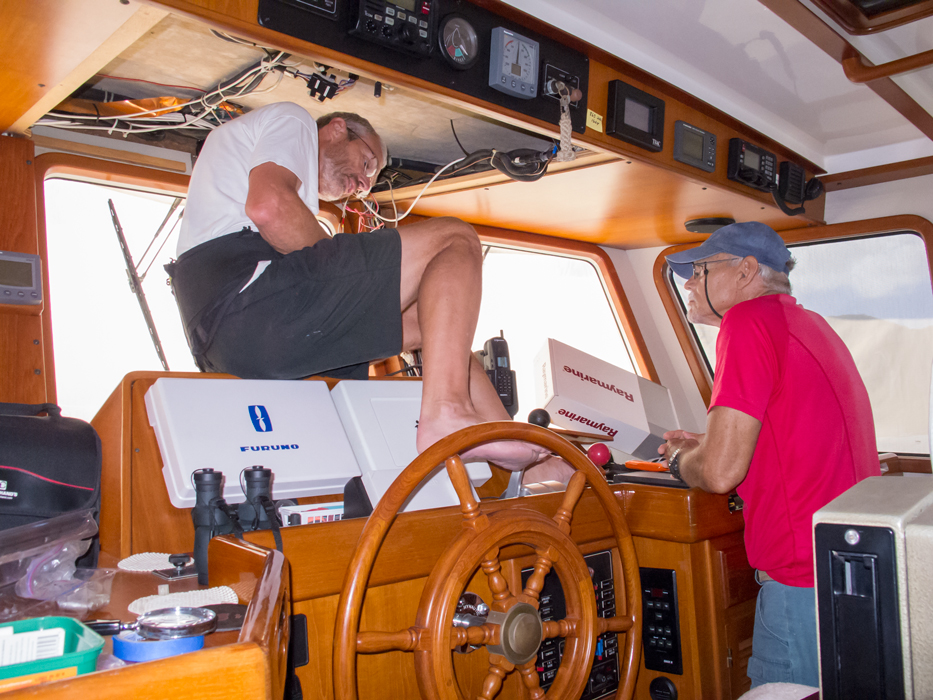
We also engaged in some major projects.  The depth sounder had been acting flaky, and an installation of a new transducer before we left Trinidad had not solved the problem.  Nor did swapping the depth instrument in the pilot house — the one into which the transducer is plugged — with the seldom-used instrument in the master stateroom.   That left what?  The Sea-talk.  So we disengaged that and ran the depth instrument in stand-alone mode, getting its power directly from the boat via a spare sea-talk plug that Hunter graciously provided.  That apparently removed the problem.  What remains now is for me to attempt to re-integrate, one at a time, the components of the original Sea-talk network in order to find the bad boy.   Why re-integrate?  Because the stand-alone configuration gives me no depth or wind indications on the flybridge, and no wind indication in the pilot house.  (I am indifferent to lack of depth indication in the master stateroom.)

The other major project was the installation of AIS on Tusen Takk II.   (A word of explanation for the benefit of land-lubbers:  AIS means Automatic Identification System.  Active systems send and receive signals; passive systems receive only.  The signals sent contain such information as the name of the vessel, the speed, the direction of travel, the coordinates, and so forth.  The receiving instrument uses that information and similar information from the receiving vessel to calculate the closest approach and the time of that closest encounter. All of this information is then displayed on a computer running navigation software, or on a chart plotter.)  At the sundowner on Nirvana a number of captains sang the praises of AIS, recounting how during night passages the unit had kept them informed of the path and intentions of the large ships that ply the seas, and had made it possible to hail an approaching ship on VHF by name, ensuring that they would answer.  When I admitted that we had no such unit, Bill (Dolce Vita) urged me to come over the next day and see his installation. As he conducted the demonstration in his cockpit, he remarked that he had another unit installed down on his nav station below, and that his new unit had replaced the old and the old had not been used for a couple of years.   He offered to give it to me, and suggested that I bring my computer over to his boat to see if it would work.  I did, and it did.

So then we had the problem of installing the system on Tusen Takk II.  The AIS unit functions as a MUX, receiving info from the vessel’s GPS at one speed through a serial connector, combining that info with the info received on a VHF (or AIS) antenna (from other, transmitting boats), and sending the info back through the same serial connector (but at a different speed) to the computer running the navigational software.   Without Bill, I would have been at a loss.   With his help, after several attempts, we succeeded in tapping into the correct GPS output and getting the unit working!   Fantastic!

(For those who are curious, the AIS I installed is a passive unit, and the computer in question is my backup navigation device, running Nobeltech 8.something on an old Dell that just keeps on ticking and running Windows XP (gakk).  When/if I upgrade I will simply need a serial-to-USB converter to get the info to the new computer running the new nav software – which will definitely NOT be Nobeltech, given their policies concerning upgrades and additions to their charts, and will definitely NOT be a Dell, given that it is not a Mac.)

Our stay in Francis was not all work.  Our neighbors got out nearly every day, either snorkeling or hiking or both.  Our projects got only somewhat in the way; we joined the crew in an expedition to explore the now-defunct Maho Resort on one day, and on another the crew took multiple dinghies to Cinnamon Bay and explored the nearby ruins and then took the more challenging path up the mountain to Centerline Road, where we turned around and came back down.

On Jan. 13 we moved over to St. Thomas and took a slip at Crown Bay Marina, where we a)  equalized the batteries, b) provisioned, c) hired a taxi to help us get our new carpets at Tropical Shipping, and d) readied ourselves and the boat for the arrival of friends from Savannah:  Beth Logan and Steve Ellis.

About the carpeting.  We sought the advice of the folks at Kadey-Krogen, and learned that a number of KK-ers had used Jennifer Highlander (carpetgirl@att.net) who works at or near Stuart, FL.   We contacted her and she agreed to help out.   We sent her patterns that we carefully cut to size on craft  paper.  We sought her advice on carpet style and color, having also sent her swaths of material from our sofa cushions and window treatments.   She ordered the carpet material, cut them to size, attached borders, and sent them and appropriate carpet padding (also cut to size) to Miami, where they were placed on a Tropical Shipping vessel and sent to St. Thomas, USVI.   We carpeted the entire boat (except the engine room 🙂  ) and are extremely pleased with the results.   Our careful creation of the patterns and Jennifer’s careful work have resulted in carpets that fit each spot perfectly.

About our Savannah guests:  tune in to the next edition of “Chuck and Barb go cruising”.


British Virgin Islands — Dec. 29 – Jan. 5, 2014

On Dec. 29 we left St. Martin at 4:00 am and travelled west 80 nm to Virgin Gorda, BVI, where we nestled in to the crowded anchorage at Vixen Point, off Saba Rock.  Our depth sounder was acting flakey, so we dropped anchor in fairly deep water.  Next morning we put down our dinghy, picked up Hunter and Devi, and crossed the Bay to the Customs and Immigration office at Gun Creek Marina.   It was a wet ride back to our boats, but we explored the southern shore of the Bay and made several stops, looking for a good place to be on New Years Eve.   We settled for the restaurant at Saba Rock, and made reservations for an early buffet dinner.  After the dinner on Dec. 31, we returned to Tusen Takk II and played some cards and Quiddler.  To our pleasure and surprise, the Terns actually hung in until past midnight, breaking their usual visiting pattern by a couple of hours.

On Jan. 1, we both moved over to Pond Bay, where we found a delightful and peaceful anchorage behind the reef.   When forecasts predicted a shift in the wind and waves a bit more northerly, we moved on Jan. 3 to a mooring off The Baths, and after going ashore and crawling through the crowded crevices of that remarkable location, moved to Marina Cay, which was not nearly so nice.

Next day we moved over to Little Jost Van Dyke and took a mooring near Diamond Cay.  We walked to the Bubbly Pond north of Foxy’s Taboo restaurant, and later that day returned to the restaurant for dinner, where the mashed potatoes that accompanied my (delicious) order of ribs inspired some mischief.  On Dec. 5 we moved to Francis Bay, USVI, checking in by phone, Barb having filed ahead a cruise plan with SVRS (Small Vessel Reporting System.)   On the way to the US Virgin Islands, as we passed Soper Hole, we noticed a very strange-looking vessel.  It turned out to be Venus, the $250 million, 260 feet-long superyacht that was commissioned by Steve Jobs.  Tragically, he died a year before the vessel was completed.  We know not the present owner.

But to learn about our experiences in the USVI, you will have to wait for the next episode of this blog.

Deshaies to Virgin Gorda — Dec. 26 – 29, 2013

On Dec. 26 we departed Deshaies at 6:20 am to begin our passages to the BVIs.   On our first day, we travelled 79 nm to anchor in White House Bay, St. Kitts.   The passage was lumpy, but not too uncomfortable.   On our first attempt to anchor, we drug.   When we pulled up the anchor in order to try again, we discovered the reason for the anchor not setting: we had snagged a large chunk of dead coral.  Attempts to dislodge the unwelcome guest with a boat hook were not successful.  Finally, Devi swam over (they were anchored right in front of us) and tied a line to the back of the anchor.  With the line secured we dropped the anchor.  That tilted the anchor enough so that the chunk became sufficiently uncomfortable and jumped off the anchor and left us in peace.   Our next attempt to anchor in a new spot was uneventful.

At 5:50 am the next morning, we were again underway.   Initially we passed Arctic Tern, but once we cleared St. Kitts, their winds were favorable and they slowly passed us, affording each an opportunity to capture pictures of the other.  Shortly after the Tern’s pass, a Brown Booby began using the solar light on our bow as a convenient perch from which to watch for flying fish.  When our boat spooked a fish, the Booby would leap off the light and chase the fish.   Soon, he would return.  When the efficacy of this approach became evident, other Boobies joined in.   The seas were on our beam, so we were doing a certain amount of rocking.   It was interesting to see how capable the Boobies were of maintaining their balance while on the light or the rail, and of how flawlessly they returned to their perch after a fish run, despite the lurching of the boat.  Not so interesting was the mess they eventually left on our deck and rails.

We spent two nights in St. Martin, having taken the opportunity to do some shopping at the new Budget Marine in Marigot.   At 4:00 am on December 29 we left Marigot and made our way downwind to Virgin Gorda, BVI, and settled in to the crowded anchorage at Vixon Point, off Saba Rock, after a passage of 80 nm.  The seas were easily 8 or 9 feet, and fairly steep, but the Krogen 48 North Sea is so comfortable in quartering seas abaft that the trip was remarkable benign.

For our account of our experiences in the BVIs, see our next blog entry.

Deshaies, Guadeloupe — Dec. 20-26, 2013

Deshaies, Guadeloupe – we have been here often, since its location renders it a convenient temporary stopping-place for over-nighting as we travel from someplace else to someplace else.  But we had never stayed for long, and had spent almost no time ashore.  This year was different, as a matter of choice and a matter of necessity.  We wanted to see some of Guadeloupe, and we wanted to hunker down in a protected anchorage while the Christmas Winds were raging.

We rented an automobile with Hunter and Devi (Arctic Tern) and spent the day of Dec. 21 touring the island.  Guadeloupe is very French; thank goodness Devi remembered enough of her high school lessons to be able to deal with the lady who delivered the auto.  That lady, like almost everyone we interacted with on the island, spoke little or no English.  

It is common knowledge that Guadeloupe is shaped somewhat like a butterfly; the west wing is the larger of the two, much more mountainous, and called Basse-Terre  and the east wing is smaller and flatter, and called, paradoxically enough, Grande-Terre.

Common knowledge not withstanding, I was surprised at how hilly the eastern half was.  As we made our way toward the extreme eastern corner, the traffic became increasing clogged.   Halfway across that eastern wing, we lost patience and turned northward and motored up to the north shore.   I had expected to see flat fields bursting with sugar cane and vegetables; instead we drove up and down forested land marked by deep ravines and high hills.   Not until we were back to the western wing did we see cane fields; this along the NE corner of that wing.

In addition to the interesting scenery, we had some enjoyable stops.  While still in the western side we stopped at a waterfall very near the highway.  Part of a national park, the “path” to the falls was paved with flat stones and protected with impressive rails.  We visited an aquarium in Pointe a Pitre and had a pizza lunch.    And we visited a rum museum, or should I write “musee du rhum”, which not only had an excellent exhibit of rum-making through the centuries, but also had a large wing devoted to insects, if you will pardon the pun, and another to models of boats.  The original rum factory owner must have been a) rich and b) an avid collector.

On another day Barb and I took an extended hike on a trail up over the mountain to the north.  Just as we reached the beach on the other side, it began to rain and we ducked into a small outdoor restaurant, Chez Samy, and said “Parlez-vous anglais?”   “Non”, was the reply, but the gentleman called over a helper/partner/friend (?) who could speak a few words of English.  We ordered a bottle of water, having not taken any with us since we had not intended to walk so far for so long.   Our translator succeeded in asking where we were from, and was pleased to learn that we lived on a boat.  He dashed off to get placemats that featured a picture of a large sailboat, and, as best as we could understand him, explained that he had been the captain/navigator/crew member (?) on the vessel when it won some type of “world championship”.  He pulled out an almost-empty bottle containing a rich red liquid, fetched some glasses and ice, and poured a little into the glasses, indicating that we should pour some of our water into the glasses.   “Sorrel?”, we asked.   “Non”, he replied.  “Groseilles. Boisson du noel.   Noel?”

“Oui”, we enthused. 

Referring to Christmas must have inspired him.  “Bon avec rhum.  Avec rhum.”

“Oui”, we enthused. 

Suddenly he dashes off again, returning with a bottle of rum and more ice.   He pours more red liquid into our glasses, adds a generous amount of rum and some ice, and dashes off to get some slices of lime.

“Mmmmm”, we enthuse.

When we have finished the small glasses, he pours us another round.  “Joyous Noel”, he says, and we respond, “Merry Christmas”.

“Poulet?” he asks, and before we can respond, grabs some paper towels and goes to the charcoal grill and pulls off two large chicken legs with huge thighs.   Then dashes to the kitchen and returns with a large white starchy vegetable, which he cuts in half and presents with the chicken, all wrapped up in the paper toweling.  Another dash, and we are given a week’s supply of baguettes. Recognizing how awkward this would be to pack way, he dashes off again and returns with a plastic bag.   Meanwhile, as all of this is going on, the original gentlemen is making grumbling noises and quietly scolding (we think) our benefactor, who totally ignores him.

“Joyous Noel”, he says repeatedly.   And then, in case we didn’t understand the context of his beneficence, says in English:  “It is Christmas.”

“Oui”, we say.  “Merci beaucoup.  Merci, merci beaucoup.  Merry Christmas.  Merry Christmas”.

As we say our goodbyes and thank him once again, he indicates that we should wait.  He gets the empty Sirop Grosseilles  bottle, dashes off to a refrigerator to get a bladder of punch, and pours punch into the empty bottle – about 2/3 full.   Nice, huh?  But wait!  He then gets the bottle of rum, and tops up our bottle with rum!

Once again we indicate our gratitude, and once again he indicates that it is because it is Christmas.

By this time it is raining pretty hard, but we are embarrassed to stay any longer, and we are very much disinclined to hike back up over the mountain.  Too far, too steep, and in the rain, too muddy and slippery.   So we walked along the road at the base of the mountain in the rain.  Much much shorter, much easier to walk.   For about half of the kilometer-long walk, Barb attempted to hitchhike.  Surprisingly, no one felt the Christmas spirit strongly enough to stop and give us a ride.  Go figure.

(We later confirmed that French “groseilles” is indeed the same as the Trini and Grenadian “sorrel” that is so popular during the holiday season.)

On Christmas eve it was blowing so hard we (the crews of TT2, Arctic Tern, and Sailacious) cancelled our reservation for dinner on shore.  But on Christmas day we hosted Hunter & Devi and Janice & Steve (Sailacious) for dinner on Tusen Takk II.  I cooked a pork loin on the grill and our guests brought side dishes and wine.   After dinner we played Quiddler.   Very fine holiday.

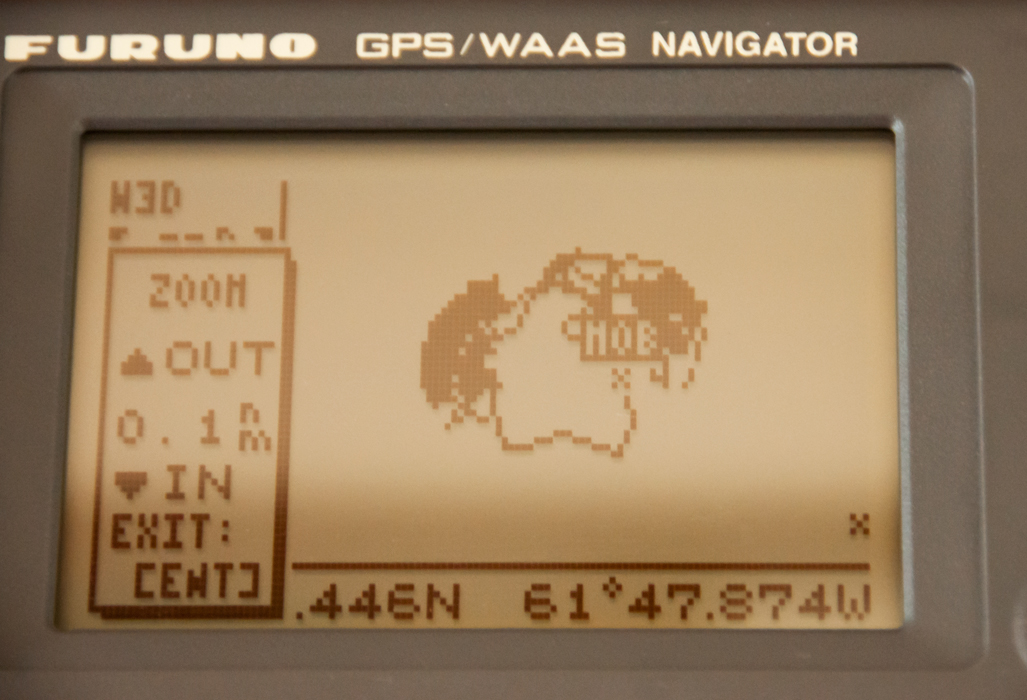
The wind mostly blew like stink while we were in Deshaies.   Except when it didn’t.   Sometimes it got still, and sometimes it even shifted to the west.  (See the picture below of the GPS screen that we leave on while anchored; the unit traces out our location as we swing.   Normally this produces a “smile”, but during our stay in Deshaies we traced out a circle with the center also filled-in.)

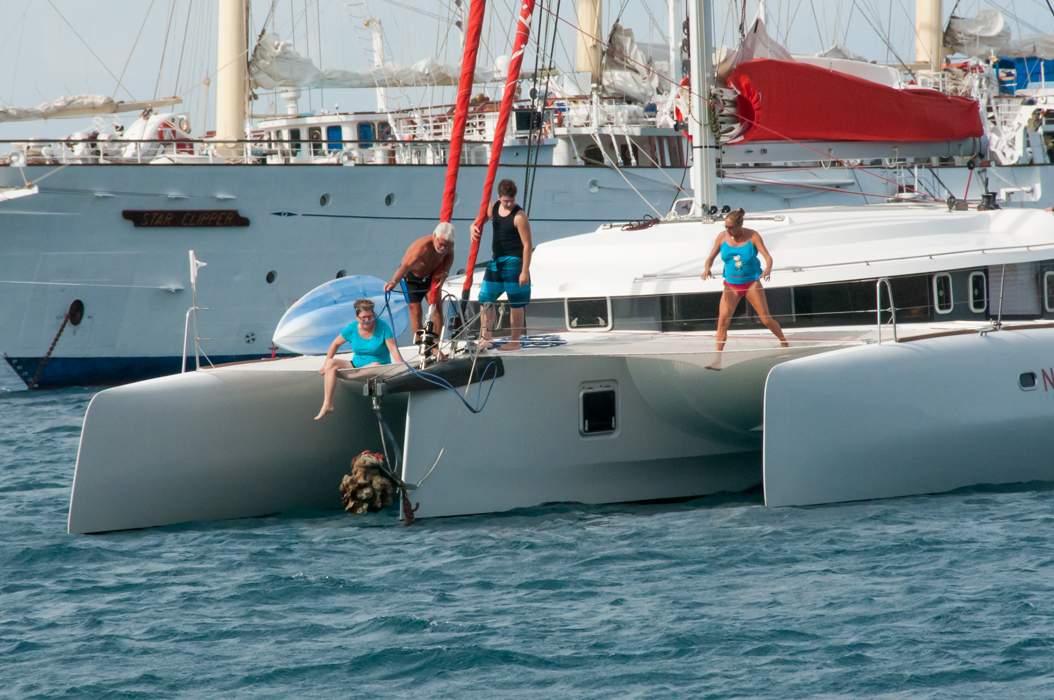
On one especially windy day we noticed that a large catamaran was attempting to leave the anchorage, but had something fouling their anchor.  We took the dinghy out to see if we could help.   But we could not make the French captain understand that he should back into the wind so that we could approach the anchor and help untangle it.   The wind was blowing so hard that we could not stay at the anchor so long as the cat was pointing directly into the wind.  After several unsuccessful attempts to help, during which the wind would grab the dinghy and push us under the cat and away from the anchor, we finally gave up.   We think that they gave up as well, and left the anchorage with the fouling chain and concrete block still stuck to the anchor and dangling from their bow pulpit.

C’est la vie!  Non?


Les Saintes, Guadeloupe — Dec. 17-20, 2013

Our stay in Les Saintes was brief, but fun.  The differences between the French islands and the former British ones are striking, and perhaps never more so than when the island is Les Saintes, the Frenchiest of the French-Caribbean islands.  Besides the language and the food, the country is cleaner and neater, with far less junk and debris lying about.  The homes are larger and better maintained.

Along with the Terns we had a number of walks, some short and some a bit more ambitious.  We walked to Grande Anse, in the area of the airport, and on another day most of the way up to Fort Napoleon.  We took a number of short excursions into the village for grocery shopping and/or lunch.  On my 70th birthday on Dec. 19th, the Terns treated us to a marvelous dinner at the Petits Saints restaurant,  Tre bon!

On Dec. 20 the winds changed direction enough that the Saintes anchorage became rolly.   Besides, during our stay when the wind was not blowing, the particular design favored by the French for moorings meant that we had a heavy metal ring banging on our bow when TT2 got too close to the buoy.  We tried wrapping cloth around the ring to provide some cushioning, but had little luck in keeping the cloth in position.  So, knowing that Deshaies had no moorings, and hoping for less rolling, we ventured out into the angry seas between the Saintes and Guadeloupe.  Good thing it was a short passage before we got behind the lee of Guadeloupe.  I will say no more.

See our next post for our experiences in Deshaies/Guadeloupe.

Dominica — Dec. 14-16, 2013

Before we left Dominica, we had a few more experiences that are worth mentioning.

Barb and Devi paid another visit to the town market, where they noticed that the fish vendors are selling lots of Lion Fish.  And the Terns and the Takks took a maxi up to the area of Ross University, with the intention of enjoying some pizza at “Tomato”, but learned from maxi riders that it was temporarily closed since the University was out of session.  A passenger who got off with us told us about an alternative pizza joint, so we went there.  Not quite the same.  We sat at the single rickety picnic table outside the shop (no inside seating).  The pizza was mediocre at best, but the real problem was that a number of rats — some big and some small — kept running back and forth under our table.  Can you picture Barb, shuddering with fear, sitting with her feet up, choking down dry cheese-less pizza?

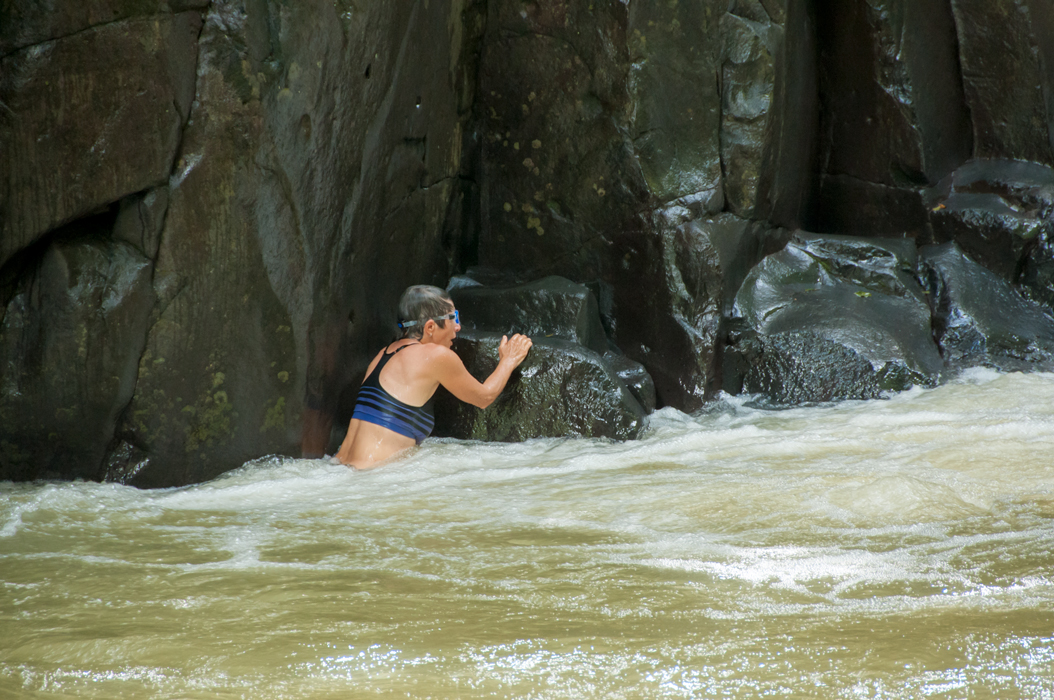
On another day the Terns and Takks caught a maxi up to the NE village of Bense.   From there we walked — first on a paved road, then on a dirt road, and finally through dense forest on a foot path that took us over a small river (jumping from rock to rock) and along another river that brought us to Chaudiere Pool.  We had taken along swim goggles in the expectation of seeing fish in the pool, but alas, a construction project upstream had clouded the river with mud.  Not to be deterred, Barb got wet and the Terns got frisky, swimming against the strong current and jumping/diving into the deepest portion of the pool.  I took pictures.  🙂

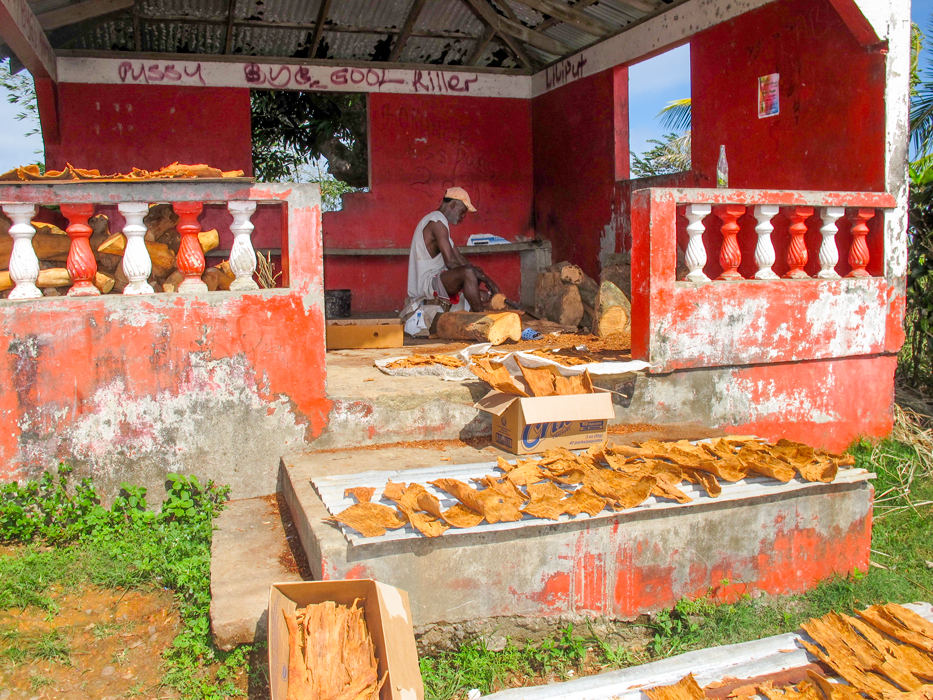
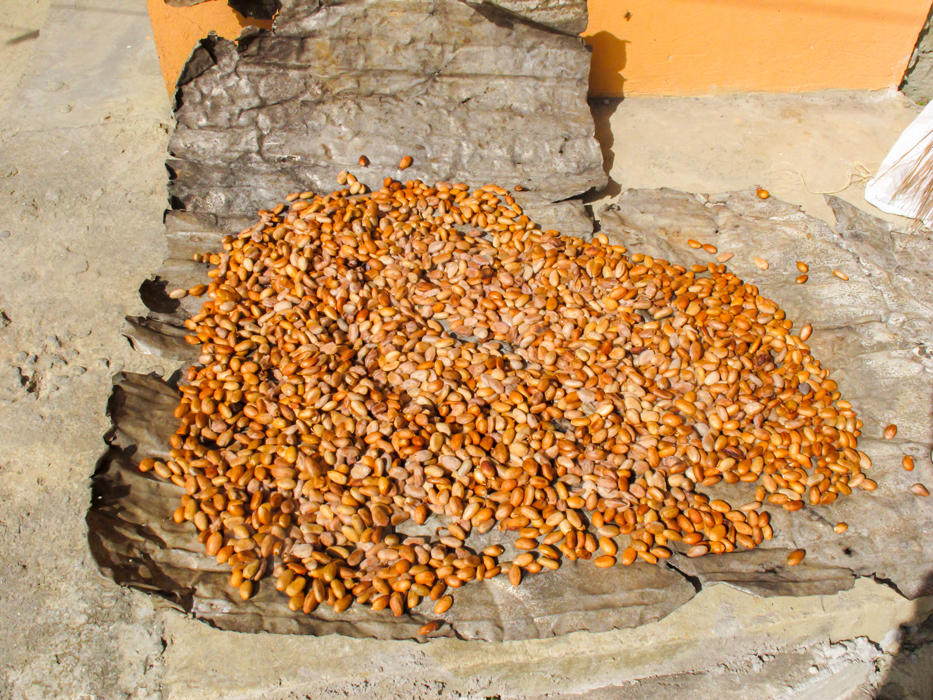
Back in Bense, we enjoyed cold drinks and speaking with the locals, some of whom were making cinnamon by stripping bark off small logs.  There was also a collection of cocoa beans drying in the sun.  Great hike and great experience.

Dominica — Dec. 6-15, 2013

The Christmas Winds (see previous post) have created rough seas and frequent squalls, so we have been hunkered down in Prince Rupert Bay, Dominica, waiting for better conditions.  We have been to the local market, where almost all offerings are island-grown.   We have dinghied and hiked to the area of Ross University (site of a two-year medical school) where we did some shopping at a modern supermarket and had lunch in a food court with many stands featuring island food and catering to students.  We hiked in the Cabrit National Park where we once again enjoyed Fort Shirley.

When the boat-boy association (PAYS) decided not to host their traditional barbecue on a Sunday, citing the bad weather and the paucity of would-be attendees in the Bay, Barb stewed for several days and then sought and received permission to use the PAYS Event Centre for a cruiser potluck.  She and Devi took our dinghy around the anchorage and invited everyone to join in, rediscovering in the process the differences found in the social mores of different nationalities.  The Canadian and USA crews, as well as several others, were appreciative participants.   The French could scarcely conceal their scorn as they declined the invitation.

Did I mention the rain?   Almost every day, multiple times.   One day it rained so hard and so long that Portsmouth experienced floods:  a creek/river near the University was so swollen that it overflowed a bridge for the first time in fifty years.   Today, Dec. 15, there are no squalls so far, but the wind is gusting above 31 km.

The Tern’s dinghy had developed a crack in the bottom, so water could seep into the space between the bottom and the dinghy floor.   When this happens, the extra weight results in a very heavy and sluggish dinghy.   Hunter and I had repaired our dinghy several years ago in Bonaire, so we knew just how to effect a repair.  We used the davit and lifted their dinghy up onto our upper deck, and every morning we have been in the dinghy repair business.   As this is written, the repair is complete, two coats of  paint have been applied, and the dinghy will splash tomorrow after the paint has dried.  (You will notice an absence of the “middle” steps in the dinghy repair pictorial chronicle below — both Hunter and I were too busy laying in increasing-sized cloth to stop for pictures.)

The way to fix a dinghy is not / to get yourself a stool / but draw a line around the spot / and call it beautifool

(My apologies to e.e. cummings)