St. Lucia – May 30-June 17, 2013

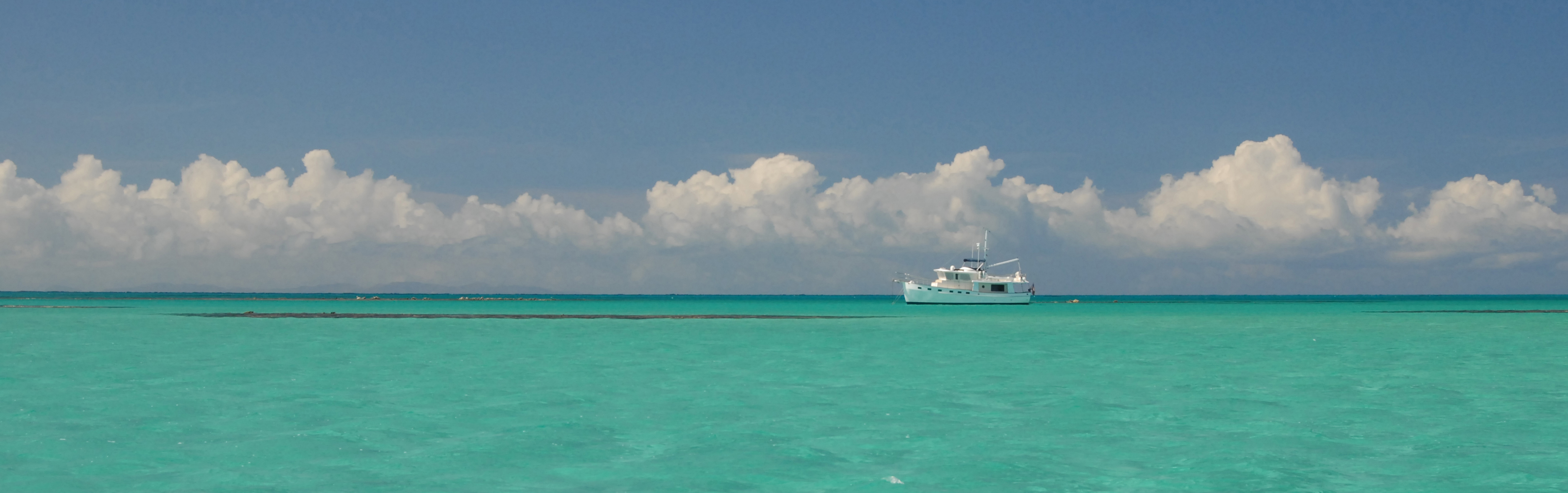
On May 30th we grew impatient with waiting for “trawler weather” and instead departed during a slight lull in the conditions that have characterized this Spring, the windiest, as a friend recently observed, in seven years of cruising the eastern Caribbean.   Since Le Marin is in the southern part of Martinique and Rodney Bay is in the northern part of St. Lucia, the 26 nm trip was without the benefit of an island to be leeward of.  Rather unpleasant trip.  Just as we arrived at Rodney Bay, the trip log maxed out at 10 thousand miles for the second time since we bought the boat in April, 2005.  Time and distance have certainly flown.

The winds have persisted pretty much unabated since we arrived, so we have been in St. Lucia longer than we expected or wished.  On June 6 we took the boat in to Rodney Bay Marina, where we equalized the house battery bank and commissioned “Vision” to wax the hull.  We had no sooner gotten settled in to the Marina when we looked up and saw another Kadey-Krogen 48 North Sea arriving at the Marina:  Ann Louise with Ann and Bill Miller aboard.  A rare sight indeed.  (They were under pressure to get to Grenada to meet guests; we look forward to spending more time with them when we catch up.)

When we returned to the Bay on June 8, we had to anchor at the north end of the bay, since the center and southern portions were the venue for a large regatta of youths on Optimists and Sabers.  On June 11, after the conclusion of the races and after we had moved back to the southern part of the anchorage, we noticed some activity on a nearby catamaran.  We could see that someone was being removed on a stretcher.  Barb grabbed a few shots on my camera, and then I took a few more when the Police arrived.  We learned later that there had been a shooting and that one person had been taken to the hospital in critical condition.  Later reports circulating through the anchorage were that a note had been found, and that the injured person had been shot in the head in a suicide attempt.  I posted to the Facebook group “Coconut Telegraph” the pictures and a short blurb from a St. Lucian newspaper, and the post began immediately to attract Facebook comments of concern and sympathy, followed by an incredibly insensitive “joke” about there now being one fewer catamaran to drag onto neighboring vessels, which itself then attracted scolds of outrage and anger.  Tired of seeing my pictures associated with the original “joke” and its subsequent venom, I removed my original post, which had the desirable effect of removing all of the associated comments.  But the controversy lived on, revived by the wife of the original  “joker” posting an irrelevant and gratuitous attack on cruisers for being excessively Politically Correct and for not having the courage to venture out to new venues and instead just cruising up and down the Caribbean chain year after year.  After more scolds and more outrage, that post also disappeared, having been removed by its author or one of the group moderators, I know not which.

On June 12 the Terns and the Takks moved down to Marigot Bay.  Barb and I finally were able to dine at the Rain Forest Hideaway, where we were greatly impressed with the service, the food, the presentation and the live jazz, the latter being a feature on Wednesday and Saturday evenings.  Next day both vessels moved down to take moorings between the Pitons, a lovely spot described by Devi as “in the cleavage”.  As we have many times before, we contracted with Peter, the head ranger at the St. Lucia Marine Management Area, to take us for a dive.  This time we dove one of our favorites:  Superman’s Leap, named thusly because one of the movies  (Superman II) featured Superman leaping off Petit Piton, as well as scenes shot in the nearby Diamond Botanical Gardens, which we also visited this time while we were in the area.  (An aside:  The film starred Christopher Reeve – nominated Best Actor — in one of his memorable roles.  Other shooting locations for the film included Canada, Paris, and Norway.)

We had intended on continuing southward after exhausting our two-night minimal mooring permit, but a consultation with updated weather forecasts made it clear that the expected weather window had disappeared and/or had been pushed back almost another week.  The winds coming down between Petit Piton and the Petit Mitan ridge to the south were extremely gusty (often in excess of 30 knots), so we decided to go back to Rodney Bay to await the weather window.   And that is where we are now, awaiting a weather window that keeps migrating.  While waiting, we have been busy socializing:  card games on shore and on the boat, a trip to pizza, attending a farewell party held at the Yacht Club for the departing Manager of Rodney Bay Marina, a trip to the East Indian restaurant Razmataz and other fun activities.  The gentle reader will have to see the next installment to learn if or when we ever leave.

Martinique – May 18-30, 2013

On May 18 we motored the 36 nm down to St. Pierre, Martinique.  In the past we have had some rolly experiences at St. Pierre, but this time it was nice and calm.  When we arrived we learned that a heritage celebration was to begin that day, so we walked up to the ruins of the theatre and found a tent and seating erected in what had been the foyer.  Unfortunately, the performance, which consisted of a long and dramatic soliloquy accompanied by a busy percussionist, was entirely in French.  We were seated much too close to the front to consider leaving early, and anyway it was fun to watch the audience react to the performer.  As we were heading back toward the dock we encountered a parade filled with bands and people costumed in a manner clearly intended to evoke the heritage of the island.

Next day, the Takks and the Terns walked northward out of town and visited the Earth Sciences Centre, not to be confused with the Pelée eruption museum that is up on the hill overlooking the bay and is much closer to the center of town.  To get to the Science Centre, one walks along the road toward Précheur, crosses the bridge into the Fort District and passes the ruins of the Fort Church.   Eventually one arrives at the Centre, instantly recognizable by its imposing modern boxy construction.  We had read that hand-held audio devices were available for English translations of the extensive exhibits; alas, they were not functioning when we arrived.  The pictures were interesting anyway.  There was also a nearly one-hour long film about Pelée and other volcanoes, also in French, but thankfully accompanied by large legible subtitles.  Very well done, unlike the lousy film we saw some years ago at the Volcano center in Montserrat.

On the way to the Centre we passed a tree that was alive with colorful and noisy birds high up in a tree.   I returned later and took some of pictures of what turned out to be Village Weavers.  Imports from Africa, they are said to be common and widespread in Hispaniola, but are otherwise not found in the Caribbean except on the north end of Martinique.  As I photographed the birds it soon became apparent that only the males were busy weaving new nests; the females merely stood off and watched the activity.  Does that seem fair?

When St. Pierre was destroyed by the eruption of Mount Pelée in May 8, 1902, there were 13 vessels in the then-busy harbor.  All but one sank; the remaining 12 now serve as a seductive attraction for those of us who scuba dive.  Many are too deep for normal non-decompression dives, but one large vessel sits upright with its bow just at the limits:  the Roraima, 400 feet long and 65 feet wide.  Although it sits in 165 feet of water, the attached mooring line runs down directly to the bow, the top of which is listed at 115 feet.  Barb doesn’t like to dive wrecks, and is especially disinclined to dive deep ones.  Hunter, always a generous and accommodating man, had little interest in the dive, but when he learned that Barb had turned down the opportunity:  “not just ‘no’, but ‘hell no’”, he volunteered to accompany me.  We were submerged for only 21 minutes total, including going up and down and hanging on the line for a safety stop on the way up.  When we reached the wreck I dipped down to circle the bow and my computer registered 135 feet maximum depth, a figure that suggests that my computer has begun registering depth inaccurately.  With the dive so short, there wasn’t time to see much; the most salient feature was the presence of at least a dozen huge lionfish hanging at the bow.   We came up with lots of air still in our tanks, but with our computers showing that we had been right at the limit of our acceptable nitrogen levels.   Ah well, at least we can brag that we have dived a casualty of the famous Pelée eruption.

On May 20 we moved 15 nm down to Anse Mitan, where we went ashore and did some modest sightseeing on foot.  While there, we also checked in to Martinique, the office in St. Pierre having been closed either for the weekend or a holiday during our entire stay.  We stopped at a vegetable and fruit stand, where a very friendly lady sold us a number of items, all of which were so delicious that I was almost tempted to return back after we had gone further south.  And a gregarious man showed me his fishing nets and the fish and fish soup he was preparing on a small fire on the beach.  All of this in French of course, with a bit of broken English on their part and no French on mine.  On the 22nd we moved 5 nm to Grande Anse D’Arlet, where we also did some walking.  And then on the 23rd we traveled the 15 nm to the outer reaches of the bay at Cul-de-Sac du Marin, where we could continue to get cooling breezes but were protected from waves by a series of reefs, and where the waters are much cleaner than the eastern anchorage with its hundreds and hundreds of vessels.

On the 25th we hosted a “noodle party”.   We provided the rum drinks and threw lines with floats out behind our boat so that the guests would not be swept away.  Everyone brought his/her own noodle for floatation.  Arctic Tern, Zero to Cruising, Aries Too, Oceana, Nahanni River, and a lady from Brazil on Tauà all participated.

After waiting for days for the winds to subside, we departed Marin on May 30, headed for St. Lucia.


Dominica – May 12-18, 2013

On May 12 we motored the 23 nm from Les Saintes, Guadeloupe, to Portsmouth, Dominica, arriving on a Sunday afternoon when the customs office was closed.  Not to worry; we were directed to a residence near the customs dock where we found a pleasant young woman who provided the appropriate forms for checking in.  Contrary to what we had recently read, we had no problem checking in and out simultaneously, being careful to make the checkout date no more than two weeks out, and lying through our teeth about our intentions to visit any of the southern ports of the island.  (The published discussion concerned whether or not one could do both at the same time if one admitted to planning to visit southern ports as well; the upshot of the discussion was that it should be perfectly permissible according to the Dominican regulations, but that some customs agents were erroneously not permitting it.)  We were disappointed to see that Dominica is back to using umpteen carbon copy forms instead of the newly resurrected computerized eSeaClear forms that were formerly available in the EC countries, and that were in the process of being reintroduced in Antigua when we were there.

We attended the Portsmouth Association of Yacht Security (PAYS) BBQ Sunday evening and learned that the event had been cancelled the previous week for lack of cruisers.  No problem on our night, the anchorage was plenty full of boats heading south.

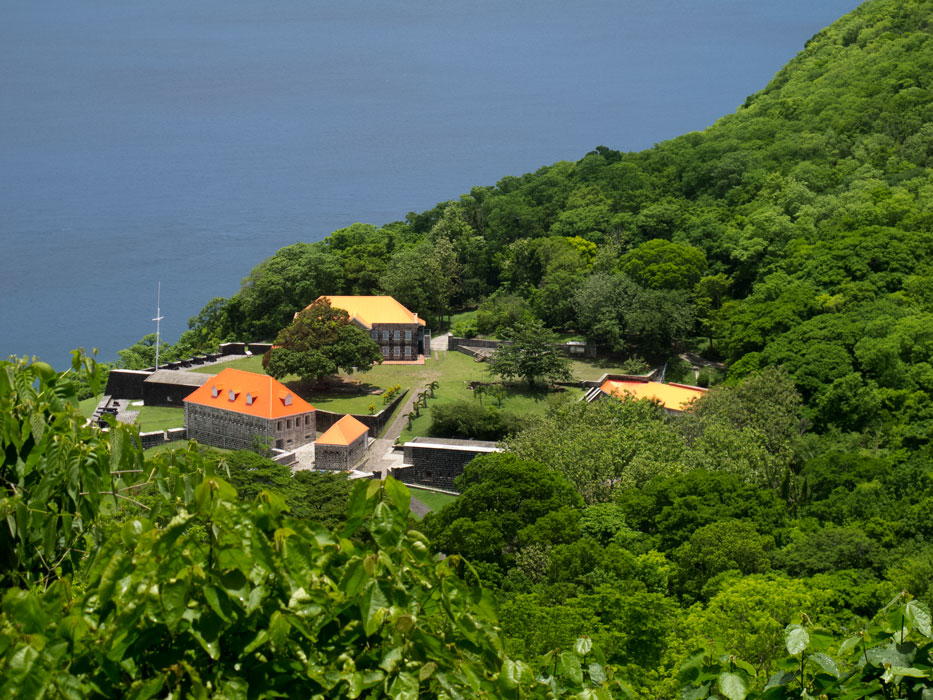
We had lots of rain while in Portsmouth, but managed to go for a walk with friends to Fort Shirley in Cabrit National Park during a lull one morning.   The fica-entangled stone ruins at the north end of the park never cease to fascinate, and there are marvelous overlooks from both the west and east ridges.  Early one morning, during one of the many squalls that struck our anchorage, I looked out of our port window and discovered a catamaran was dragging down upon us.  I quickly ran to the pilothouse and gave a series of short blasts on our horn.  Fortunately, the cat was occupied and after a bit several young men came boiling out and soon enough got their engine started and the boat moved well forward.   Many of our friends have been struck or had near misses; after eight years we have still not been hit by a dragging boat, although we were once struck by a sailboat attempting to enter a slip adjacent to ours at a Trinidad marina.

On one rainy morning Hunter and Devi (Arctic Tern), Steve and Ann (Receta) and Barb and I were taken by Martin (Providence), one of the founders of PAYS, to snorkel in the reef and rock formations south of Rollo Head.  Fascinating submerged terrain and well worth the long trip across Prince Rupert Bay.

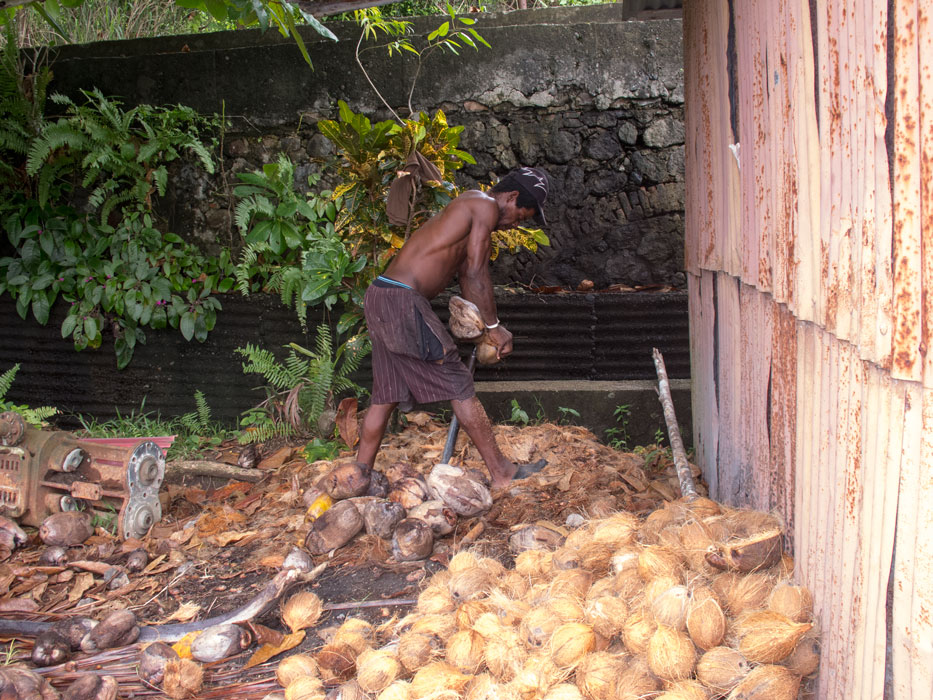
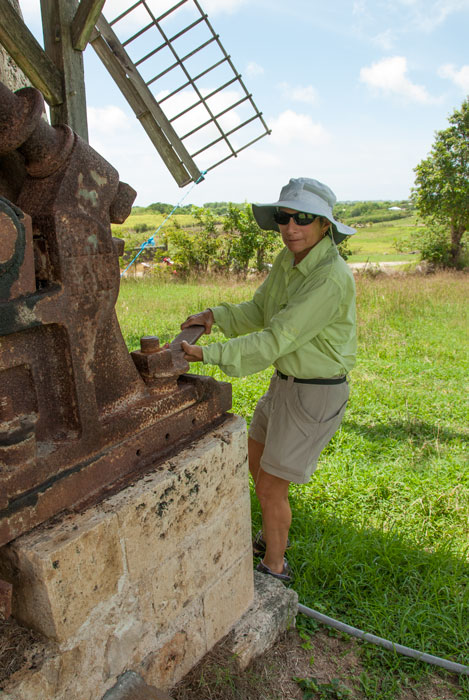
On Wednesday, May 15 the Terns and TT2s travelled 11 nm down the coast to anchor at Mero, off the now-closed Castaway Resort.  We took the Tern’s dinghy ashore and walked north on the coastal highway up to the Macoucherie rummery, hoping to find the ancient factory in operation.   Alas, we were there at the wrong time of year.   The office was open, however, and we were granted tastes of their products laid out in a very minimal tableau.  Not surprisingly, the entire yearly production is consumed locally.  The factory has existed since slave days, and in fact was constructed by slave labor.  When in operation, the squeezing press is powered by a water wheel turned by flow down a diversion channel.  While we were looking around, we noticed coconut shells were being flung from behind a small building.  Barb took her camera around the corner and discovered the source, which can be seen in one of the photos below.

Next day we motored down to Roseau, where the Terns and we were secured to moorings owned by Aldive, south of Roseau proper and Sea Cat’s dock.  As we were completing our mooring chores, a RIB approached and we were introduced to Roscoe, the security man for the Roseau anchorage.   Roscoe stopped by a number of times while we were in the mooring field.

We did a one-tank dive in Scotts Head Marine Park aboard Aldive’s boat that afternoon, and a two-tank dive the next day.  I took my housed Nikon down with me on the three dives; I have included just a few of the pics I was happy with.  During our surface interval between the two dives on the second day, we had some excitement.   A small green boat with a new 70 hp outboard came past our boat and landed on the rocky shore.  The two occupants jumped out and soon disappeared behind the large boulders at the bottom of the steep cliff ashore.  Immediately a large Coast Guard RIB with powerful motors zoomed by us and landed next to the green boat.  Several officers bearing machine guns jumped ashore and also disappeared behind the boulders.  Another officer boarded the small green boat.   So far as we could see no one was apprehended.  The green boat was confiscated.  Later we heard that “contraband” had been found on the green boat.  Roscoe said that “weed” had been found.

The Terns and Takks also hiked up to a factory in Roseau that employs vision-handicapped individuals to weave baskets and other items.  It was a return visit for us both; TT2 has a large basket in the cockpit that is used to store shoes and sandals.  On our return from the factory we each purchased pieces of barbecued chicken at a roadside grill.  In all of our travels up and down the eastern Caribbean, we have never had a problem with eating local foods prepared at such stands, and we have had some mighty tasty experiences.

On May 18 we left Roseau and Dominica and motored down the 36 nm to St. Pierre, Martinique.  But before we could leave, we had one further complication.   When we had arrived, we had been asked to use extra-long painters to attach to the oversized mooring float.   During our stay, the shifting winds had sent us circling the float so many times that our painters were hopelessly entangled around the float and could not be retrieved.   Arctic Tern, of course, had long since departed.   Barb called Aldive on the VHF, and Billy, the owner and son of Al, came out and after a long struggle managed to free us.  (Billy named the dive operation after “Al” to honor his father, who had taught him how to dive.  Passing it on, Billy teaches local youths how to dive, and after they have become dive masters, hires them.  Our young dive master was Ruddy, a buoyant, mischievous and impertinent young man who enjoyed taunting one of the black Coast Guard officers.  Shouting across to shore: “Hey fat man, how come you not climbing up the hill?  You let the white (said in creole) officer climb the hill, but you are too fat?”  When the officer had had enough, and demanded Ruddy’s name, Ruddy gave him his father’s name: the father who had abandoned his family when Ruddy was a boy, the father who had trafficked in drugs, and the father who no longer lived on the island.  When we asked Ruddy if it was wise to taunt a Coast Guard officer, Ruddy just smiled and shrugged:  “We have free speech here in Dominica.”

But I have digressed.   To learn about our experiences in Martinique, you will have to tune in to the next exciting episode of … um … you know what.

Ilet des Saintes — May 6-12, 2013

On May 6, we left Anse Canot, Marie Galante, and motored downwind and westward back to Ìlet des Saintes.  Arctic Tern, as usual, had departed before us and was already settled into the mooring field at Terre d`en Haut when we arrived.  The mooring buoys there, as in other French islands, feature a heavy metal ring mounted atop a metal stem protruding from the top of the float, and no painter.  So a vessel with a high bow, such as our beloved Kadey-Krogen trawler, has some difficulty getting attached.  Hunter, well aware of our problem, was already standing by in his dinghy in order to help feed our painters through the ring and back up to the Admiral on the foredeck.

We like Terre d`en Haut a lot, but had not spent much time there in recent years.  So when I suggested that we walk to lunch to a restaurant I remembered fondly for its menu, but not so accurately for its location, I led Arctic Tern and Bodacious on a wild goose chase before conceding defeat and “settling” for Douceur de I`Isle, near Baie de Pompierre, where we each had a satisfying meal.  On another day, after Arctic Tern had departed for Portsmouth, Dominica, TT2 and Bodacious tried again, and had success on the road to Grande Anse, just opposite the cemetery.  Alas, I still can not call up the name of the restaurant.  But it is good.

And speaking of restaurants, when Ann and Steve (Receta) arrived, we joined them for dinner at La Saladerie, where we had a marvelous meal.  The restaurant is also an art gallery; the owner Edouard has filled the walls with his creations that have earned him fame in France and sales worldwide.

We also did some diving in the Saintes.  Arctic Tern, Bodacious and TT2 first dove below Pain de Sucre, and the next day the southwest corner of Ìlet à Cabrit.  Jack joined us for a third day of diving at Pain de Sucre, and Barb and I dove there yet one more time the next day.  On those last two times, I took my housed Nikon down with me.

After Arctic Tern had left, and before Receta had arrived, Bodacious and TT2 pulled the dinghy up on the south beach of Ìlet à Cabrit and followed the trails up to the ruins of the fort on the island.

On May 12, Receta and TT2 left the Saintes and moved the 23 nm to Prince Rupert Bay at Portsmouth, Dominica.  As we left the mooring field, we passed by the magnificent square rigger Sørlandet, whose home port is Kristiansand, Norway, home of many of our Norwegian friends.

Neither vessel got so much as a nibble on our fishing lines as we traveled south to Dominica.  But to learn about our activities in Portsmouth, one must tune in to the next exciting episode of “Chuck and Barb go cruising.”


Guadeloupe/Marie Galante — May 1-6, 2013

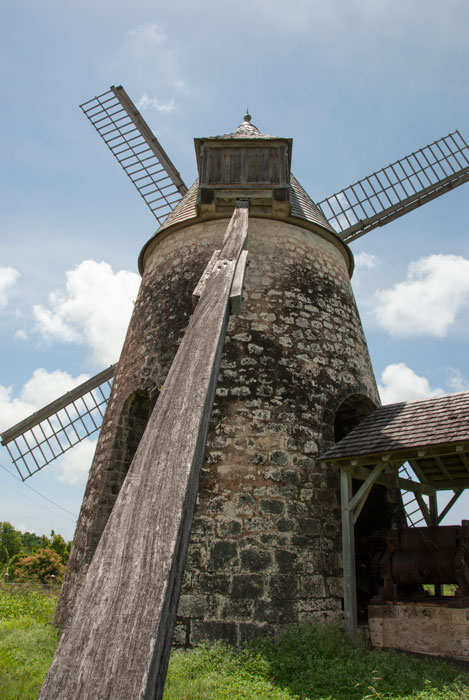
When the Antigua Classic Yacht Regatta concluded, we hung around Falmouth Harbour for a few more days, waiting for better weather for our trip southward.  When we could see that a weather window was on its way, we moved back up to Jolly Harbour, where we did some last-minute provisioning and cleared out with customs.  On May 1 we motored down to Deshaies, Guadeloupe, arriving early enough to go ashore, check in, and see a little of this charming little village.  On the way down we caught another Sailfish, and once again, intimidated about the prospect of getting injured while attempting to release it, I decided to use a gaff to land it.  Next day we continued south, stopping for a dive at Pigeon Island before continuing on to Iles des Saintes.  With the forecasts promising especially mild weather for the next few days, we decided to visit for the first time yet another island of Guadeloupe: Marie Galante.  We were joined in the expedition by Arctic Tern and Bodacious.   As is their wont, Arctic Tern was well on their way before we on TT2 had even cleared the sleep out of our eyes and breakfasted.  Bodacious brought up the rear.  Our initial destination was Grand Bourg, the main town in Marie Galante.  When we were about half-way there, Arctic Tern reported that the enclosed harbour looked much too small to accommodate our three vessels, so we all diverted to St. Louis, the main yacht anchorage and the second-largest village on the island.  Next day, we all went in early and rented scooters from two adjacent vendors.  Jack and Jo (Bodacious) were tandom on a larger scooter.  The rest of us were solo, with Hunter also on a larger bike.  The scooters were easy to master and a blast to ride.  Plenty of power, handlebar brakes, and automatic transmissions.   We circumnavigated the island in a clockwise manner, with a major diversion at one point to find our way to a windmill that we could see in the interior.

Our first major stop was on the northeast side of the island at Gueule Grand Gouffre, a round sinkhole that features a rim about 200 feet high with an arch at the bottom opening to the sea.

We had lunch at a restaurant at Capesterre, right beside an extensive and beautiful beach.

We stopped at two rum factories.   The first, Habitation Bellevue, had a nice tasting station and gift shop.  There were trailers arriving with cut sugar cane, and all phases of the production cycle seemed to be underway.  Fermentation vats were bubbling away.   Others were being filled.   Some were being cleaned in preparation for the next batch.  Cane was being fed into the presses that squeeze out the juice.   Fermented juice was being distilled.  And everything was open, with no apparent restrictions on where an observer could go.

At another rummery, much smaller and more primitive, it was apparent that the cane is delivered by old-fashioned wooden-wheeled carts pulled by oxen, and that the cane is fed to the press by hand or pitchfork.   As we arrived, everything was being shut down for the day, so we could not stay and observe the processes.

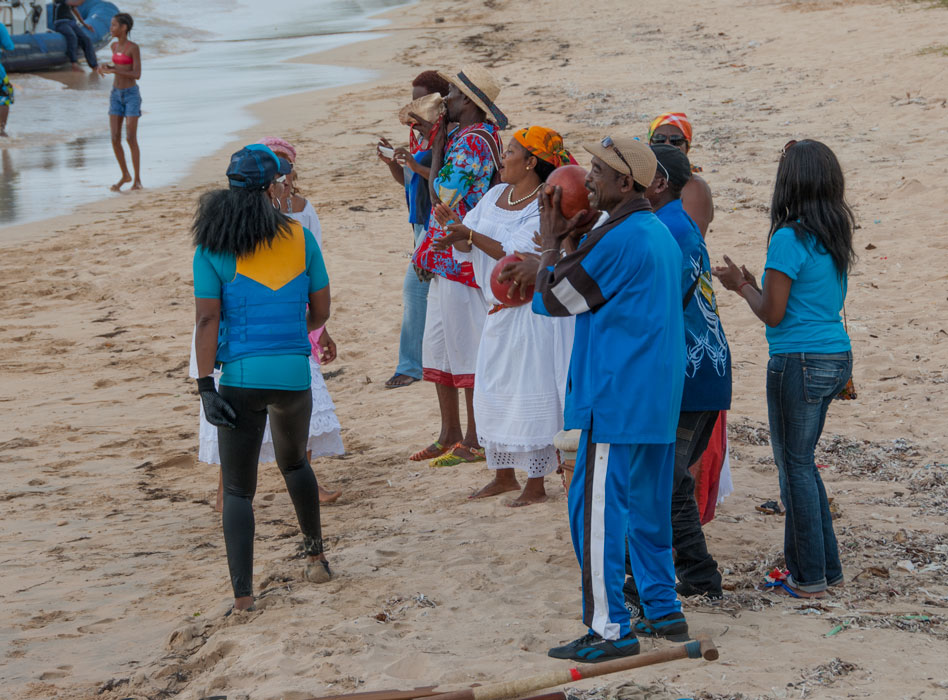
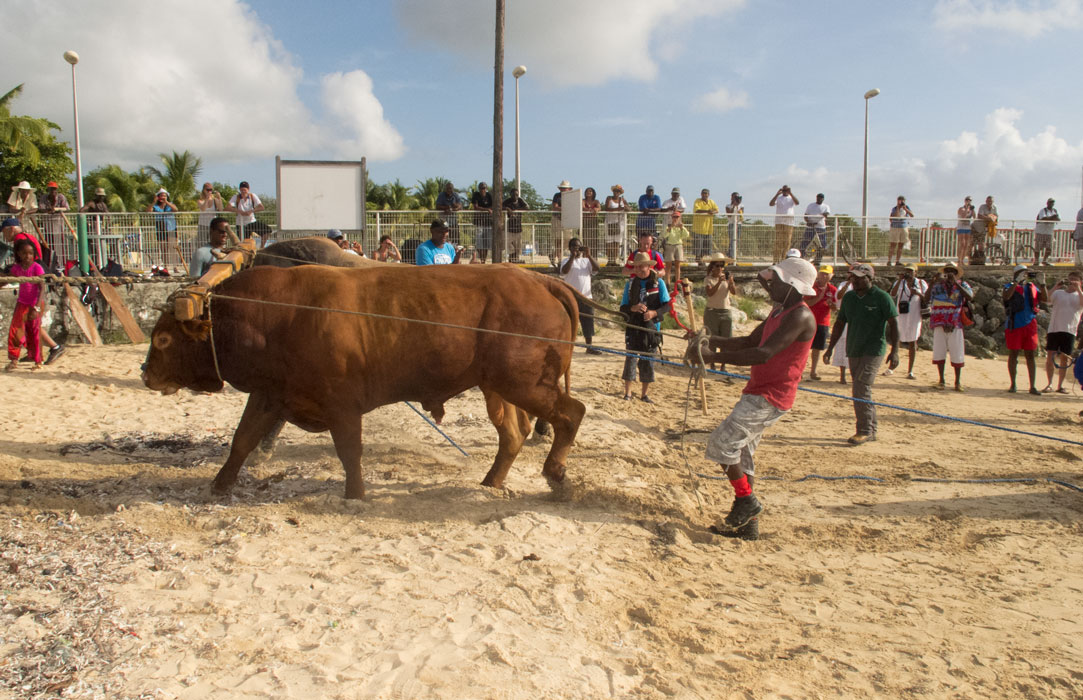
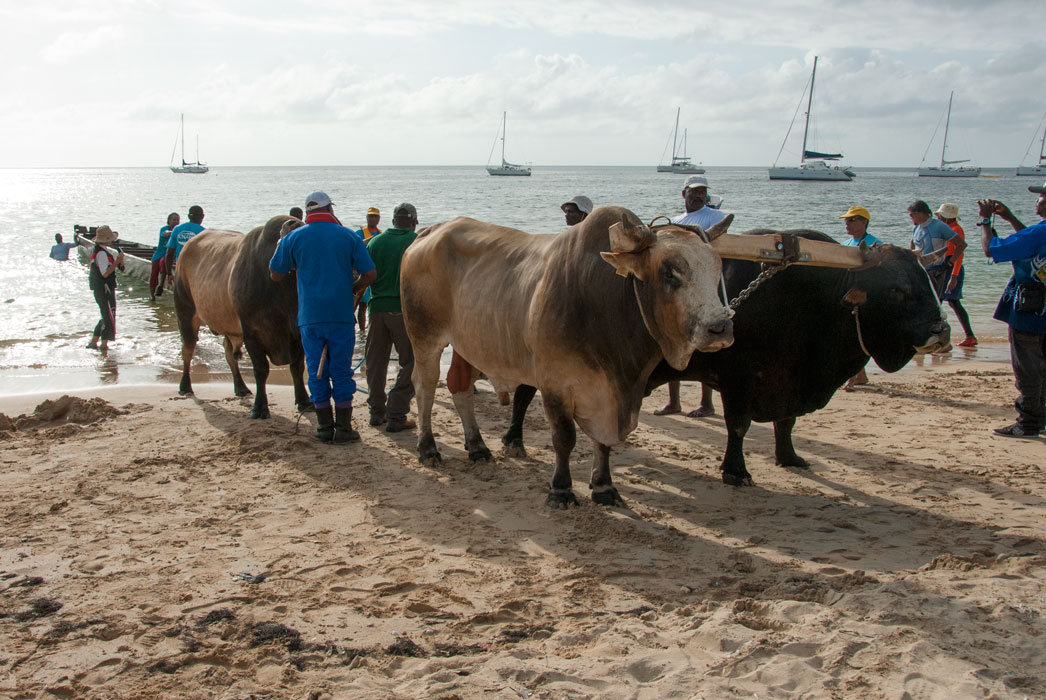
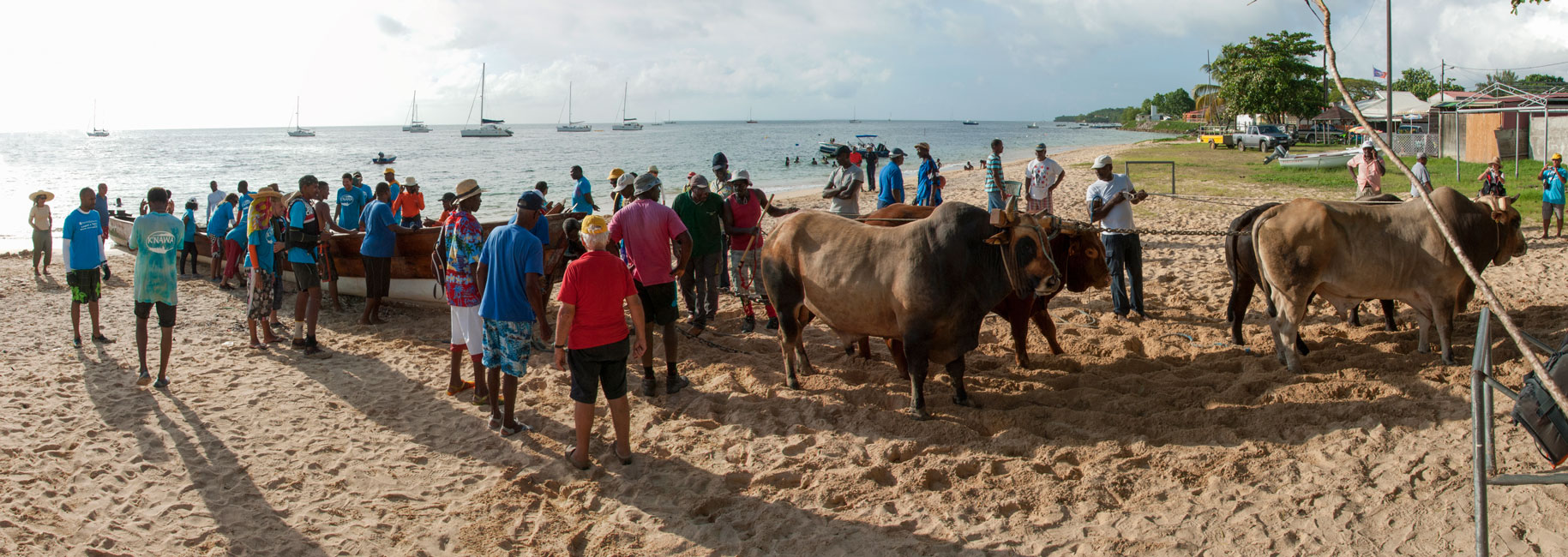
We were required to return our scooters by 4 pm.  Afterwards, as we strolled toward the town pier where our dinghy was tied, it became apparent that a crowd had gathered at the base of the pier and on the adjacent beach.  Chanting and singing and blowing of conch.   We soon realized that the crowd was there because a long dugout canoe had just arrived at the beach.  Posters on the side of a small building revealed that the canoe was a reproduction of the kind that had been used by Arawak Amerindians for ocean-going passages.   And then we noticed that yokes were being affixed to two pairs of ox bulls.  The yokes were set upon the necks of the bulls just behind their horns, and were then securely tied to the horns.   Each bull had a large nose ring, to which was attached a long rope that ran up over the forehead of the bull and then up over the bull’s back.  Verbal commands, reinforced by pressure applied to nose rings, were used to control the bulls.   As we watched, the oxen teams were positioned in front of the canoe and chains were attached to the yokes.   The lead team’s chain was attached to the rear team’s yoke.   The rear team’s chain was attached to a line that was tied to a ring near the bottom of the front of the canoe.   When all was arranged, commands where shouted, control lines were tugged, and the canoe and teams surged forward.   When the canoe was about three-quarters ashore, the line attached to the canoe broke.   After several attempts to refasten the line, aided by Hunter who jumped in with his handy Leatherman tool to cut off the old knot, the canoe was brought fully ashore.   A remarkable and unforgettable spectacle.

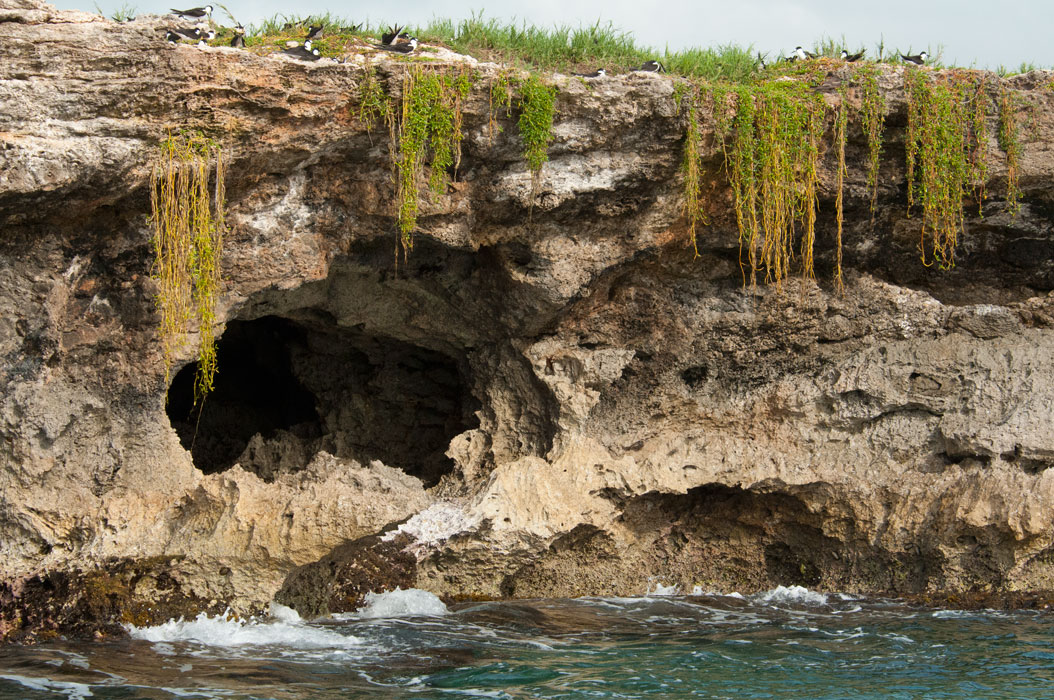
The next day we all motored north a few miles to anchor near Ilet du Vieux Fort, where we had heard there was good snorkeling.   As we approached by dinghy it became apparent that the island was teeming with nesting Bridled Terns.   They seemed unperturbed by our presence, so we anchored our dinghies and had a marvelous snorkel, circumnavigating the small island.   The west side was especially captivating, filled with arches and eroded caves.   Later I returned with my telephoto lens and took a few pictures of the birds.   When we returned to our boats, we found that the anchorage had become somewhat rolly, so Tusen Takk II and Arctic Tern moved one harbor south to Anse Canot, where we found blissful comfort.   Bodacious had her stabilizing fish out.   Although intended for stabilization while underway, they provided just enough area and weight to render sufficient at-anchor stabilization in the captain’s judgment to render a move unnecessary.

Next day, May 6, we all moved back to Les Saintes.   But to read about our adventures there, the gentle reader will have to tune in to the next exciting episode of “Chuck and Barb go cruising”.


Antigua Classic Yacht Regatta — April 18-23, 2013

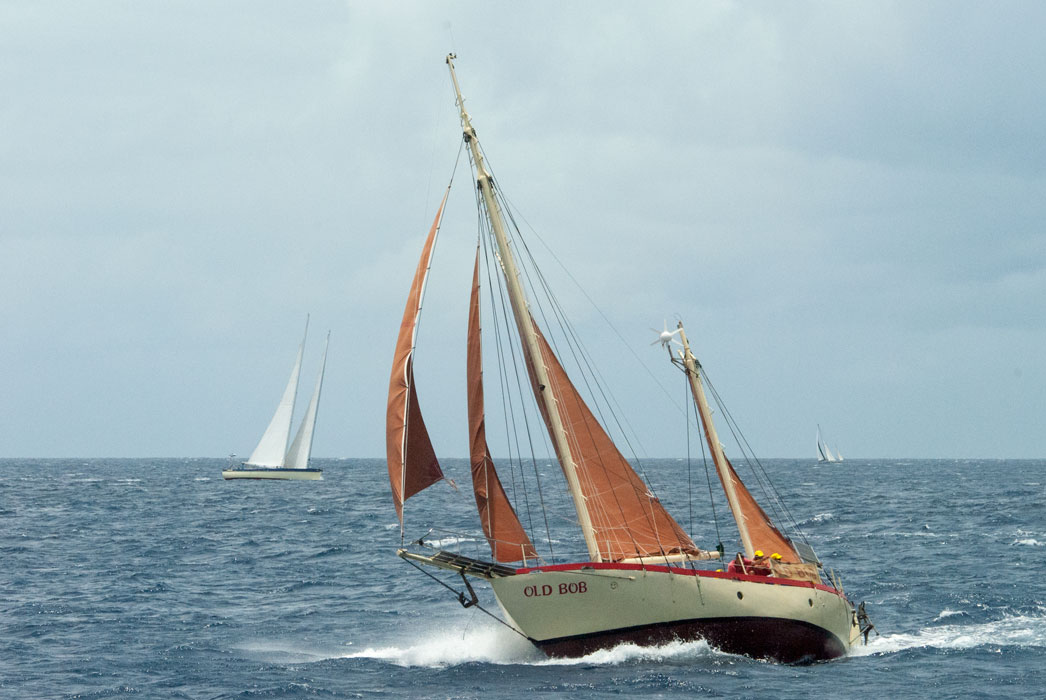
As faithful readers already know, we timed our stay in Antigua to include the Antigua Classic Yacht Regatta.  Not because we are avid sailors, but because so many of our cruising friends would be there at that time.  Besides, it is a colorful event.  “Classic” in the strictest sense would be defined as a vessel built in the 20s or 30s.  The expanded definition for the purposes of the regatta includes boats built using modern materials but having the fine lines of Classics.  And finally, the regatta definition includes the traditional workboats of the past that are now being used as yachts, such as the Carriacou sloops.

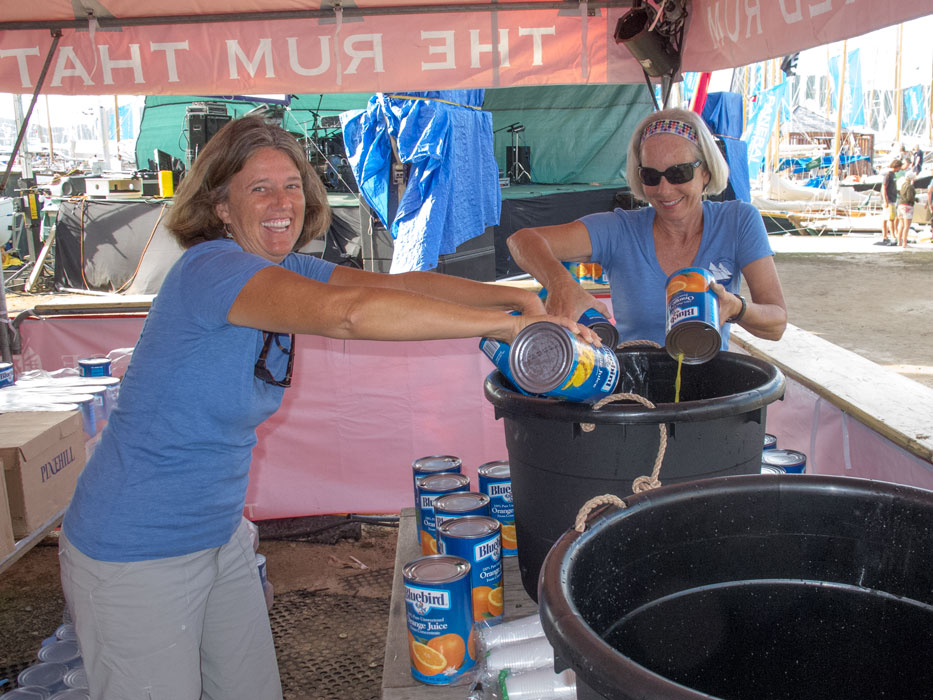
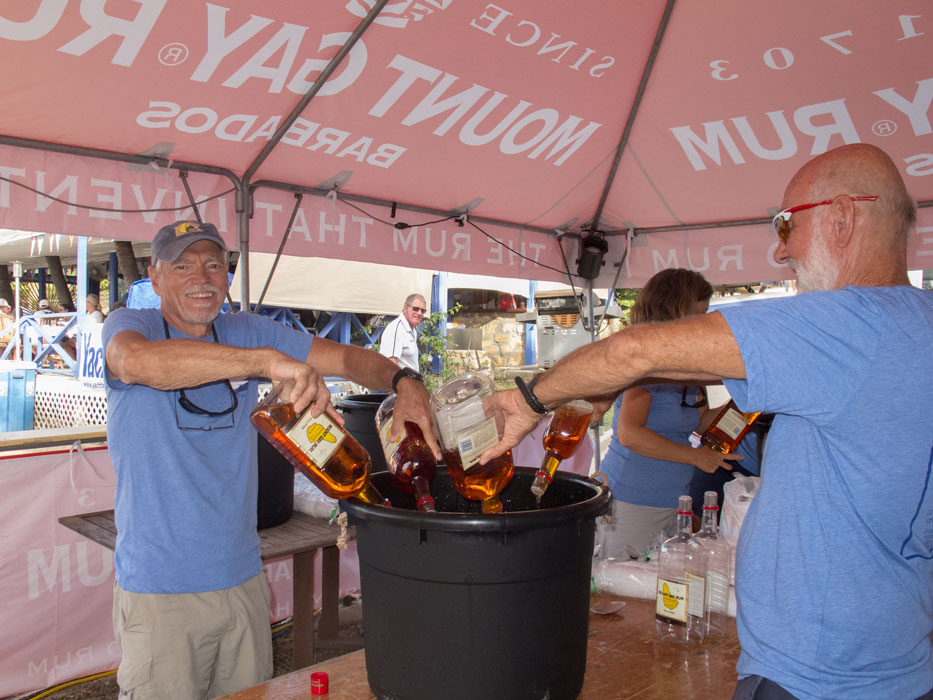
Some of our friends were able to find vessels willing to take them on as crew; many others were volunteering for shore duty as support staff.  Barb and I volunteered as well.  Barb thought she would mostly be manning a reception desk or serving drinks or food, and I was signed up to help vessels get in and out of their slips by using our dinghy as a “bow or stern thruster”.   As it turned out, when I got a chance to get on a press boat in order to photograph the event, I curtailed my thruster duties and switched to photography.  One day on a press boat and another on friend Jack’s Krogen 39 Bodacious, the latter on a very windy day that saw at least three vessels break their masts.  In addition to her other duties, Barb took over the thruster duties, much to the amazement of some of the more sexist owners and observers.  Our most memorable assignment was to create the complementary rum punch for one of the many parties that occurred; we shared that duty with John and Kathy (Oceana), mixing four huge tubs of punch, which of course had to be tested for goodness before opening the gates to the thundering crowds.

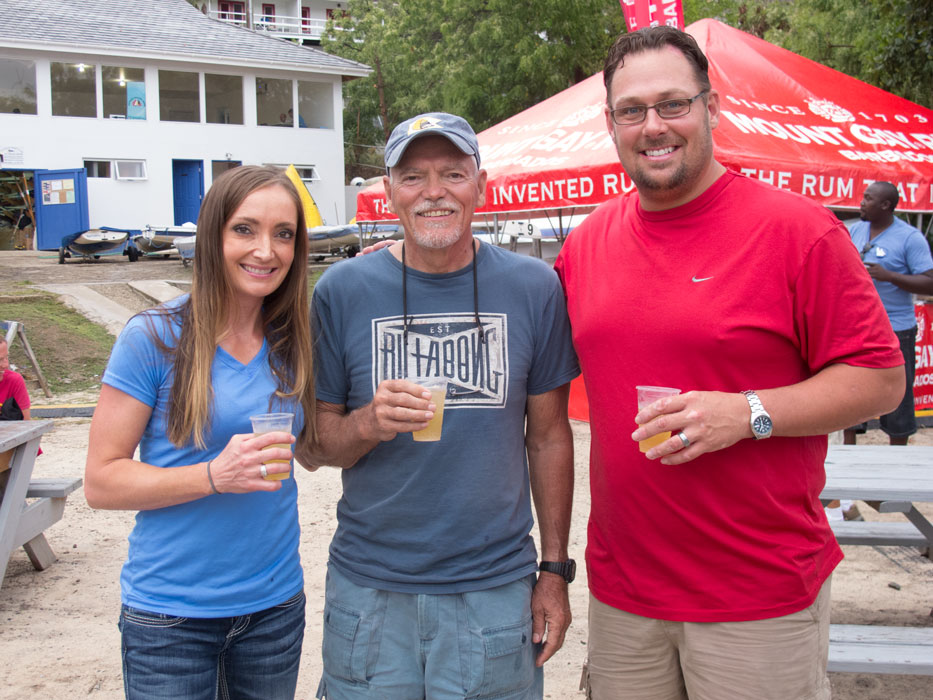
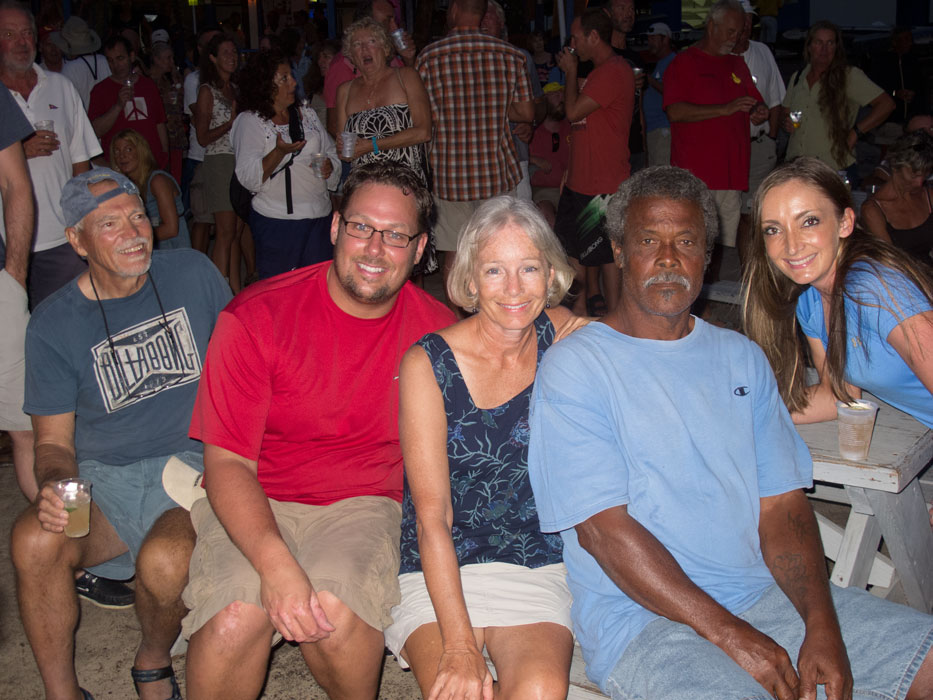
Panerai, maker of expensive watches, was one of the sponsors.  Every afternoon they served free drinks and nibblies in their hospitality lounge.  On Sunday night the Sail Maine sponsors served “our” rum punch and a delicious lobster bisque with pieces of fresh baguette.  If a small bowl of bisque wasn’t enough, one could go back for seconds, or thirds, or fourths.  Barb had so many servings of the bisque as well as rum punch that she got sick in the middle of the night.  I was just fine, having stopped at four of each.

On the afternoon of the last day of racing, there was a boat parade of the competitors in and out of English Harbour.  Next day, there was a reprise of the trapeze act that had been hosted by the competitor Tree of Life as it traversed the parade. Mount Gay Rum one night had a party in which they distributed the coveted red caps, earned by purchasing a sufficient number of Mount Gay drinks at several different watering holes throughout the week.  And on the last day, there was a tea in the garden at English Harbour, during which all women were encouraged to wear colorful dresses and hats.   Also at that venue during the tea were dinghy rowing and sculling contests.

Attending the regatta was a great deal of fun.  I am certain that our livers will eventually recover.


Cathy and Jon Dockter Visit – Antigua, April 12-19, 2013

Niece Cathy and her husband Jon left a late Midwestern snowstorm and arrived with luggage bulging with items we had purchased from the States and had pressed them into delivering.  A spare hydraulic arm for the stabilizers, a replacement wifi antenna, a 90-day supply of one of my anti-arthritis drugs (and a couple of other less-important drugs), a packet of marking pencils for recording fish counts during dives, a pair of sunglasses for the admiral, and the re-conditioned underwater housing for my camera.  Whew!

We had originally proposed that they join us in St. Martin and accompany us down to Antigua.  But the timing was wrong.  Good thing we later suggested an alternative.  We were concerned that we might not be able to get to St. Martin on the schedule they proposed, and suggested that we instead meet them in Antigua. They would not have been happy passengers.  Our three-day voyage (see previous post) to Antigua turned out to be lumpy, and the seas stayed that way for their entire visit.  So much so, that we had to abandon our intention of spending just a couple of days at the Classic Yacht Regatta and then moving to more remote anchorages on the northeast corner of the island.

Cathy and Jon were a super couple to host.  Congenial, helpful, warm and up for most anything.  We hiked up to Shirley Heights for the Sunday barbecue, took the bus to St. John and Jolly Beach, attended bunches of Classics parties, took a short trip out in the dinghy to watch the regatta, went out another day in rough conditions with Bodacious to watch the start of the race, played some Mexican Train on board, and generally acted like Antigua tourists.  We regret not being able to provide as much sea, snorkel and sun time as they probably had expected, but hope they had as much fun as we did.

In the album, below, pictures marked with “(JD)” were taken by Jon on his iPhone.

USVI to Antigua – April 3 – 12, 2013

On April 3rd, we said goodbye to Charlotte Amalie and motored over to Christmas Cove.  We spent two nights there, and then moved to Francis Bay, stopping along the way at Caneel to briefly moor the boat while we dinghied in to Cruz Bay for a final pickup of mail and some grocery shopping.  When we arrived at Francis we provided Hunter and Devi (Arctic Tern) and Paul and Susan (Island Roamer) dinghy transportation to the Maho Bay Resort for our last-ever Friday-night partake of prime rib at the resort, not because we expect never to return to Francis, but because the resort has lost its lease and must vacate by May 1. Horrible news.  It will be sad to see the little tent-cabins replaced by upscale private housing; it will be sad to no longer have the prime rib; it will be sad to no longer be able to watch the fascinating glass blowing that was hosted every Friday night after the meal.

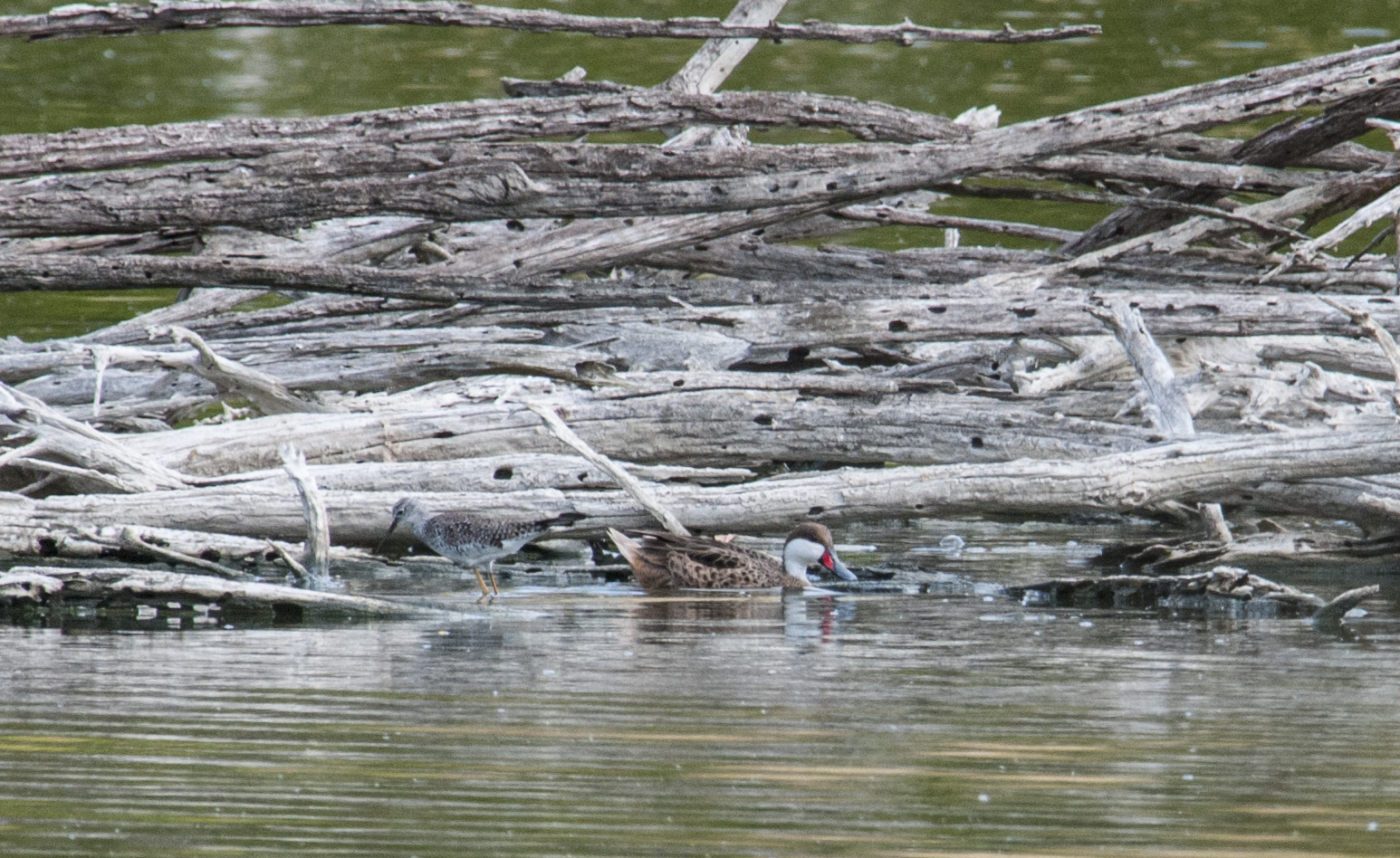
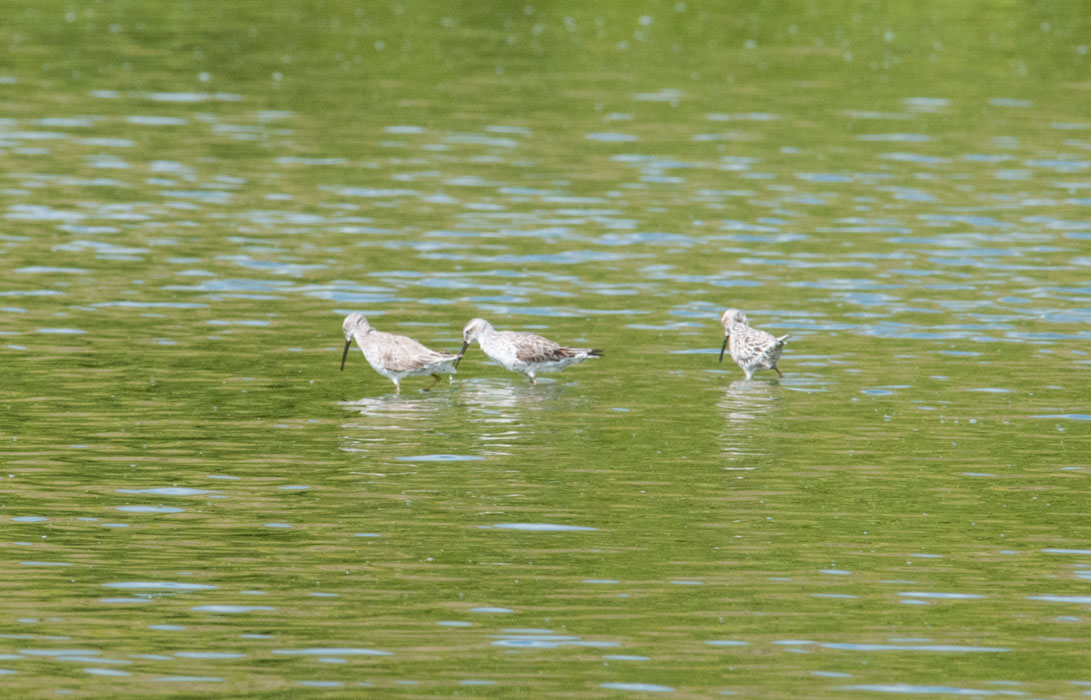
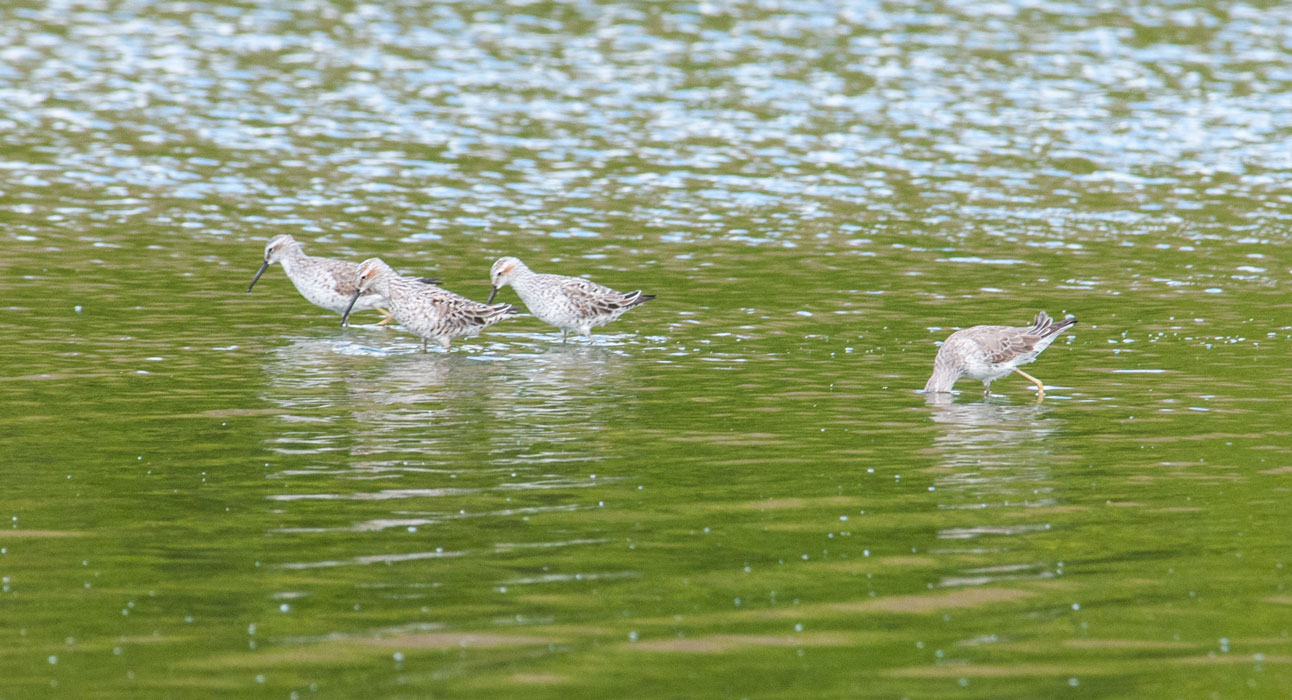
Saturday I finally got over to Francis Pond to attempt to photograph the White-cheeked Pintails that I had seen there much earlier in our stay in the Virgins. Procrastination is a strategy that I have often employed with considerable success, but it failed miserably on this occasion. We have had very little rain, and the pond had shrunk both in circumference and in depth. There were wading birds out in the middle, but at first no pintails.  Finally I noticed movement WAY off on the other side, where presumably the water was deeper.  See the disappointing pictures, below.

Early Sunday morning (at 3:08 am) we set out for St. Martin.  We had been watching closely the weather forecasts, since the howling winds had been predicted to slack only slightly for two days in the near future.  Originally we planned on moving up to Virgin Gorda on Sunday in order to shorten the distance to St. Martin, but when a last-minute weather check indicated that Sunday looked as good as the predicted lull of Monday/Tuesday, we decided to strike out between Salt and Peter Islands of BVI toward St. Martin.  It was a lumpy ride, all the more so since one of the stabilizers failed only a couple of hours into the trip.  We disabled that side and continued.  Midday we were passed by Maltese Falcon, also heading toward St. Martin, but making considerably better time, their retracted sails notwithstanding.

I was able to replace the hydraulic arm when we reached St. Martin after a 96-nm trip of 15 hours and 25 minutes. Next morning the wind/waves were still higher than is completely comfortable, so instead of getting up super early and slogging directly to Antigua, we opted to head to St. Kitts.   That added about 10 nm to the overall distance to Antigua, but meant that we would only be out in the washing machine conditions for about 64 nm, arriving at our intended anchorage in St. Kitts after 9 hours and 40 minutes. We anchored in White House Bay, one among 16 vessels.  Next morning, on our way to Antigua and out about one hour from the anchorage, we heard Arctic Tern unsuccessfully hailing Unicorn. We hailed Arctic Tern, and learned they were just outside Basseterre, several miles up the western coast of St. Kitts.  Their intention was to check in to St. Kitts and wait for better conditions to proceed to Montserrat, and to get some rest, since they had motored directly from North Sound, BVI, having departed sometime in the darkness early Sunday and just arriving in St. Kitts shortly after daylight on Monday. We learned later that Unicorn had opted to sail instead of motor, and when wind angle had not cooperated, had diverted to St. Martin.

Our trip to Antigua was uneventful, if once again a bit uncomfortable. 48 nm in just under 8 hours.  We anchored in Five Island Bay, nestled up close to the resort – close enough to get gratis wifi using just our computers’ antennas, a “good thing”, since our external wifi antenna failed this season.  Next morning we moved around to the outside approach to Jolly Harbour and took the dinghy in to check in. Yes, we took the dinghy.  The customs nazi “lady” infamous for being a – um, I cannot use that word in our blog – has been transferred elsewhere and replaced with a thoroughly friendly gentleman. So, no more silly requirement that the vessel has to be within sight of the customs dock in order to check in. There were quite a few folks ahead of me in the line; apparently Antigua is attempting to use eSeaClear again, and there was some kind of problem with the computer or its data so we were all reduced to filling out umpteen copies by hand.  But we learned from the gathering that cruisers planned to assemble that night for dinner at the adjacent restaurant Port Afina.  Bill (Dolce Vita) made the arrangements.  About 26 of us, arranged in tables for six.  Each table received three pizzas: pepperoni, cheese and veggie.  Two types of pasta and salad served buffet style.  Quite good food, and quite a party.

In other news, the dredging of the channel into Jolly Harbour appeared to finally be getting started on our last day there.  We had read that it would start on March 25, and then that it would start on April 2.  So actually starting on April 12 was something of an accomplishment.  There also appeared to be a lot of construction going on in the area; there were backhoes on tracks working on the hills both to the north and to the south of the channel.

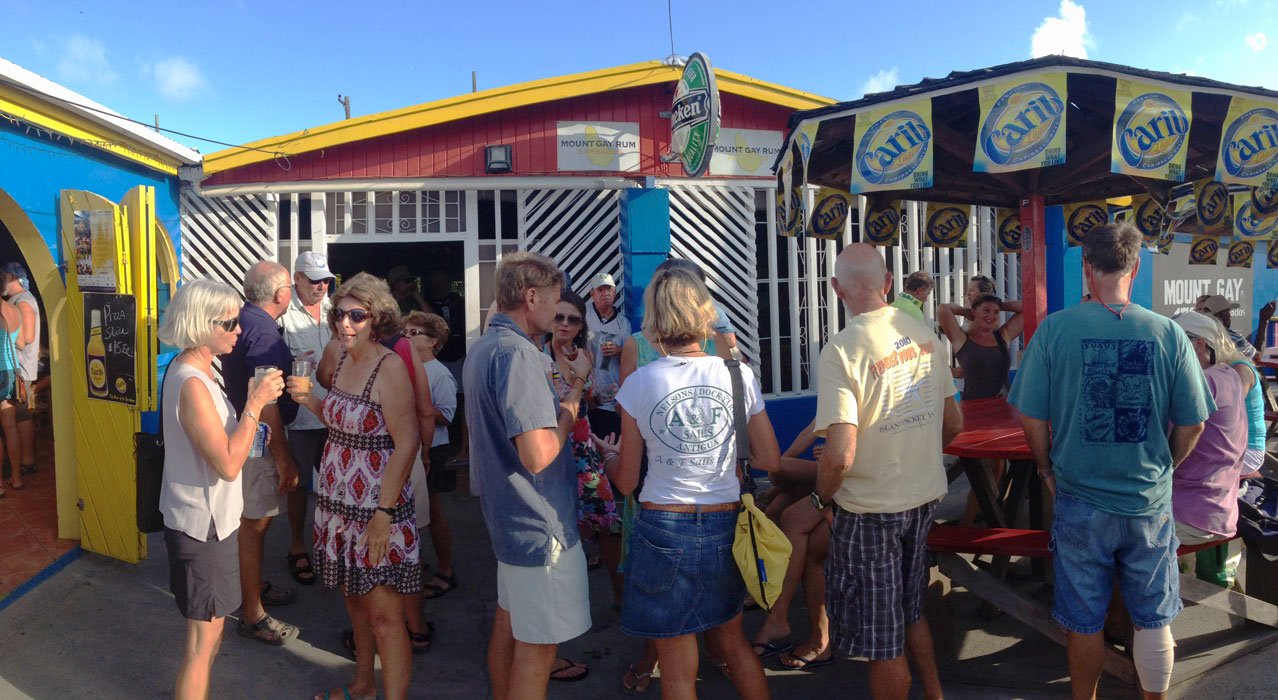
On Friday, we moved into Falmouth Harbour, where we anchored near many cruising friends, all here for the approaching Classic Yacht Regatta.  We joined many of those friends at The Mad Mangoose, the venue for the first of many rum parties at which a ticket is given for each rum drink ordered.  When enough have been collected, they can be redeemed for a coveted red cap sporting the notations “Mount Gay Rum” and “Antigua Classic Yacht Regatta”, and the year of the event.  Redemption occurs on Friday, April 26, at a party entitled, naturally enough, “Mount Gay Rum Red Cap Party”.

Wedding Bells – USVI, Mar 27-Apr 2, 2013

When we left Road Town on the 27th, we went back to Charlotte Amalie, to await the arrival of Barb’s niece Stephanie and her fiancé Raoul. They were coming to St. Thomas from Wichita in order to get married and spend ten days on a honeymoon, and we were going to be their witnesses and photographers. We picked them up by dinghy at Yacht Haven Grand on Mar 29th, and took them to Tusen Takk II for a quick tour before heading to Christmas Cove to spend the afternoon snorkeling, relaxing and having lunch. That evening we all took advantage of “hamburger night” at Shipwreck restaurant back in St. Thomas. Saturday was the wedding, which took place on the beach of Bluebeard Resort. In addition to the presiding minister and ourselves, the other person in attendance was John, a friend of Raoul’s and a local musician, who has traveled the world over performing at festivals, pursuing surf waves, and snowboarding.

Readers of the previous post will wonder how I could photograph the wedding, since I had not yet received my replacement Nikon d200. Earlier that day I had purchased at one of the duty-free shops of St. Thomas a new Nikon d300s, which will definitely NOT be used for underwater photography.

Saturday night the newlyweds treated us all to dinner at Enkai, probably the best sushi restaurant in St. Thomas. Monday night we had the happy couple out to the boat for dinner, and afterwards taught them Mexican Train dominoes.

When not getting married or spending time with us, Steph has been completing her certification scuba dives, so she can now join Raoul in their combined honeymoon/dive vacation.

PS: Sunday, March 31, was the birthday of my beloved mother. Ninety-four and going strong.  When I called her to convey birthday greetings, she told me that she had come from good stock; one of her female forbears had lived to be 100, and had died not from disease or old age, but from being attacked by a bull! Stay out of pastures, Mom!

Complications — Virgin Islands, Mar 20–27, 2013

After the departure of Mom and Sis, we did some re-provisioning and laundry, and then on Mar 22 left Charlotte Amalie and traversed up to the BVIs to do some diving.  We checked in at Soper’s Hole, and then moved over to Norman where we dove Angelfish Reef, in the extreme southwestern corner of the island.  The winds were just enough north of east that the site was protected, so we spent the next two nights anchored in adjacent Privateer Bay, thereby avoiding the noise and mooring fees of the Bight.  We were able to refill our scuba tanks at Sail Caribbean Dive Shop, Pirates Bight Branch.  On the 23rd we dove Ring Dove, just outside the entry to the Bight.  On the 24th, Spyglass Wall, on the north side of Norman.  On the 25th we got bogged down with chores and getting tanks refilled, and on the 26th we dove the southeastern corner of Pelican, the small island just east of the Indians.

We enjoyed all of the dives, with Spyglass being our favorite, but they were all not without complications.  On the first dive, Angelfish Reef, I had decided to take my housed camera down and renew one of my passions: underwater photography.  I spent a great deal of time on Mar 21, relearning the controls, greasing o-rings, remembering how to rig the two external flashes, etc.  Just before the dive I put the housing in a bucket of water to check for any leaks.  Then, in preparation for the dive, I hung the housing (with camera inside) on a painter that suspended the outfit about 10’ below the surface.  When I entered the water I checked the housing, and all appeared to be well.  So I detached the housing and dropped to the edge of the reef to a depth of about 45’.  Kneeling in the sand and adjusting the positions of the flashes, I noticed water drops on the inside of the lens port!  Yikes!  I immediately surfaced, but by the time I got myself and the housing aboard, there was almost a cup of water in the housing.  Long story made short:  my beloved Nikon d200 was ruined.  I sent the housing back to the States to have all of the seals and o-rings replaced, and with any luck it will be finished in time to be sent to Bismarck, ND, so that niece Cathy and her husband Jon can bring it with them when they come to see us in Antigua in the middle of April.  And I immediately ordered a used d200 from B&H in New York.  (The housings are brand-and-model specific, and the d200 is no longer made.)   As this is written my “replacement” d200 awaits our pickup at a mailing service in Cruz Bay, St. John.

In other news of “complications”, we first attempted to dive Spyglass from Tusen Takk II.   But it was very windy and the painter on the dive mooring was very short.  While Barb was attempting to get the end of the painter up high enough for her to send our lines through the eye at the end of the painter, the wind blew us off.  Barb bravely tried to muscle the boat back into position by refusing to release the boathook from the painter, all the while shouting for me to come and help her.  We have been in that situation before, and I am of the opinion, reinforced by bitter experience, that even such a brave and strong person as myself cannot prevail; the only hope is to stay at the controls and try to move the boat back into position, a task made especially difficult when, as is our case, the bow thruster is inoperative.  Barb, on the other hand, maintains that had I come soon enough I could have threaded our line through the eye before we were blown off. (Digression:  we have mentioned the bow thruster problem before; we are still awaiting the parts for a repair.)  Our boathook is longer than many; it contains three sections rather than two, and extends to 12’ instead of 8’.  This, because the bow of a Krogen is higher than many other trawlers, and certainly higher than most sailboats.  Can you guess what happened?  The last section of the boathook separated from its companions!  But it floated, so we were able to retrieve it by using a fishing net.  But the section, after being re-attached, refuses to telescope back into its intended nested position.  So after the dive, which we did from our dinghy after temporarily anchoring the boat in Benures Bay, we made a special trip over to Nanny Cay, only to find that they only stock the 8’ versions.  (Days later, Barb took a ferry over to St. Thomas where she purchased a shiny new 12 foot, three-part boathook, while I saw to the problem of mailing off the underwater camera housing.)

When winds shifted a bit more southerly, we ceased anchoring in Privateer Bay and spent our nights in the Bight.   There, we enjoyed a few sessions at Pirates Bight restaurant/bar, including a reunion with long-time cruising friends Chris and Barbara (Moonsail), who we met oh-so-long-ago when we first entered the Caribbean in ’07.  The Bight was unusually busy while we there, since it was the week before Easter and the Puerto Rican “armada” was in evidence.

But why is this entry entitled “Complications”?  When the goddess of irony asked if we wanted any, we thought she said “compensations”, and we asked for extra!

The doors on the pilothouse are sturdy, metal, and “barn” style, with separate top and bottom.  In addition to the latch and lock mechanisms, there are “dog” handles on both the top and bottom doors than can be used to close the doors extra tight during inclement weather or heavy seas.   When we are washing the outside of the pilothouse and its windows, we employ the dogs to ensure that no water leaks inside.   Recently, an outer dog broke off in Barb’s hand when she was preparing to spray a door.  Krogen Yachts happened to have just one set on their shelf, and they sent it to us.  We were anchored in the narrow shoulder at the approach to Cruz Bay when Barb took the ferry over to St. Thomas to look for a new boathook.   When I had gotten the camera housing mailed off, I returned to the boat and decided to install the new door dogs, which come as a unit:  an inside dog, a shaft and an outside dog.  I removed the setscrews, but the inside dog would not come free from the shaft.   I decided that before struggling with that complication, I should double check that the gap between the dogs was the correct length for our doors.   So I opened up the door and stepped outside.  No sooner had I done so, than the inside dog spontaneously separated from the shaft and fell to the deck and bounced into the water.   I donned snorkel gear and fruitlessly searched for the dog in the sandy bottom.  When Barb returned, I switched to scuba gear, and found the dog immediately.  The sound you may hear is that of a goddess giggling.

On Mar 27 we checked out of the BVIs at Road Town, Tortola.  Possession of the exit papers rendered us eligible to purchase duty free diesel at Delta Petroleum.  We had done so last year as well, but this time there was a, um, complication. The large sailboat that snuck in just before us took forever.  We couldn’t understand why.  Circling endlessly just outside the fuel dock, we could see with our binoculars that there was no activity.  What was the holdup?  When at last it was our turn we learned the problem.  New rules:  a customs official must be summoned to ok and oversee the fueling operation, presumably to keep locals from the USVI from checking in briefly and then buying cheap fuel on their exit.  But there was an additional complication, of course.   The customs official that had serviced the sailboat had departed, and was not inclined to return so soon.   So we waited.  And waited.  Finally, a different customs official was summoned, and we could proceed while the official napped dockside.  But there was a complication.  Strong winds from the east had necessitated that we dock on the port side.  Not optimal, because the tank intakes are on the starboard side.  We followed the rule of thumb that says to fill the tank furthest from the dock first.  We had transferred most of our remaining fuel from the outside tanks to the center, so there was not much fuel in the starboard tank when we began fueling.   So by the time the starboard tank was full, the boat was listing strongly to starboard.  When I switched to filling the port side, the hose running from the starboard intake to the port tank apparently ran too steeply “uphill”, because the fuel would not flow into the tank.   So the best that I could do was to top up the center tank, giving a total less than what I wanted to purchase.  Four hundred and forty-six gallons at $3.95 per gallon. Not particularly inexpensive by USA standards, perhaps, but a good deal here in the Caribbean.