Visiting Bill & Colleen — Parks, AZ, September 2-16, 2016

We had an enormously enjoyable and productive visit with Bill & Colleen.  New friends Bruce & Jan Dodge were also often present.  We met a number of Bill & Colleen’s neighbors at a Labor Day neighborhood gathering, and again when invited over to a couple’s home and again when Bill & Colleen threw a neighborhood BBQ rib party.  We had a number of ladderball tournaments.  We played Spades most evenings — the girls somehow managed to erase their previously abysmal record and humiliated the boys.  We took quite a few walks through woods and clearings looping around a nearby hill.  The weather was beautiful; the skies bright blue and temperatures mild.

While rooting around under the RV one day early in our visit (sealing all cracks to keep mice out), I discovered some cracked supports in one section of the structure that anchors the coach to the chassis.  And so yet another project was entered into — yet another example of the generosity and abilities of Bill, who borrowed a welder from a friend and scrounged up some angle iron and rectangular piping and proceeded to give me some experience with being the right-hand man of a metal worker.  We had to take off the rear wheels in order to get access to the area needing repair.  When we were finished, several days later, we looked up the specs and learned that the prescribed torque value for the lug nuts on the wheels was a surprising 465 lbs. or so.  Bill’s largest torque wrench topped out at 150 lbs.  What to do?  Bill and Bruce put their heads together and created a torque-mulitplying arm by welding a nut to a long metal arm at just the right position.  By attaching the torque wrench to the nut at the end of the arm,  the nominal value of 150 lbs. was actually 465 lbs.  Is there anything these two guys cannot do?

Lava River Cave is a lava tube cave in northern Arizona’s Coconino National Forest, accessible from Bill & Colleen’s by about 11 miles of gravel roads . At approximately 3/4-mile long, the cave is the longest of its kind known in Arizona. The cave was discovered by some lumbermen in 1915. Geologists believe the cave was formed sometime between 650,000 and 700,000 years ago when molten lava erupted from a nearby volcanic vent. The top, sides and bottom of the flow cooled and solidified, while lava in the middle flowed out, leaving a hollow space to form the cave. Examples of both ʻAʻā and Pāhoehoe basaltic lava can be seen in the cave.

The cave is mostly dry, but due to the temperature change, there is a lot of condensation on the walls, ceiling and floor near the entrance, which makes it slippery. Temperatures inside are around 40°F  during the summer, and it is not uncommon for some of the rocks to be covered with ice. The cave can range in height from 30 feet  to only 2 to 3 feet. There are no light sources inside.

Barb’s sister Audrey drove up from Las Vegas and joined us all for a few days.  She slipped on a slick rock in the cave and hurt her back, and so wasn’t able to complete the transit of the cave.  Barb hiked the first half and then decided she had had enough of dark caves and joined Audrey on the surface.

Walnut Canyon National Monument is a United States National Monument located about 10 mi  southeast of downtown Flagstaff, near Interstate 40. The canyon rim elevation is 6,690 ft; the canyon’s floor is 350 ft lower. A 0.9 mile long loop trail descends 185 ft into the canyon passing 25 cliff dwelling rooms constructed by the Sinagua, a pre-Columbian cultural group that lived in Walnut Canyon from about 1100 to 1250 CE.

Back in Flagstaff, we also visited the Riordan Mansion State Park, which features the duplex home of Timothy and Michael Riordan, lumber baron brothers who married sisters, Caroline and Elizabeth Metz. The brothers were members of an important Arizona Territorial family who played a role in the development of Flagstaff and northern Arizona and were involved in lumber, railroads, cattle, banking, and politics.

Cooperatively the Riordan brothers built their thirteen thousand square foot mansion in 1904 while Arizona was still a territory. The home consisted of two similar six thousand square foot wings for each family, connected by a large common room.

As we left early in the morning on September 16, we were bid adieu by Bill & Colleen and neighbor Willie and Bill’s friend Casey.

fairwell_photo

On Our Own, Again — Page, AZ, August 29-September 1, 2016

Horseshoe Bend, one of the most photographed areas on the Colorado River, is located just north of Grand Canyon and outside Page, Arizona.

Antelope Canyon is a slot canyon located on Navajo land east of Page, Arizona. The Navajo name for Upper Antelope Canyon means “the place where water runs through rocks.”

Antelope Canyon was formed by erosion of Navajo Sandstone, primarily due to flash flooding and secondarily due to other sub-aerial processes. Rainwater, especially during monsoon season, runs into the extensive basin above the slot canyon sections, picking up speed and sand as it rushes into the narrow passageways. Over time the passageways eroded away, making the corridors deeper and smoothing hard edges in such a way as to form characteristic ‘flowing’ shapes in the rock.

Flooding in the canyon still occurs. A flood occurred on October 30, 2006, that lasted 36 hours, and caused the Tribal Park Authorities to close Lower Antelope Canyon for five months.

Antelope Canyon is a popular location for photographers and sightseers, and a source of tourism business for the Navajo Nation. Private tour companies have been permitted to offer tours since 1987. It has been accessible by tour only since 1997, when the Navajo Tribe made it a Navajo Tribal Park. Photography within the canyons is difficult due to the wide exposure range (often 10 EV or more) made by light reflecting off the canyon walls.  (My pictures within the canyon were made by taking multiple pictures at varying levels of exposure and then combining them using HDR (High Dynamic Range) software in Adobe Photoshop CS6.)

In the 1940s and early 1950s, the  U.S. Bureau of Reclamation planned to construct a series of Colorado River dams in the rugged Colorado Plateau province of Colorado, Utah, and Arizona. Glen Canyon Dam was born of a controversial damsite the Bureau selected in Echo Park, in what is now Dinosaur National Monument in Colorado. A small but politically effective group of objectors led by David Brower of the Sierra Club succeeded in defeating the Bureau’s bid, citing Echo Park’s natural and scenic qualities as too valuable to submerge. By agreeing to a relocated damsite near Lee’s Ferry between Glen and Grand Canyons, however, Brower did not realize what he had gambled away. At the time, Brower had not actually been to Glen Canyon. When he later saw Glen Canyon on a river trip, Brower discovered that it had the kind of scenic, cultural, and wilderness qualities often associated with America’s national parks. Over 80 side canyons in the colorful Navajo Sandstone contained clear streams, abundant wildlife, arches, natural bridges, and numerous Native American archeological sites. By then, however, it was too late to stop the Bureau from building Glen Canyon Dam.

Emboldened by Echo Park and desperate to protect the Grand Canyon from a similar fate as Glen, Brower and the Sierra Club directed attention towards the proposed Bridge and Marble dams. The Sierra Club launched an extensive publicity campaign to sway public opinion against the plan; in response to the USBR’s argument that new reservoirs would open up the Grand Canyon to recreational boaters as Lake Powell had, a full-page advertisement in the New York Times ran the slogan: “Should we also flood the Sistine Chapel so tourists can float nearer the ceiling?” Faced with a tremendous outcry, the Bureau abandoned its Grand Canyon dams, effectively terminating most of the Pacific Southwest Water Plan, in 1968. The coal-fired Navajo Generating Station was built near Page, to make up for the electric power that was lost with the cancellation of the dam project. The Sierra Club lost its IRS tax-exempt status a day after the advertisement was released; ostensibly, this was due to its disruptive political activities. However, the group’s membership more than doubled in the next three years, many of them citizens unhappy with the IRS’ action.

The Glen Canyon Bridge or Glen Canyon Dam Bridge is the steel arch bridge carrying U.S. Route 89 across the Colorado River. The bridge was originally built by the United States Bureau of Reclamation to facilitate transportation of materials for the Glen Canyon Dam, which lies adjacent to the bridge just 865 feet upstream. Carrying two lanes, the bridge rises over 700 feet above the river and was the highest arch bridge in the world at the time of its completion in 1959.

Lake Powell, straddling the border between Utah and Arizona, is the reservoir on the Colorado River created by Glen Canyon Dam. The reservoir is named for explorer John Wesley Powell, a one-armed American Civil War veteran who explored the river via three wooden boats in 1869. It is a major vacation spot that around 2 million people visit every year. It is the second largest man-made reservoir by maximum water capacity in the United States behind Lake Mead. However, due to high water withdrawals for human and agricultural consumption, and because of subsequent droughts in the area, Lake Powell is currently larger than Mead. The existence of the reservoir led to the creation of Glen Canyon National Recreation Area in 1972, a popular summer destination on public land managed by the National Park Service.

Lake Powell is a water storage facility for the Upper Basin states of the Colorado River Compact (Colorado, Utah, Wyoming, and New Mexico). The Compact specifies that the Upper Basin states are to provide a minimum annual flow of 7,500,000 acre feet to the Lower Basin states (Arizona, Nevada, and California).

Approximately 12 miles from Page, and 9 miles from Glen Canyon Dam, is an unusual campground:  Lone Rock Beach Primitive Camping, featuring camping on a sandy beach or in dunes with no designated campsites.  Open fires are permitted, but must be within a four foot squared area. There are 4 micro flush toilets, 6 vault toilets, 1 comfort station/wheelchair accessible, and an outdoor cold shower, There is an Off Road Vehicle area, a dump station, potable water (seasonal), and a day use area. No launch ramp. $14 per vehicle/per night. (But no charge to Golden Age Passport holders.)  No reservations.

The site is named for Lone Rock, a large isolated redrock formation.

[Facts in this post gleaned from several Wikipedia posts.  Opinions are those of this blog’s authors.]

Capitol Reef National Park — Utah, August 24-28, 2016

Still with Bill & Colleen,  on August 24 we both found camper pads at Capitol Reef National Park. The bulletin boards announced that there would be a special program that evening at the outdoor arena: a melodrama complete with a beautiful heroine and a dashing hero and suitably nasty villains. The bad guys were struggling to steal the land destined to become a national park; the good guys were resisting. Booing and hissing and cheering were encouraged.   All of this in anticipation of the Centennial Celebration of the birth of the National Park Service, to be held the following day.  We attended both events, booing and cheering on the first night, and singing happy birthday and eating cake on the second day.

Selected pictures of the melodrama:

And of the Parks birthday celebration the next day:

Capitol Reef’s defining geologic feature is a wrinkle in the Earth’s crust, here called “Waterpocket Fold”, extending almost 100 miles from Thousand Lake Mountain to Lake Powell. Over millions of years three processes – deposition of nearly 10,000 feet of sedimentary rock made of limestone, sandstone, and shale, followed by uplift along an ancient fault reactivated by tectonic activity, and finally, erosion by rain, flash floods and freeze-thaw cycles – have shaped the Fold.

Petroglyphs and pictographs on rock walls give evidence of the people who lived here about 300 to 1300 CE.

In the 1880s Mormons established the small settlement of Fruita at the confluence of the Fremont River and Sulphur Creek. They built irrigation systems to water orchards and pastures, and sustained for decades a self-reliant lifestyle, tending apple, peach, pear, and apricot trees – trees now maintained by the Park Service and opened briefly to park visitors when the fruits are ripe.

Park literature says that in the Park there are over 100 species of mammals, reptiles, amphibians, and fish; and 239 species of birds. We didn’t see quite that many, but here are a few:


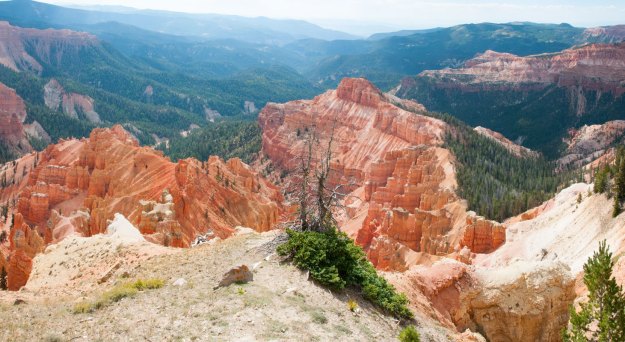
Bill & Colleen left the Park on the morning of August 27, since they had obligations elsewhere. We stayed until the next day, when we headed down to see Barb’s brother Mike, who has a cabin near Cedar Breaks. We’ve talked about that area before, so I’ll content myself with a quick panorama:

cedar_breaks


Heading southward — Idaho & Utah, August 19-23, 2016

After returning to our RV, we caught up with Bill & Colleen at the Murdock Camp Ground near Sun Valley/Ketchum.  We spent August 20 being tourists in Ketchum/Sun Valley, including a ride up a ski lift to the top of one of the famous runs on Bald Mountain.  We also sought out the grave of Ernest Hemingway in the Ketchum Cemetery.  We had lunch at Gretchen’s in the Sun Valley Lodge, named in honor of Gretchen Kunigk Fraser, the first American to win an Olympic gold medal in skiing.   She later made Sun Valley her home.

On August 21 we stopped at the Craters of the Moon National Monument and Preserve, a U.S. National Monument and national preserve in the Snake River Plain in central Idaho. It lies between the small towns of Arco and Carey, at an average elevation of 5,900 feet above sea level. The protected area’s features are volcanic and represent one of the best-preserved flood basalt areas in the continental United States.

The Monument and Preserve encompass three major lava fields and about 400 square miles  of sagebrush steppe grasslands to cover a total area of 1,117 square miles. All three lava fields lie along the Great Rift of Idaho, with some of the best examples of open rift cracks in the world, including the deepest known on Earth at 800 feet (240 m). There are excellent examples of almost every variety of basaltic lava, as well as tree molds (cavities left by lava-incinerated trees), lava tubes (a type of cave), and many other volcanic features. The 60 distinct solidified lava flows that form the Craters of the Moon Lava Field range in age from 15,000 to just 2,000 years. [Description adapted from Wikipedia.]

Our visit included a Ranger-guided walk through a lava tube, created when a mass of flowing lava congealed on the outside but continued to flow on the inside until the inside was evacuated.

We spent the night in the Arco RV Campground.

On August 22 we stopped at the Experimental Breeder Reactor-I, the worlds first nuclear power plant.

Experimental Breeder Reactor I (EBR-I) is a decommissioned research reactor and U.S. National Historic Landmark located in the desert about 18 miles southeast of Arco, Idaho. At 1:50 pm on December 20, 1951, it became the world’s first electricity-generating nuclear power plant when it produced sufficient electricity to illuminate four 200-watt light bulbs.  It subsequently generated sufficient electricity to power its building, and continued to be used for experimental purposes until it was decommissioned in 1964. Besides generating the world’s first electricity from atomic energy, EBR-I was also the world’s first breeder reactor and the first to use plutonium fuel to generate electricity. EBR-1’s initial purpose was to prove Enrico Fermi’s fuel breeding principle, a principle that showed a nuclear reactor producing more fuel atoms than consumed. Along with generating electricity, EBR-1 would also prove this principle.  [Wikipedia]

Outside the plant were two enormous experimental nuclear “engines”  constructed to explore the possibility of powering a plane with nuclear energy.  The intended plane still exists, but is stored elsewhere.  As you might suppose from the size of the engines, the experiment was not a success.

We also stopped briefly in the town of Blackfoot, where we visited the Idaho Potato Museum.  Boy do we know how to have fun!

After the museum we continued on to Pocatello, where we camped in a County Fairgrounds.  The place looked familiar.  Here is why.


On August 23 we continued onward, stopping to overnight in a “dispersed” (and free) campground near Nephi, Utah.  That night, as on most nights, the four of us played Spades.  That night, as on most nights, the mighty men prevailed.

Our next stop was in Capitol Reef National Park.  But that marvelous destination deserves its own post.  Stay tuned.

VOMIT — August 10-18, 2016

Before I discuss the events that occurred during the time frame listed in the title of this post, I should give a little background.

Last Fall, while pursuing our annual visit to our doctors in Savannah, GA, Barb saw a cardiologist  to see whether she should be taking statins for her cholesterol. Among the tests he ordered was an ultrasound of her carotid arteries.  She had no alarming symptoms, but saw the doctor given the medical history of her family and because numerous doctors had recommended statins, an option about which she was skeptical.

The full report was not available by the time we left Savannah to return to the Caribbean, but the initial indication was that there was no significant blockage and that all was well.  Early this year when settling up medical bills from last year and paying the balance for the ultrasound, she decided to find out what the report said.  The only way she could  get it was to have it sent to our mailing service in Green Cove Springs, FL.  She eventually got the report and learned that a 1.3 cm nodule had been found on her right thyroid.

So this year during our extended visit to Bismarck, Barb decided to seek medical advice.  The ultrasound was repeated, with no change in size.  But the recommendation was to take a biopsy by needle to investigate the nature of the nodule.  That biopsy revealed a cell type that is consistent with follicular neoplasm.  We were told that cells of this type are suspicious and could be cancerous, but that the only way to be sure is to remove the entire affected wing and then examine it.  If it is cancerous, the other wing would also be removed (and additional treatment would probably be undertaken.)  So surgery was strongly recommended.  We decided to involve the medical facility currently ranked number one in the United States:  Mayo Clinic.  We were able to secure an appointment, but several weeks in the future.

Meanwhile, Mom was recovering from her own medical issues, so we decided to take our RV to the west and visit Yellowstone National Park and then join our friends in McCall, ID for an informal rendezvous at the home of Tom and Leslie Arnold.

And that brings us to the events of this post.  On August 10 Barb and I left our friends (still partying) and our RV in Tom & Leslie’s yard and drove our little Chevy Tracker to Boise to catch a flight to Minneapolis, where we rented an automobile to drive to Rochester, MN.

In the following days Barb met with an endocrinologist, had yet another ultrasound, and had another needle biopsy.  Same result:  surgery recommended.  We also got a more precise meaning of “for this type of cell, most turn out to be benign”.  “Most”, as in eighty-five percent.   Remarkably,  Barb was able to schedule the surgery for the day after we got the results of the biopsy.  The surgeon, a specialist who performs hundreds of these a year,  removed the right thyroid (and the small isthmus that separates the wings), waited for the removed tissue to be examined, and then closed up the incision, because, yes, the nodule was benign.

They call this situation a VOMIT – “Victim of Medical Imaging Technology”. If the nodule had not been discovered by the initial ultrasound in 2015, Barb would not have had the surgery. But of course if it had been cancerous, it would have been a good thing that it was detected.

The surgery was done in the morning and Barb walked back to our hotel room late in the afternoon. She had a sore throat for a few days — the after-effect of a tube they put in her throat for the surgery — but otherwise felt generally fine. Well, there were some early episodes of low energy, but we don’t know if that is the consequence of anesthesia or of having lost half of her thyroid.  Hopefully her left thyroid will make enough hormone to compensate for the missing right side.

We made it back to McCall, ID and our RV very late Wednesday.  Thursday morning I Installed a new charging relay on the RV — restoring the ability of the RV alternator to charge the house batteries when underway– and got underway after Leslie and Tom fed us a huckleberry pancake breakfast.  Our destination:  Sun Valley, where we would meet Bill & Colleen.  But that gathering deserves its own post.  Stay tuned.

Cruiser Rendezvous — August 5-10, 2016

On August 1  Barb and I departed Bismarck in our camper, heading out west to join friends in what we labeled a “Cruiser Rendezvous”, since we are all either current or former Caribbean cruisers.  We spent the first night in Miles City and the second night  at Rocky Mountain RV Park, just north of Yellowstone National Park.  We spent August 3rd from sunup to sundown within Yellowstone, and then returned to Rocky Mountain RV Park.  Next morning, we continued west, stopping for the night at Lolo, Montana, at a campground that doubled as a square-dance center.  Finally, on August 5th we arrived at the home of Tom and Leslie Arnold, near McCall Idaho, the site of our rendezvous.  Not everyone had arrived yet, but eventually the full complement was there:  Tom & Leslie, Mike & Roberta, Jack & Jo, Bill & Colleen, Bruce & Jan, Chris & Barbara, Dave & Helen and, of course, Barb and I.

Our gracious hosts, Tom & Leslie:

hosts


On August 6th, a number of us drove through McCall to the Ponderosa State Park to walk the Lily Marsh Trail near Payette Lake.

Barb and I owe Bill & Bruce an enormous debt of gratitude.  They helped us decide how to upgrade our camper by adding a solar panel and an inverter/charger and by expanding our house battery bank and by rewiring the master control panel.  They created the list of materials to accomplish these goals, and then took delivery at Flagstaff and then brought it all to McCall.  And then they spent DAYS of their Idaho vacation formulating the details and installing the upgrade.  And they did this not just for us, but for Mike & Roberta as well.  Incredible.  Thanks a billion, guys.

Each couple was in charge of creating a dinner for one night for all guests.  Barb and I did a Low Country Boil.  After the Boil our friends surprised us with a toast and a candle-topped dessert in celebration of our 34th anniversary.

And then we all gathered around a fire in Tom’s new bonfire burner.

On August 8 we had an after-dinner private concert featuring Rob Mehl.  Great songs, and what a story teller!

On August 9, most of us braved a chilly and blustery day to take a pontoon boat cruise on Payette Lake.  We stopped at a friend of Tom’s at one point, and took a short walk to “Charley’s Garden”, a private-but-open-to-the-public garden.

We thank Tom & Leslie for conceiving and realizing this event.  We thank them for opening up their home and their commodious guest house.  We thank them for organizing such enjoyable side activities.  We thank them for being such gracious hosts.

Yellowstone National Park — August 3, 2016

With Mom doing so much better, we felt able to leave Bismarck on August 1 to attend a “Cruiser Rendezvous” of current and former cruiser friends at the home of Tom & Leslie Arnold near McCall, Idaho.  Along the way, on August 3rd we spent the entire day — from sunup to sundown — visiting Yellowstone National Park. We left our RV just north of the Park at the Rocky Mountain RV Park, and drove down in our Chevy Tracker “toad” (the RV slang word for a vehicle towed behind a motor home).  Our first stop was at Mammoth Hot Springs Terraces. “Mammoth” is an appropriate appellation.   I ended the day with over 20 thousand Fitbit steps.

Our next stop was at the Norris Geyser Basin.

Adjacent to the iconic Old Faithful Geyser is a huge parking lot and museums and visiter center and several general stores.  And three yurks!

And then the Kepler Cascades.

The most colorful pools were in West Thumb Geyser Basin, adjacent to the thumb-shaped West Thumb extension of Yellowstone Lake.

We observed the Lower Yellowstone Falls from two points.

As we proceeded along our “circular route”, we passed a gorgeous valley on our way back north,  and Tower Fall.

Near the top, we diverted to the east toward Slough Creek, were we saw much wildlife.

I had entered the Park with apprehension about there being too many people and vehicles, but I found the day’s experiences well worth the effort.  America’s first national park has good reason to be one of her most favorite.

Clearing Skies — July 17-31, 2016

Mom continues to improve.  Karl & Julie Bergh stopped in to see Mom on the 17th, and the Tadewalds stopped in again on the 19th on their way back to Minneapolis after vacationing in points west.

On the 20th Barb and I drove to Rochester, MN, so that I could see my rheumatoid arthritis doctor at Mayo Clinic.  After my appointment we drove back on the 21st as far as Wahpeton, ND before stopping at a motel.

Next day we met, at Ft. Ransom, Karl & Julie, who took us to see North Dakota’s only waterfall.  Lovely 2 mile walk in through prairie and forest, and then back out the same way.   By any standard, the maybe six-foot spring-fed falls themselves are less than impressive, but the day was beautiful and our wine and cheese picnic at the destination was a welcome bonus.   On the way to the trailhead, we passed a “tractor trek” traversing the Scenic Byway.

When we left the falls area, we followed Karl and Julie up to the old farm near Kathryn where Mom spent some of her early childhood living with her Norwegian grandparents.  (When Mom entered the first grade, she could only speak Norwegian and had to learn English.)  On the way to the farm we stopped at the former site of a mill.  Across the road was a log cabin that has been restored.  We also stopped at a rural Lutheran church, where we found the gravestone of Torbjor Hovde Bergh (originally spelled Berg), Mom’s mother.  There were a lot of Norwegian names in the graveyard.

Mom’s old home was last occupied by two Norwegian bachelor farmers, Ole & Clarence Hovde, uncles of Mom.  When they died, the home was abandoned, leaving farm equipment in the yard and a remarkable amount of “stuff” in the house.

In this final picture of this post, you see Cathy’s kids Cole & Katie, as well as Zona and Mom. Mom has been declared “graduated” from Home Care, which means smom-2he can venture out in public.  We had a nice Italian dinner.  We must remark on what a tremendous host Zona has been during our stay in Bismarck.  (Photo by Cathy.)


Storm Clouds — June 19 – July 17, 2016

Our previous post was entitled “Before the Storm”.  This post is about the storm.  Not easy to write about, but our blog is designed to keep friends and family informed about the events of our life, and the events described herein have definitely impacted our life.

Those readers who normally check in to mostly read about “living the dream” in the Caribbean, such readers may want to skip this post.

To set the scene, remember that we are in Bismarck, staying at the home of sister Zona and 97 year old mother Evelyn.

6/19

Mom wakes up with a sore back.  We all think she had “slept wrong”.  We had planned on going to Lake Isabel (Zona’s cabin, west of Bismarck and just a little south of the tiny town of Dawson), and ask Mom if she feels up to the trip.  She says she wouldn’t hurt any more in the car and at the lake than at home, and so we should go.

Cathy (Zona’s daughter) and her husband Jon and their kids Cole and Katie are already at the lake when we arrive.  Mom settles into a recliner at the cabin, and the rest of us lounge around and later go out on the boat.

6/20

Mom’s back is worse.  We take her to the office of her primary physician.  She is unable to see Dr. Stein, but an X-ray is ordered.  Mom sees Stein’s Physician Assistant, who decides the problem is muscular and prescribes a muscle relaxant and schedules an appointment with a physical therapist.  The p.t. meets with Mom, tells us the X-ray revealed a compression fracture at T-9 and gives us xerox copies of mild exercises designed to help Mom to strengthen and straighten her back.  A CT scan and bone scan are ordered for Friday (6/24).  Mom has a very uncomfortable night.

6/21

Mom is in agony.  We still cannot get her in to see Dr. Stein, and so decide to take her to the Emergency Room at  Sanford Medical Center.  There, the two scans are done immediately, instead of waiting until Friday.  She is admitted to the hospital.

6/22

We meet Dr. Lwu, who tells us that there appears to be a tumor at the site of the fracture.  She recommends a procedure called Kyphoplasty, which involves inserting needles through the back from the side of the backbone and inflating the collapsed cavity to its former position and then cementing it in place.  This should reduce the pain in and of itself, but will also offer a chance of collecting enough material from the presumed tumor to be able to effect a diagnosis. The Kyphoplasty is scheduled for Thursday (6/23).  Mom’s kidney function appears compromised, and so a larger CT scan with contrast (to look for other possible tumors) is rejected.

6/23

Dr. Keys is assigned to Mom to deal with her weakened kidneys.  Tests are ordered.  The Kyphoplasty is performed and Dr. Lwu reports that all went well.  She predicts a lessening of pain but reports that preliminary indication from the sample is plasmacytoma.

6/25

Mom is visited by my Bergh cousins and their spouses and by Zona’s daughter Cathy and her husband Jon and their children Katie and Cole.

6/27

Plasmacytoma is confirmed.  Dr. DuFan from Bismarck Cancer Center recommends radiation treatments to lesson pain and shrink the tumor.

6/28
first_discharge

Mom visits the Bismarck Cancer Center to be measured and marked for the radiation treatments, and is then discharged from the hospital.


6/26-7/8

mom_chuck_hosp_walkOn 6/30 Zona’s son Erik and his wife Cindy and their children arrive.  Mom has her first radiation treatment.  On 7/1 Mom has trouble breathing, so we take her back to ER.  Her kidney function is now normal, so she gets a CT scan with contrast, where it is discovered that she has a blood clot in her lung.  She is readmitted to the hospital, since heparin and later coumadin must be administered until her blood is sufficiently thin to prevent additional clots.  These drugs mean that she cannot undergo a bone marrow biopsy, an option necessary to determine whether the cancer is also in her bone marrow (making it multiple myeloma).  She had pretty much already decided not to undergo chemo- or immuno-therapies anyway, so the determination is largely irrelevant.

Although most of our attention was focused on Mom and her health, there were other experiences during this period.  On 7/3, Mike & Roberta stop in for a few days, on their way out west in their new-to-them camper.  7/4 Barb’s son Jeff arrives and spends the weekend.  7/5 Mom has her first radiation treatment, with very little change in her pain.  July 8, the Tadewalds and the Pruddens arrive from Minneapolis to see us all, but especially Grandma Shipley.

7/9 – 7/19

July 9, Mom is released again from the hospital, her blood having finally gotten thin enough to minimize the chances of another clot.  She must continue with coumadin and be taken in to the lab for blood test, but she is home!  She has about a week in which she suffers occasional bouts of extreme pain, usually after having been on her feet for a bit.  The only thing that seems to help is to get into just the right position in a bed with a raised head or in a recliner with a lowered back.  And then one day, after about 9 or 10 radiation treatments, the pain is largely gone.  From that point on, she slowly begins to regain her balance and her strength, thanks to the assistance of three different home care specialists that each visit several times a week.  From that point on, we celebrate Mom’s freedom from pain by playing Progressive Rummy multiple nights a week.

Mom is not out of the woods yet, since there may be cancer lurking elsewhere and since she is still much weaker than before all of this started.  But she had three weeks of radiation, and on the last day of treatment we learned that it generally takes two weeks of recuperation for every week of treatment before the fatigue is totally gone.  Meanwhile, her spirits are high and she is exercising with dedication and she is largely pain free.  We are so glad.


Before the Storm — May 25-June 18, 2016

We flew from Curacao to Bismarck on Wednesday, May 25, and retrieved our camper on Saturday, May 28.

Zona’s daughter Susie and her family visited over the weekend from Minneapolis.  On the 29th we all gathered at Zona’s for a big feed.  Neighbors Jerry & Jeanne also joined in.  Maddie spent a lot of time riding horses with Jerry.

On June 2, we joined the Dockter family in an expedition to Medora and the Theodore Roosevelt National Park.  The Dockters took their camper and we took ours, and Zona and Cathy each drove a car.  We all camped in the Medora Campground, where we were joined by Dawne & Jerry Renner in their luxurious diesel pusher.  The official excuse to spend some more time in the area was to attend the Medora Run/Walk on Saturday.  Barb and I walked, and discovered that, all of our exercising in Bonaire not withstanding, our arthritic joints and stopping to take photos along the way had us coming into the finish in almost dead last place (as walkers!).  After the main race there was a kiddy race in which Katie participated.

On Sunday morning Barb and I got up super early and motored up to the Cottonwood Campground in the Park to participate in a Park-hosted bird watch.  On the way up we came up over a hill and encountered a lone bison walking right up the center line of the road.  We pulled off to the side and let him pass.  The bird watch was very well attended.  The large crowd was broken up into three subgroups.  We chose the “open land” group, and ended up climbing a steep hill.  Our guide was very knowledgeable about bird songs and identified many birds by sound that I didn’t even see, let alone photograph.  At the conclusion of the watch we were all treated to a complementary breakfast of juice and pancakes and sausages, after which there was a raffle in which I won a Teddy Roosevelt T-shirt.

On our way back to Bismarck from Medora and the Theodore Roosevelt National Park, Barb, Mom and I took a detour off Interstate 94 and traversed the “Enchanted Highway” southward down to the little town of Regent.  Local artist Gary Greff conceived of the project, taught himself how to weld, built it beginning in 1989, maintains it and plans more sculptures.  From the “Official North Dakota Travel & Tourism Guide”:  The Enchanted Highway begins at Exit 72 on I-94 near Gladstone and terminates 30 miles down the road in the small town of Regent. Beginning with “Geese in Flight” at Exit 72, large metal sculptures are placed along the county highway, each with a parking area and kiosk.  Sculptures include “World’s Largest Tin Family,” “Teddy Rides Again,” “Pheasants on the Prairie,” “Grasshoppers in the Field,” “Deer Crossing” and “Fisherman’s Dream.” The gift shop in Regent has miniatures of each statue and the Enchanted Castle motel and restaurant offer hot meals and a soft bed.

The project is the work of a single man who decided to do something to save his town of Regent from extinction.  He cajoled local farmers along the highway into donating land for the sculptures.  Alas, not all farmers have been interested in helping; he has the materials assembled for another planned sculpture (Spider Webs) but has not succeeded in getting the land!

We met Gary at his Enchanted Castle when we stopped in to pay for our night of camping ($20) at the Regent Enchanted Campground.  Very congenial guy — he gave us an extended tour of the Castle that combines a bar, a restaurant and a hotel, all featuring a medieval theme complete with swords, battle axes, metal suits of armor, etc.

I didn’t get a picture of the “Geese in Flight” sculpture, but here are the others:

(The size of these sculptures is only apparent when the pictures are expanded and the Shipleys within are revealed.)

On Thursday,  June 9, Barb and I took the camper (and dinghy) up to Lake Sakakawea, where we camped in the Lake Sakakawea State Park Campground over a long weekend.  We had originally planned on only two days, but extended our stay just in time before the place got essentially fully-booked.  We had a number of nice walks along the grassy and occasionally wooded shoreline, just north of Garrison Dam, which we also toured.